When Your GPU Produces Nothing 📺
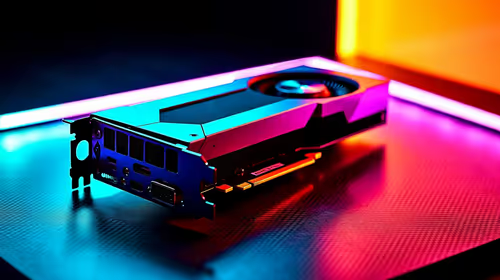
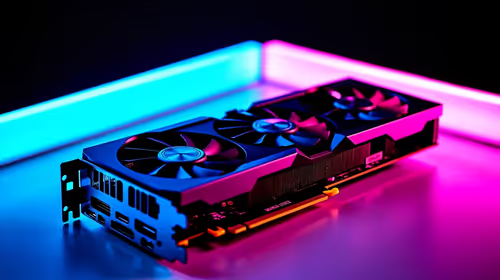
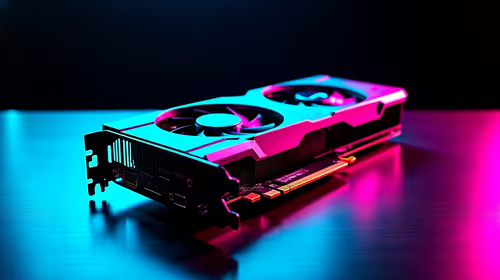
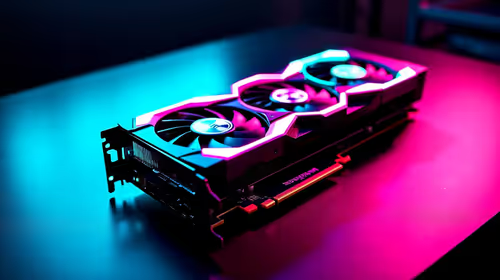
A graphics card that won't display anything is deeply frustrating — your PC runs, but your monitor stays black. Before replacing components, systematic diagnostics reveal whether the issue is hardware failure, seating, BIOS configuration, or power delivery. This guide walks you through each stage.
Stage 1: Verify PC Is Actually On
Start simple. Monitor no-output scenarios often hide easier problems:
- Listen for fan spin-up (GPU and CPU fans should activate immediately)
- Check for LED indicators on the motherboard (most boards have status lights)
- Ensure the monitor is plugged into your GPU, not the motherboard's integrated graphics port
- Test the monitor on a different device (phone, laptop) to confirm it's not dead
- Verify power cables are fully seated at both the PSU and motherboard — wiggle them firmly
Stage 2: Reseat the GPU
Looser GPU slots are more common than you'd think, especially after shipping or moving your PC:
- Shut down completely and flip the PSU switch to OFF
- Remove the PCIe power cables from your GPU (both 6-pin and 8-pin connectors)
- Locate the metal retention clip at the end of the PCIe slot — it releases by pressing a small latch
- Gently pull the GPU straight out (don't yank or twist)
- Inspect the gold finger connectors for visible corrosion or dust
- Reinsert the GPU with firm, even pressure until the retention clip clicks
- Reconnect power cables, ensuring they're fully seated
- Power on and test
Stage 3: Clear the CMOS
Corrupted BIOS settings can disable GPU output entirely:
- Power off and flip the PSU switch
- Open the case and locate the CMOS battery (coin-cell on the motherboard)
- Remove the battery for 30 seconds, then reinstall
- Some motherboards have a CMOS clear jumper instead — consult your manual
- Power on; the BIOS will reset to defaults and auto-detect your hardware
GPU Diagnostic Pro Tip ⚡
down your previous BIOS settings before clearing CMOS. Take a photo of your overclock values, RAM timings, or boot order. After clearing, you may need to re-enable XMP DOCP for your memory.
Stage 4: Test with Integrated Graphics (if available)
If your CPU has integrated graphics, test with it:
- Power down and remove the GPU completely
- Plug your monitor directly into the motherboard's HDMI or D-Sub port
- Power on; if you get video output, your motherboard and monitor work fine
- This narrows the issue to the GPU itself or its connection
Stage 5: Investigate Power Delivery
Undervolted or unstable power to the GPU causes complete output loss:
- Power on the PC (even without monitor output) and let it run for 10 seconds
- Feel the GPU heatsink — it should be warm, not ice-cold
- Cold heatsink indicates the GPU isn't receiving full power
- Check PCIe power cables aren't damaged, pinched, or connected to a failing PSU
- Test with a different (higher-wattage) power supply if available
Stage 6: Swap Your Monitor Cable and Port
DVI, HDMI, and DisplayPort cables fail more often than GPUs:
- Borrow a monitor cable from another device and test
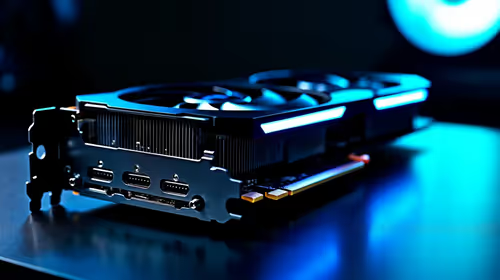
- Try every video output port on your GPU (most have multiple HDMI or DisplayPort options)
- If your GPU has multiple outputs, one might work while others don't — this often indicates a bad capacitor on the board
- Test at different refresh rates and resolutions via BIOS settings (if you can access them via keyboard alone)
Stage 7: BIOS GPU Detection and Slot Testing
Access BIOS on motherboards that support it without display:
- Some boards beep once if GPU is detected, multiple times if not
- Try moving your GPU to a different PCIe x16 slot (most boards have two)
- Ensure PCIe Gen settings aren't locked to Gen 3 if your GPU is Gen 4
- Check BIOS manual for any PCIe slot that disables when another is populated
When It's Truly Hardware
If the GPU isn't warming up, isn't detected in BIOS, and integrated graphics work fine, your card is likely dead. Browse Evetech's GPU lineup for replacement options, whether you need budget-friendly or premium performance.
Ready to restore your display? Work through these steps methodically and you'll identify whether it's a connection issue, BIOS misconfiguration, or genuine hardware failure. Need replacement components? Evetech stocks everything from entry-level to flagship graphics cards in stock now.