Struggling to hit that buttery-smooth 144 FPS in the latest AAA title without your PC sounding like it’s about to take off? You’re not alone. Here in South Africa, getting maximum performance for your rand is key. What if you could get a massive frame rate boost for free? That's the magic of AI in DLSS and FSR, the two leading upscaling technologies changing the game for everyone. Let's dive into how this wizardry works. 🚀
Understanding Upscaling: More Frames, More Fun
At its core, upscaling is a clever trick. Instead of making your graphics card render every single pixel for a 4K image (which is over 8 million pixels!), the game renders at a lower resolution, like 1080p. Then, a smart algorithm steps in, using data to "upscale" that lower-resolution image back to 4K.
The result? Your GPU has less work to do, which means significantly higher frame rates. The challenge, however, is making that upscaled image look just as sharp and detailed as a native 4K image. This is where the AI in modern upscaling technology truly shines.
NVIDIA DLSS: The AI-Powered Powerhouse
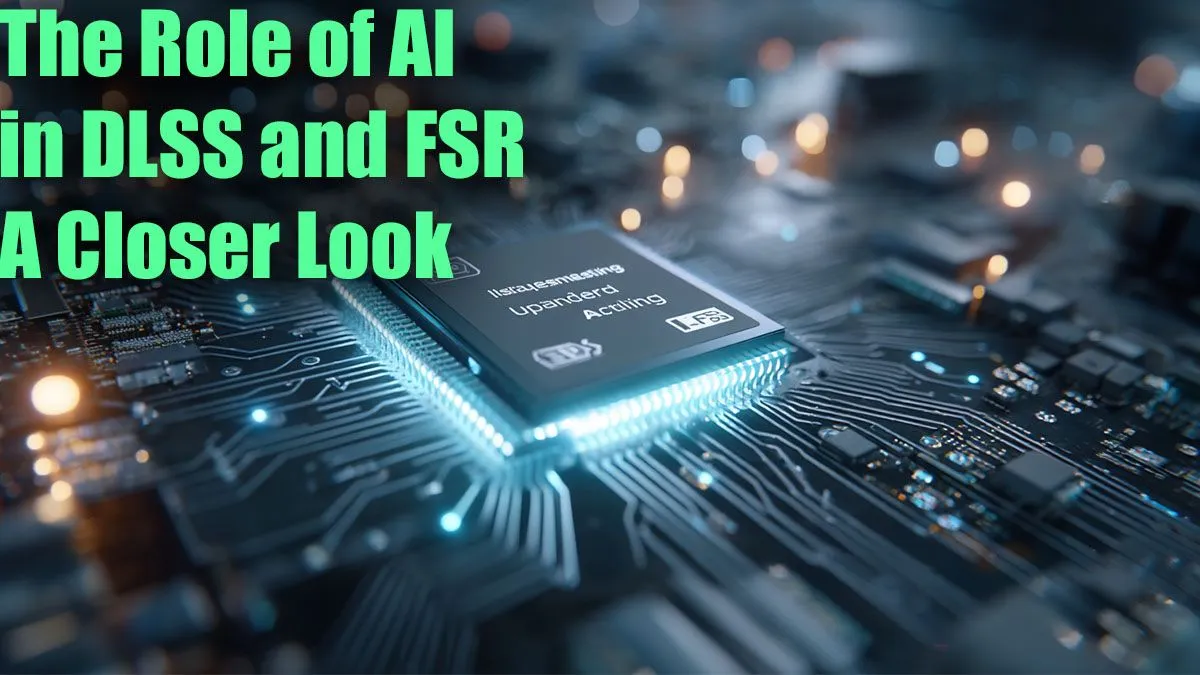
NVIDIA's Deep Learning Super Sampling (DLSS) is the prime example of AI in action. It relies on two key components: deep learning and dedicated hardware.
NVIDIA trains a neural network on a supercomputer, feeding it ultra-high-quality, 16K offline-rendered images of games. This AI learns how to construct a perfect high-resolution image from a lower-resolution input. This "brain" is then sent out to your PC via driver updates. When you switch on DLSS in a game, the Tensor Cores found on the latest NVIDIA GeForce graphics cards go to work, using that trained AI model to reconstruct the image in real-time. 🧠
The result is often an image that is impressively sharp, sometimes even better than the native resolution, all while delivering a massive performance uplift.
Which DLSS Setting is Best? 🔧
Most games offer 'Quality,' 'Balanced,' 'Performance,' and 'Ultra Performance' modes. For single-player games where visual fidelity is key, start with 'Quality.' For competitive shooters like Warzone or Apex Legends where every frame counts, 'Performance' is your best bet for maximising FPS without a major visual sacrifice.
AMD FSR: Open-Source and Ready to Rumble
AMD's FidelityFX Super Resolution (FSR) takes a different, more open approach. Unlike DLSS, FSR doesn't require specialised AI hardware. It's an advanced spatial upscaling algorithm that can run on a huge variety of GPUs, including many older NVIDIA cards and, of course, the full lineup of powerful AMD Radeon graphics cards.
While early versions were good, FSR 2.0 and beyond have made huge leaps. They now incorporate temporal (time-based) data from previous frames to improve image quality, bringing it much closer to DLSS. The debate over AI in DLSS and FSR often centres on NVIDIA's deep learning versus AMD's sophisticated algorithms, but both deliver fantastic results for gamers.
AI in DLSS vs FSR: The Showdown
So, which one should you use? The answer usually depends on the graphics card in your rig.
- NVIDIA DLSS: If you have an NVIDIA RTX card (20-series or newer), DLSS is typically the top choice. Its AI-driven reconstruction often produces the cleanest image with the most detail, especially on fine objects like fences or foliage.
- AMD FSR: If you have an AMD card, an older NVIDIA card, or even a Steam Deck, FSR is your champion. Its open-source nature is its biggest strength, bringing performance-boosting tech to millions of gamers.
Ultimately, both technologies are a massive win for PC gaming in South Africa. They allow you to push graphical settings higher or aim for higher refresh rates without needing to buy a brand-new, top-of-the-line GPU. It's always worth checking the best graphics card deals to see how much performance you can get for your budget, knowing these AI tools are there to back you up. ✨