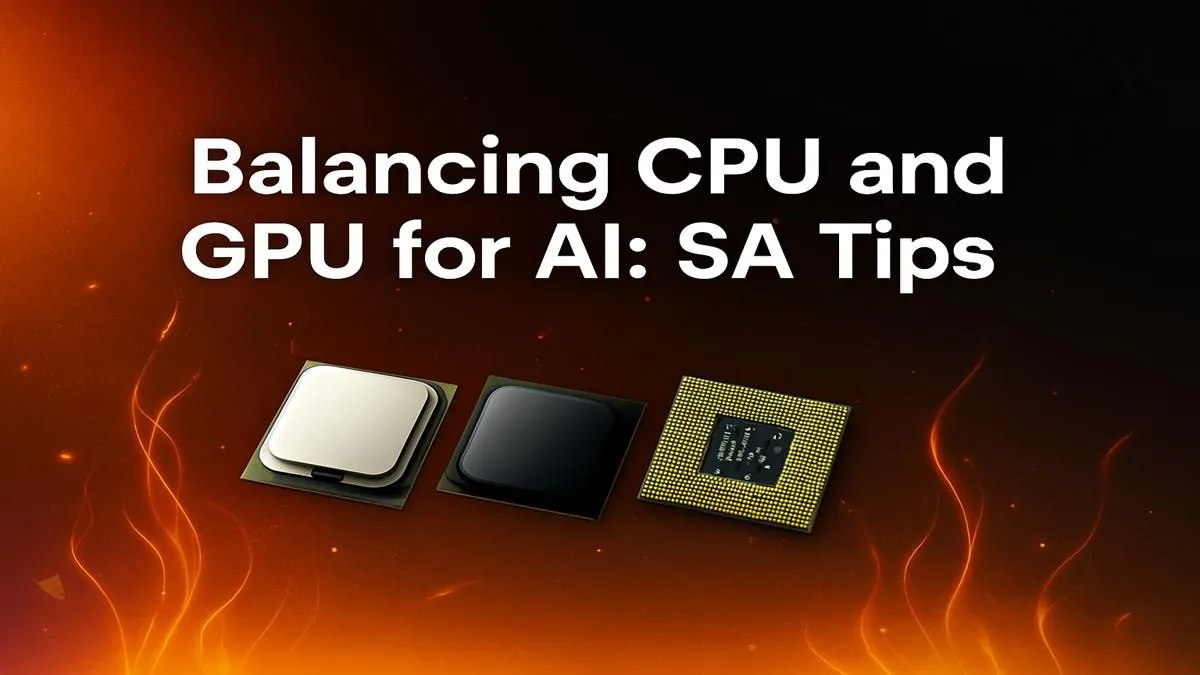
So, you're keen to dive into the world of Artificial Intelligence, right here in South Africa? 🇿🇦 Maybe you're dreaming of generating mind-blowing images with Stable Diffusion or running a local language model without relying on the cloud. But as you plan your build, a critical question pops up: where should you invest your hard-earned Rands? On a monster GPU or a CPU with a dozen cores? The secret isn't picking one over the other; it's about balancing CPU and GPU for AI.
Why Both CPU and GPU Matter for AI 🧠
It's easy to think AI is all about the Graphics Processing Unit (GPU). While GPUs are the undisputed champions of the heavy lifting, the Central Processing Unit (CPU) is the unsung hero of any AI rig. Think of it like this: the CPU is the project manager, and the GPU is the specialised workforce.
The CPU handles all the essential prep work: loading datasets, pre-processing information, and managing the operating system. It feeds the GPU a constant, organised stream of data to work on. A slow CPU can bottleneck even the most powerful GPU, leaving it starved for data and wasting its potential. Finding the right CPU processor is the first step in building a responsive and efficient AI machine.
Finding the Right Balance for Your AI Workflow
The ideal CPU and GPU balance for AI depends entirely on what you plan to do. There’s no one-size-fits-all solution, so let's break it down by common tasks.
For Deep Learning and Model Training
This is where the GPU truly shines. Training complex neural networks involves performing millions of parallel calculations, a task GPUs were born to do. For serious training, an NVIDIA GPU with plenty of CUDA cores and VRAM is essential. However, your CPU still needs to be capable enough to handle data augmentation and pipeline management. Pairing a high-end GPU with a mid-range CPU, like a powerful AMD Ryzen CPU, often provides the best performance-per-Rand for these demanding workloads.
For Generative AI and Inference
Running pre-trained models—like generating images or text—is called "inference." This is still very GPU-intensive, but the CPU's single-core performance becomes more noticeable. It affects how quickly the model loads and how responsive the application feels. You don't want to wait ages for your prompts to start processing! For a snappy and interactive experience with tools like Stable Diffusion, pairing your GPU with a modern Intel Core processor known for strong single-thread speeds is a fantastic strategy.
VRAM is King 👑
When choosing a GPU for AI, VRAM (video memory) is often more important than raw clock speed. Larger AI models require more VRAM just to load. For anyone serious about running local AI models in SA, 12GB of VRAM is a good starting point, but 16GB or more will give you much more flexibility for future, more complex models.
Practical Tips for Your SA Build 🔧
Getting the perfect balance between your CPU and GPU for AI doesn't have to break the bank. Here are a few final thoughts:
- Start with Your Goal: Define your primary AI task first. Is it training, inference, or data analysis? This will dictate where your budget should lean.
- Don't Skimp on the Foundation: A weak CPU will always hold back a strong GPU. A solid 6 or 8-core processor is a safe bet for most AI builds.
- Memory and Storage Matter: Fast RAM (32GB is a great start) and a quick NVMe SSD are crucial for feeding your components data without delay. They are key supporting actors in the CPU-GPU balancing act.
Ultimately, building a PC optimised for AI is about creating a synergistic system where no single component creates a bottleneck.
Ready to Build Your AI Powerhouse?
The world of artificial intelligence is complex, but getting the right hardware doesn't have to be. Explore our massive range of PC components and find the perfect CPU and GPU to bring your AI projects to life.