Jumping into the world of AI and machine learning in South Africa? It’s an exciting ride! 🚀 But before you can train the next great algorithm, you need the right hardware. While GPUs get all the glory, choosing the best CPU for machine learning is the foundation of a powerful, bottleneck-free system. Get this choice right, and you'll save yourself hours of frustration. Let's dive into what you need to know for 2025.
Why the CPU is Crucial for Your Machine Learning Rig
Think of your PC as a team. The GPU is your star player, smashing through the heavy calculations needed for model training. But the CPU? It's the coach, manager, and support staff all in one. It handles everything that happens before and after the main event.
This includes tasks like:
- Data Preprocessing: Cleaning, loading, and transforming massive datasets. These tasks often can't be fully offloaded to a GPU and rely on strong single-core and multi-core CPU performance.
- Pipeline Management: Orchestrating the flow of data and managing complex workflows.
- Inference: Running a trained model on new data, a task that can be surprisingly CPU-bound in certain applications.
A weak CPU will leave your expensive GPU waiting for data, creating a massive bottleneck that slows down your entire workflow. That's why even if you're looking at a rig built around a powerful NVIDIA GPU, pairing it with a capable processor is non-negotiable for serious AI work.
Decoding CPU Specs for Machine Learning in South Africa
When you're browsing for the best CPU for machine learning in South Africa, you'll see two main specs thrown around: core count and clock speed. What's the difference, and which one matters more?
- Core Count: Think of cores as individual workers. More cores mean you can handle more tasks simultaneously. This is fantastic for parallel processing tasks like transforming large batches of data or running multiple experiments at once.
- Clock Speed (GHz): This is how fast each individual worker can perform a task. A higher clock speed is better for single-threaded operations, like tasks in your workflow that have to be completed one after the other.
For machine learning, the ideal CPU has a healthy balance of both. Many modern data science libraries are optimised to use multiple cores, so prioritising a higher core count is often a smart move. This is why many of our custom-built AMD gaming PCs, known for their impressive core counts, are becoming popular choices for hybrid gaming and AI rigs.
Check Your Bottlenecks 🔧
While your ML model is training, open your system's Task Manager (Windows) or Activity Monitor (macOS). If you see your CPU usage consistently hitting 100% while your GPU is sitting idle, you've found a CPU bottleneck! This is a clear sign that your processor can't feed the GPU data fast enough, and an upgrade could dramatically speed up your workflow.
Our Top CPU Recommendations for Machine Learning
Finding the perfect processor depends on your budget and the scale of your projects. Here’s a breakdown of the tiers to help you find the best CPU for machine learning for your specific needs in SA.
The Enthusiast's Starting Point: Intel Core i5 / AMD Ryzen 5
Don't underestimate the modern mid-range! A recent Intel Core i5 or AMD Ryzen 5 with 6 to 8 cores provides more than enough power for learning, experimenting with smaller datasets, and running most pre-trained models. They offer incredible value and are a fantastic entry point into the world of AI.
The Prosumer Powerhouse: Intel Core i7 / AMD Ryzen 7
This is the sweet spot for most serious developers and data scientists. With 8 to 16 cores, these CPUs chew through data preprocessing tasks and allow for more complex model training without breaking the bank. They provide a significant performance uplift over the entry-level chips, making them a wise investment if you're working on client projects or extensive research.
The Ultimate Workstation: Intel Core i9 / AMD Ryzen 9 & Threadripper
When you're dealing with massive datasets and training models for days on end, you need maximum firepower. 🧠 High-end Core i9 and Ryzen 9 CPUs offer the highest core counts and clock speeds in the consumer space. For the most demanding workloads, stepping up to a platform like AMD's Threadripper is the ultimate solution. These processors are specifically designed for this level of work, and you'll often find them in our top-tier pre-built professional workstation PCs.
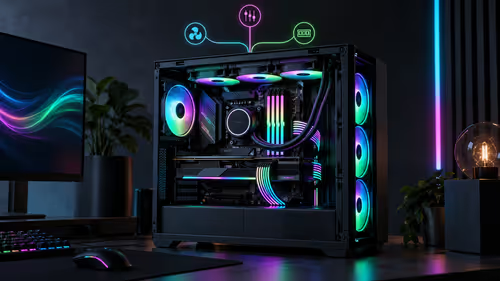
A balanced system is key. The most powerful CPU in the world won't help if it's starved for memory or slowed down by a hard drive. Ensure your build includes at least 32GB of fast RAM (64GB is better) and a speedy NVMe SSD to keep your entire AI pipeline running smoothly.
Ready to Build Your AI Future? Choosing the right CPU is key, but it's just one piece of the puzzle. Whether you're building a dedicated desktop rig or need power on the go, a balanced system is what truly unlocks performance. Explore our massive range of high-performance laptop specials and find the machine to conquer your next project.