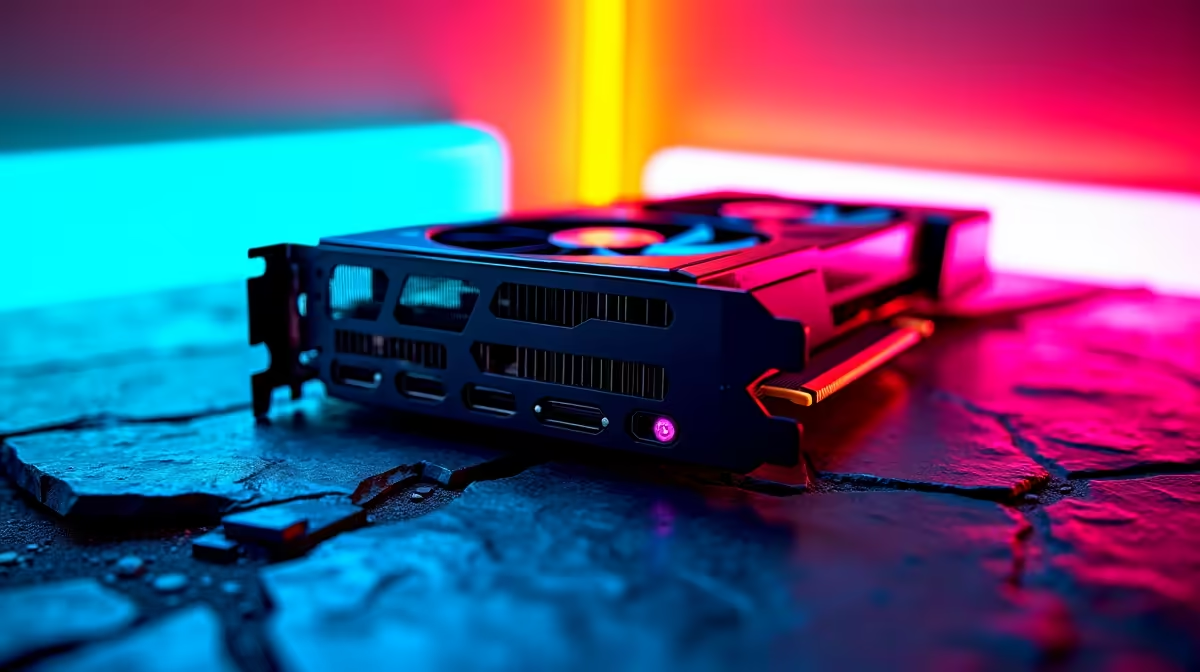
You've seen what AI can do. From generating incredible art with Midjourney to coding assistance from ChatGPT, Large Language Models (LLMs) are everywhere. But running them locally on your own machine? That feels like next-level stuff. It's not just possible; it's the new frontier for PC power in South Africa. The secret isn't your CPU… it's your graphics card. This guide breaks down the best GPUs for LLMs to help you build a powerful, future-proof rig.
Why Your GPU is the Engine for Local AI
So, why is a graphics card, something we usually associate with gaming, so crucial for AI? It comes down to a concept called parallel processing.
Think of it like this: a CPU is like a single, brilliant rocket scientist who can solve incredibly complex problems one by one. A GPU, however, is like an entire army of specialised technicians working simultaneously on smaller parts of a massive project. LLMs are exactly that—a massive project with billions of parameters. A GPU can process thousands of these calculations at once, making it exponentially faster for AI tasks. This is what makes finding the best GPUs for LLMs so critical for your setup.
The key components that give GPUs this superpower are:
- VRAM (Video RAM): This is the single most important factor. It's the high-speed memory on the graphics card where the AI model is loaded. If the model is bigger than your VRAM, performance drops dramatically or fails completely. More VRAM = bigger, more complex models.
- Tensor Cores (NVIDIA) / Matrix Cores (AMD): These are specialised circuits inside the GPU designed specifically to accelerate the mathematical operations used in AI and machine learning. 🧠
Choosing the Best GPUs for LLMs: What to Look For
When you're shopping for a GPU to power your AI ambitions, the spec sheet looks a little different than it does for pure gaming. While framerates matter for Cyberpunk 2077, VRAM and memory bandwidth are king for running Stable Diffusion or a Llama 2 model.
VRAM: The Undisputed Champion
We can't stress this enough: get the most VRAM you can afford.
- 12GB VRAM: A decent starting point for experimenting with smaller models and AI image generation.
- 16GB VRAM: The current sweet spot for enthusiasts. It opens the door to running more capable local LLMs and fine-tuning models without constant issues.
- 24GB+ VRAM: This is the pro-level. With 24GB, you can tackle serious model training and run some of the most powerful open-source LLMs available today.
Many of the most popular AI software libraries are built on NVIDIA's CUDA platform, which gives them a significant head start in compatibility and performance. You can find these powerful cards in our range of NVIDIA GeForce gaming PCs, which offer a great balance of gaming and AI capability.
Check Your Software First! 🔧
Before you buy, check the system requirements for the AI tools you want to use, like TensorFlow or PyTorch. While NVIDIA's CUDA is the most common platform, AMD's ROCm is gaining ground. Ensuring your chosen GPU is well-supported by your software will save you a lot of headaches later on.
Performance and Ecosystem
While VRAM is #1, raw processing power still matters. A card's memory bandwidth (how fast it can access its VRAM) and the number of specialised cores directly impact training and inference speeds. While NVIDIA has historically dominated the AI space, AMD is making serious strides, offering compelling performance-per-rand in many cases. Their latest cards, found in our high-performance AMD Radeon gaming PCs, are becoming increasingly viable for AI workloads.
Top GPU Tiers for AI-Ready PCs in South Africa
Ready to pick a card? Here’s a look at the top contenders for building the best AI-ready PC for your budget.
The Pro Tier: NVIDIA RTX 4090
With a massive 24GB of GDDR6X VRAM, the RTX 4090 is the undisputed consumer champion for AI and LLMs. It can handle large models with ease and offers blistering speeds for both training and inference tasks. It’s a significant investment, but for professionals or serious hobbyists who need the absolute best, there is no substitute. ✨
The High-Performance Sweet Spot: RTX 4070 Ti SUPER / RTX 4080 SUPER
The recently launched "SUPER" variants offer fantastic value. The RTX 4070 Ti SUPER, with its upgraded 16GB of VRAM, is arguably one of the best GPUs for LLMs in terms of price-to-performance. It provides enough memory for most popular models while delivering excellent speeds, making it a perfect heart for a powerful AI machine that doesn't completely break the bank.
For those doing intensive, round-the-clock AI work, a standard gaming PC might not be enough. Professional workloads demand stability, optimised cooling, and components built for endurance. In these cases, it's worth a look to explore our range of customisable workstation PCs, which are designed for exactly this kind of demanding task. 🚀
Ready to Build Your AI Powerhouse?
Choosing the best GPU for LLMs is the first step to unlocking incredible creative and analytical power. Don't let hardware hold you back. Explore our range of AI-ready PCs and configure the perfect machine to bring your ideas to life.