The AI revolution isn't just happening in Silicon Valley server farms... it's happening right here in South Africa, on your desktop. With powerful open-source models like DeepSeek, you can run a private AI assistant or coding partner locally. But what kind of hardware do you need? We put DeepSeek to the test in the Evetech Lab to reveal the true DeepSeek GPU performance you can expect from today's top hardware. The results might surprise you. 🇿🇦
Understanding DeepSeek and Why GPU Performance is Crucial
Before we dive into the numbers, what exactly is DeepSeek? It's a family of powerful, open-source AI models focused on coding and language. Think of it as your personal, offline version of ChatGPT or Copilot. You can run it on your own machine, ensuring privacy and customisation.
But this power demands a price... computational power. Running AI models like DeepSeek locally hinges on raw GPU performance. Your Graphics Processing Unit (GPU), traditionally the heart of a gaming rig, is uniquely suited for the parallel processing required by AI. The more capable your GPU, especially in terms of VRAM (video memory) and core count, the faster the model can generate responses, measured in "tokens per second." Poor GPU performance means a slow, frustrating experience.
Our Exclusive DeepSeek GPU Performance Benchmarks
Enough theory. We wanted clear, real-world data on DeepSeek GPU performance right here in our South African lab. We took some of the most popular graphics cards on the market and put them through their paces using the DeepSeek-Coder 6.7B model, a popular choice for developers.
Our methodology was simple: a clean OS install, the latest drivers, and a standardised test to measure the average tokens per second during a code generation task. Here’s how the big players stacked up.
NVIDIA RTX 40-Series: The VRAM Kings
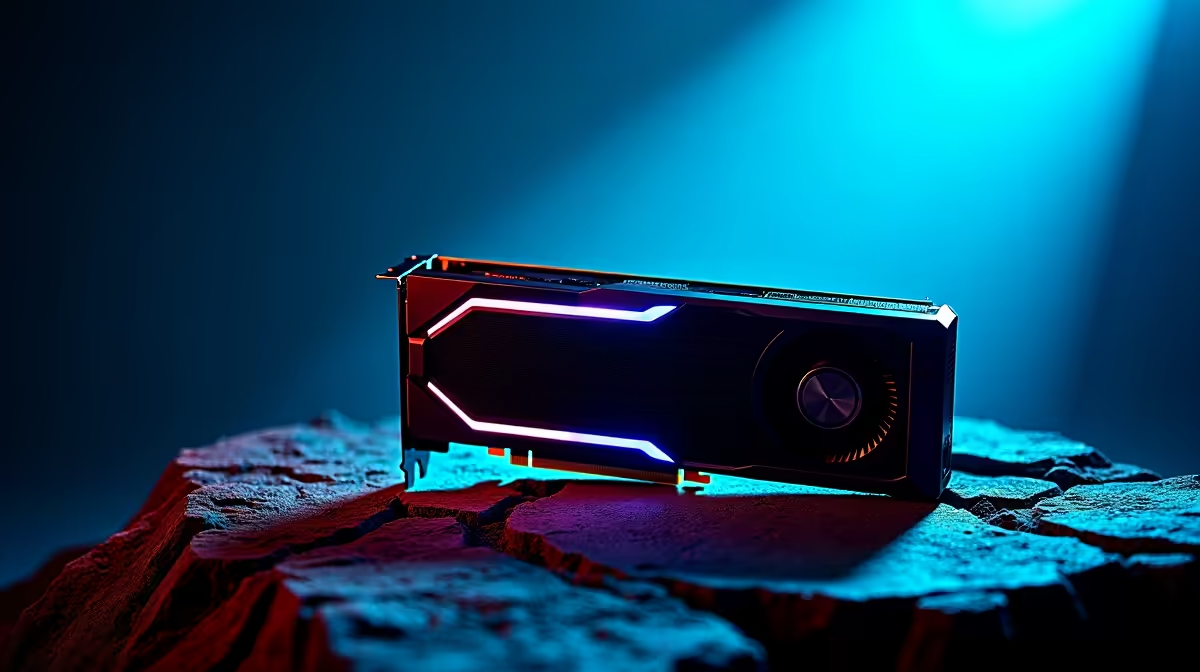
NVIDIA has long been the leader in the AI space, and our tests confirmed why. Cards like the RTX 4070 SUPER and RTX 4080 SUPER, with their generous VRAM and powerful CUDA cores, delivered exceptional results. For those looking to build a machine that excels at both gaming and AI, these high-end NVIDIA GeForce gaming PCs offer a fantastic balance, providing a smooth and responsive experience when working with DeepSeek. The RTX 4090, unsurprisingly, remains in a league of its own for prosumers who demand the absolute best.
Pro Tip for Local AI 🧠
Before running models like DeepSeek, ensure you have the latest NVIDIA drivers with CUDA installed, or the ROCm equivalent for AMD cards. Creating a dedicated Python virtual environment using venv or conda is also best practice. This prevents library conflicts and makes it easier to manage dependencies for different AI projects, ensuring stable performance.
AMD RDNA 3: A Worthy Contender
Team Red isn't sitting on the sidelines. While NVIDIA's software ecosystem (CUDA) is more mature, AMD's recent driver improvements have made their cards increasingly viable for AI workloads. The Radeon RX 7900 XTX, with its massive 24GB of VRAM, showed impressive potential in our DeepSeek benchmarks. For gamers who want top-tier rasterization performance and are willing to explore the growing open-source AI software stack, the latest AMD Radeon gaming PCs represent incredible value for money.
Analysing the Results: What This Means for You
So, what's the key takeaway? VRAM is king. For running models like DeepSeek smoothly, having at least 12GB of VRAM is highly recommended. While raw processing speed matters, the ability to load the entire model into your GPU's memory without compromise is the biggest factor for a good experience.
This is where the line between a gaming PC and an AI development machine begins to blur. For serious AI development, where you might be fine-tuning models or working with even larger datasets, the robust configurations found in powerful workstation PCs often provide the stability and component quality needed for long, intensive workloads. These systems are built for reliability under constant, heavy load. 🚀
The Future of Local AI in South Africa
The ability to run sophisticated AI on local hardware is no longer a distant dream... it's a reality. As models become more optimised and hardware more powerful, the potential for innovation right here in South Africa is immense. The landscape of GPU performance is evolving from being just about frame rates in the latest AAA title to enabling powerful new tools for creativity and productivity. Whether you're a developer, a content creator, or just a tech enthusiast, your next PC upgrade has a new, exciting dimension to consider.
Ready to Build Your AI Powerhouse? From gaming to coding with your own local AI, the right hardware makes all the difference. Our exclusive benchmarks show that incredible DeepSeek GPU performance is within reach. Explore our range of custom-built PCs and configure the perfect machine to master the future, today.