Quick Answer
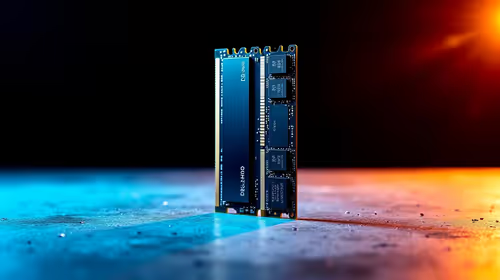
For machine learning workloads, a SATA SSD serves best as a high-capacity dataset storage drive rather than a primary training drive. Choose based on sustained read speed, endurance rating, and capacity. NVMe handles your OS and active model weights while SATA SSD handles dataset archives and checkpoints.
Why SATA SSD Matters for Machine Learning
Machine learning pipelines are data-hungry. Training runs stream large volumes of image, text, or tabular data from disk into RAM and GPU VRAM continuously. The bottleneck varies by pipeline: some workloads are GPU-bound and barely stress storage, while others, particularly large language model fine-tuning with hundreds of gigabytes of token data and image classification with massive datasets, are genuinely I/O-bound during data loading stages.
NVMe drives deliver sequential reads of 3,000 to 7,000 MB/s depending on the generation. SATA SSDs max out around 550 MB/s sequential read. For active training on datasets that fit in RAM or that use smart prefetching through PyTorch DataLoader, this difference is often negligible. Your GPU waits on itself, not the drive. However, for cold-start data loads and random access across large datasets that exceed your system RAM, the NVMe advantage becomes tangible.
Where SATA SSD earns its place in a machine learning rig is as a high-capacity secondary drive. NVMe drives at 4TB and above remain expensive in South Africa. SATA SSDs offer 2TB, 4TB, and 8TB configurations at significantly lower cost per gigabyte. Dataset archiving, model checkpoint storage, and version control of large model weights are natural SATA SSD roles.
Key Specs to Evaluate
Sequential read speed matters most for data loading. SATA SSDs from reputable manufacturers cluster around 500 to 560 MB/s sequential read. The variance between brands at sequential read is small. Where products differ is in sustained performance under queue depth, random 4K read speeds, and thermal throttling behaviour under extended loads.
Endurance, expressed as TBW (terabytes written), is critical for ML use. Training runs write checkpoints and logs constantly. A 2TB SATA SSD with 1,200 TBW endurance outlasts a cheaper drive rated at 300 TBW over a multi-year ML workstation lifespan. Samsung 870 EVO and WD Blue SA500 are established high-endurance SATA options. Crucial MX500 offers strong price-to-performance for dataset storage roles.
Cache behaviour matters under sustained load. SATA SSDs use DRAM cache or HMB (Host Memory Buffer) to maintain performance during large sequential writes. Drives with dedicated DRAM cache, typically found in mid to upper-tier models, sustain performance longer during checkpoint writes than HMB-only or cache-less designs.
Building a Practical ML Storage Configuration
The practical approach for a South African ML workstation in 2026 is a tiered storage setup. An NVMe drive of 1TB or 2TB hosts your OS, Python environment, and active project data. A SATA SSD of 2TB to 4TB handles dataset storage and checkpoint archives. For practitioners running very large datasets (500GB-plus), adding a second SATA SSD in RAID 0 doubles sequential throughput to approximately 1,000 MB/s, approaching lower-end NVMe speeds at substantially lower cost.
This approach is particularly relevant in the SA market where high-capacity NVMe drives carry significant import and distribution premiums. A 4TB Samsung 870 EVO or equivalent delivers reliable performance and capacity for dataset work at a fraction of the cost of a 4TB PCIe 4.0 NVMe.
Frequently Asked Questions
Is NVMe always better than SATA SSD for machine learning? Not always. For dataset storage and checkpoint archiving, SATA SSD provides excellent value. NVMe's advantage appears when training loops are genuinely I/O-bound, which depends on your dataset size, preprocessing pipeline, and how aggressively your data loader prefetches. Many ML workloads see minimal real-world training time difference between SATA and NVMe once data is loaded into RAM.
How much storage do I need for machine learning datasets? It depends on your domain. Computer vision datasets like ImageNet at full resolution run 150GB. NLP training corpora and LLM fine-tuning datasets easily exceed 500GB. A 2TB SATA SSD comfortably handles most research-scale datasets with room for checkpoints. Production ML environments with proprietary datasets often need 4TB or more.
What endurance rating should I look for in a SATA SSD for ML? For a primary dataset drive used in active training, aim for at least 600 TBW on a 2TB model. Higher-endurance models like the Samsung 870 EVO rate at 1,200 TBW on 2TB configurations, which covers multi-year workstation use with checkpoint-heavy training runs.
Can I use a SATA SSD as my only drive for machine learning? Yes, especially if budget is a constraint. A single 2TB SATA SSD running everything is a step up from a traditional hard drive. The limitation is that datasets loading from SATA at 550 MB/s may cause GPU idle time on I/O-heavy pipelines. If possible, pair a smaller NVMe for the OS and active environment with a SATA SSD for dataset storage.
Ready to Find Your Perfect Match? Shop SATA and NVMe SSDs for your ML workstation at Evetech