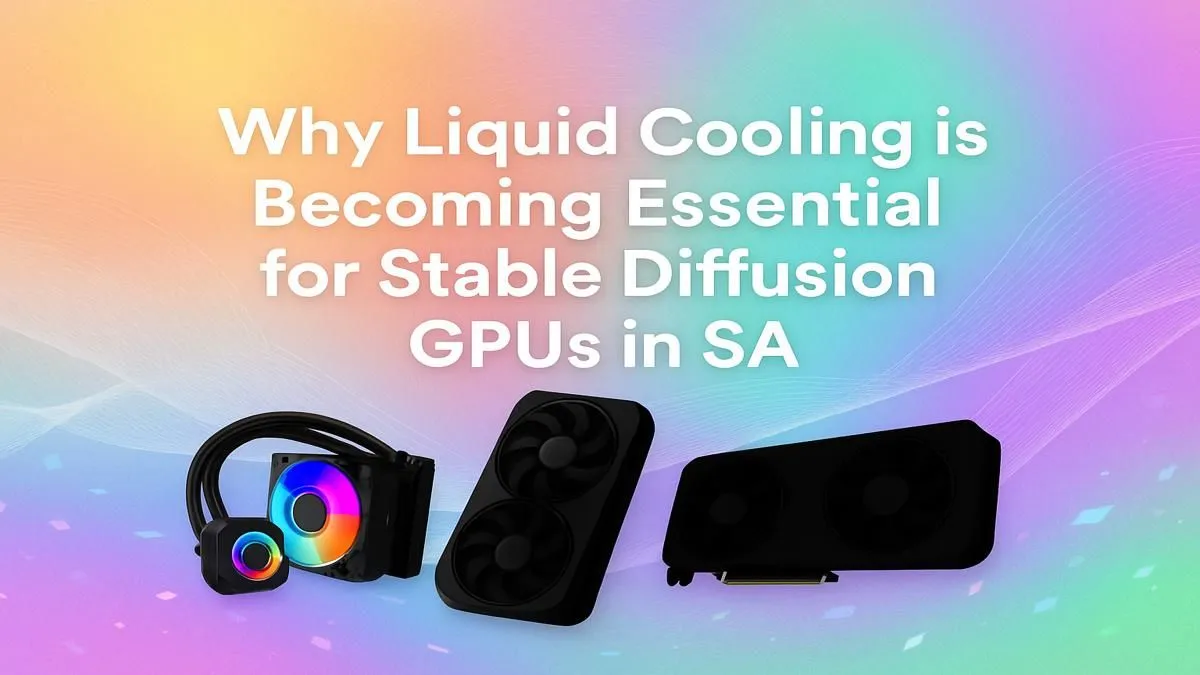
So, you’ve dived headfirst into the incredible world of Stable Diffusion, generating mind-blowing AI art. But as you push for higher resolutions and more complex prompts, have you noticed your PC starting to sound like a jet engine? Or worse, are your generation times getting longer? In South Africa's warm climate, your GPU is likely thermal throttling, and standard air cooling just can't keep up. Let's talk about why liquid cooling for Stable Diffusion isn't a luxury... it's a necessity.
Why Stable Diffusion Pushes GPUs to Their Limits 🌡️
Unlike gaming, which has peaks and troughs of intensity, running Stable Diffusion is a relentless marathon for your GPU. The process, known as iterative denoising, involves hundreds of steps where your graphics card is running at 100% load, continuously. This sustained pressure generates a massive amount of heat. When the GPU's core temperature hits its predefined limit (often around 85-90°C), it automatically reduces its clock speed to protect itself. This is thermal throttling, and it's the number one enemy of fast, consistent AI image generation. Many of today's high-performance graphics cards are built for gaming bursts, not the constant grind of AI workloads.
The South African Climate: An Unseen Performance Bottleneck
Here’s a factor many people overlook: ambient room temperature. If you’re working in a room that’s already 25°C or hotter during a classic South African summer day, your air cooler is starting with a massive disadvantage. It’s trying to dissipate intense heat using air that’s already warm. This means your GPU hits its thermal limit much faster and throttles more aggressively. This is especially true for the powerful NVIDIA GeForce cards, favoured for their CUDA cores which excel at AI tasks. An effective cooling solution for Stable Diffusion becomes critical.
The Clear Advantage of Liquid Cooling Your AI Rig ❄️
This is where liquid cooling changes the game. Instead of just blowing warm air around inside your case, a liquid cooler uses a fluid to absorb heat directly from the GPU die and transport it to a radiator, where fans can dissipate it much more efficiently.
The benefits are immediate:
- Sustained Peak Performance: Your GPU can maintain its maximum boost clock for hours on end, dramatically speeding up your creative workflow.
- Lower Core Temperatures: A well-implemented liquid cooling setup can keep your GPU running 15-25°C cooler under the same heavy load.
- Quieter Operation: Because the heat transfer is so much more efficient, the radiator fans don't need to spin at frantic speeds. Your workspace stays much quieter.
While top-tier AMD Radeon GPUs also pack a punch for creative workloads, the principle remains the same: sustained heat is the enemy of sustained performance.
Check for Throttling Yourself 🔧
Download a free tool like HWMonitor or MSI Afterburner. Run a few complex Stable Diffusion prompts and watch the "GPU Temperature" and "GPU Clock" speeds. If you see the temperature hitting its ceiling (e.g., 85°C) while the clock speed drops significantly, you've confirmed you are thermal throttling. It's the clearest sign you need better cooling.
Is It Overkill for Your Setup?
So, do you absolutely need liquid cooling for Stable Diffusion? If you're just occasionally experimenting with simple prompts, a high-end air cooler in a well-ventilated case might be sufficient. But if you are a serious hobbyist, a digital artist, or a professional relying on AI for your work, the answer is a resounding yes. The time you save on renders and the consistency you gain are invaluable. For those running intensive, commercial-grade projects, even professional workstation graphics cards benefit massively from superior cooling to deliver reliable, non-stop performance. Investing in a proper cooling solution protects your hardware and optimises your workflow. 🚀
Ready to Unleash Your AI's Full Potential? Don't let thermal throttling bottleneck your creativity. For sustained Stable Diffusion performance in South Africa, a powerful GPU needs elite cooling. Explore our massive range of PC components and build a rig that stays cool under pressure.