You've seen the headlines. AI is everywhere, from creating stunning art to powering the next generation of apps. Here in South Africa, we're quick to adopt new tech, but it raises a crucial question for our PC builds: we obsess over GPUs and CPUs for gaming, but what about memory? When you're diving into artificial intelligence, just how much does RAM speed for AI really matter? Is it all hype, or is it the secret ingredient to unlocking true performance? 🧠
Understanding AI's Thirst for Data
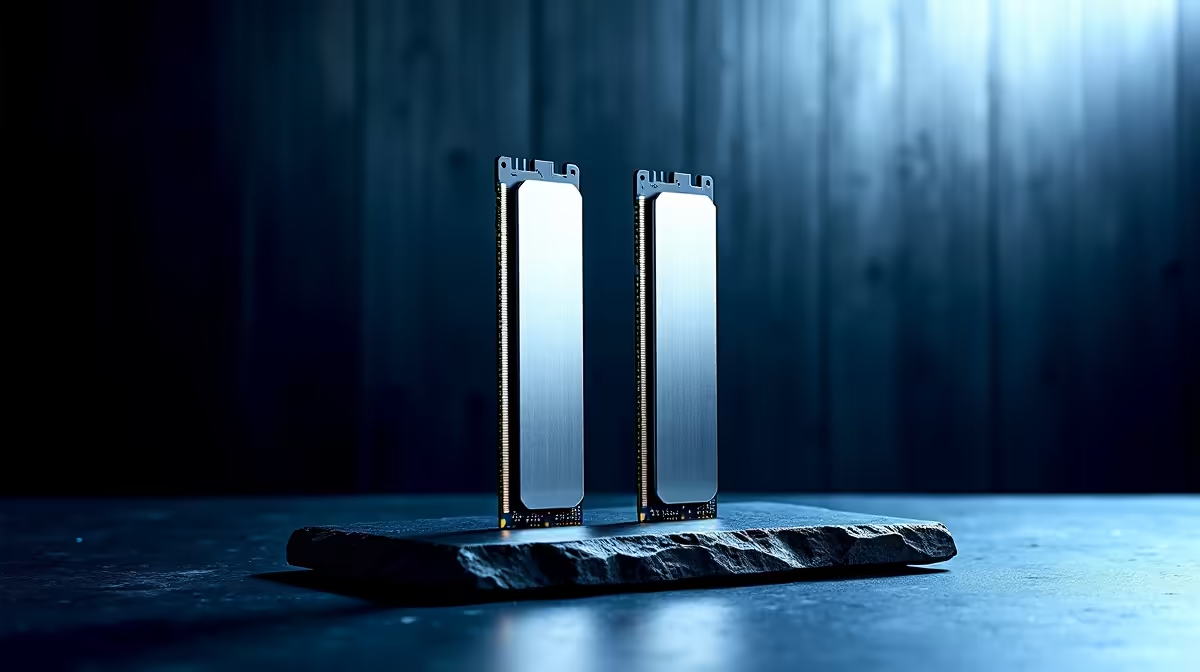
Unlike gaming, which often prioritises latency and quick asset loading, AI workloads are a different beast entirely. Training a model or running a complex inference task involves feeding your processor colossal amounts of data… constantly. Think of it less like a quick sprint and more like trying to drink from a fire hose. The core job of your RAM is to be the ultra-fast reservoir holding that data, ready for the CPU or GPU to process it.
This is where the conversation about RAM speed for AI begins. If your memory is too slow, it becomes a bottleneck, leaving your powerful processor waiting around. This is especially true for tasks like:
- Large Language Models (LLMs): Running models locally requires loading massive parameter files into memory.
- Data Pre-processing: Cleaning and preparing huge datasets before training.
- Generative AI: Creating images with Stable Diffusion, where the model and data are constantly being accessed.
For many users, a balanced system like those found in modern AMD Radeon gaming PCs provides a great starting point for both gaming and exploring AI.
RAM Speed for AI: The Speed vs. Size Debate
So, what's more important: more gigabytes (GB) or faster megatransfers per second (MT/s)?
For AI, the answer is… it depends, but capacity often comes first. You simply cannot run a 20GB model if you only have 16GB of RAM. It just won't load. Your first priority must be ensuring you have enough memory for your specific tasks. Once that box is ticked, speed becomes the critical factor for performance.
Think of it like a workshop. Capacity (GB) is the size of your workbench. Speed (MT/s) is how fast you can grab tools and materials from it. A massive workbench is useless if you move at a snail's pace. A high RAM speed for AI workloads ensures your processor isn't starved for data, directly translating to faster results. This is why high-performance NVIDIA GeForce gaming PCs, often packed with the latest DDR5 RAM, excel at these dual-purpose roles. 🚀
Check Your Bandwidth ⚡
Not sure how your current RAM stacks up? Use a free tool like AIDA64 Extreme or the built-in benchmark in 7-Zip (under 'Tools') to test your memory's read, write, and copy speeds. This gives you a real-world baseline of your system's data-moving capability before you decide to upgrade.
Real-World Impact: Where Does RAM Speed Shine?
Let's move from theory to rands and cents. Does faster RAM actually make a noticeable difference?
For AI Developers & Enthusiasts
If you're running models locally in South Africa, yes. When working with generative AI like Stable Diffusion, faster RAM can shave seconds off each image generation. For developers compiling large codebases or working with machine learning libraries like TensorFlow, higher memory bandwidth reduces wait times and keeps you in a state of flow. The difference between 4800MT/s and 6400MT/s DDR5 can be tangible.
For Content Creators & Professionals
Many creative applications now use AI-powered features. Think of Adobe Photoshop's Generative Fill or DaVinci Resolve's AI-based audio transcription. These tools are memory-intensive. A system with faster RAM can process these tasks more smoothly, allowing for a more interactive and less frustrating editing experience. For these demanding professional workflows, purpose-built Workstation PCs are often optimised with both high-capacity and high-speed memory from the start.
The Verdict: Finding the Sweet Spot
So, does RAM speed matter for AI? Absolutely. While capacity is your entry ticket, speed determines how fast you move once you're in the game.
For most users exploring AI tools and enjoying high-end gaming, 32GB of DDR5 RAM running between 5600MT/s and 6400MT/s is the current sweet spot for performance and value. For professionals and serious AI developers, investing in 64GB or even 128GB of the fastest RAM your motherboard can support is not overkill… it's a direct investment in productivity.
Ready to Power Your AI Ambitions?
Whether you're generating art, training a model, or using next-gen creative tools, the right hardware is essential. Don't let slow memory become your bottleneck. Explore our range of powerful Workstation PCs and configure a machine built to conquer any AI task you throw at it.