

Quick Answer
The Ryzen 5 5500 delivers entry-level machine learning performance suitable for learning and small-scale model training, offering strong value for SA buyers at its current price point in 2026.
Ryzen 5 5500 Specs and ML Relevance
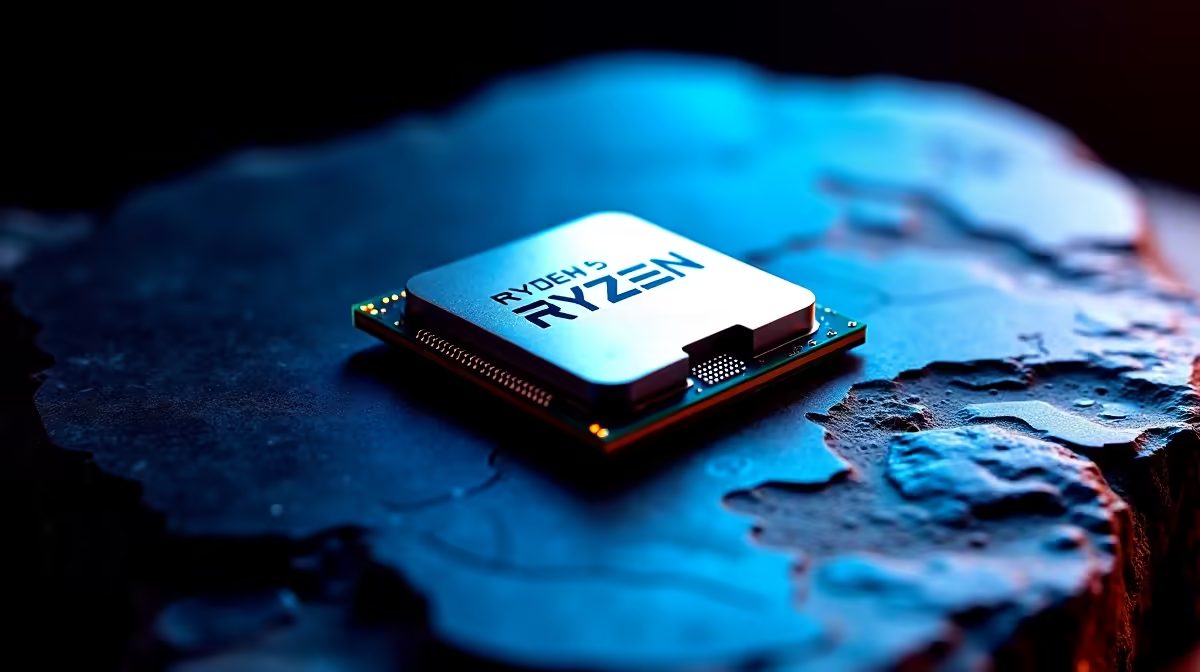
The Ryzen 5 5500 is a Zen 3 desktop processor with 6 cores and 12 threads, running at a base clock of 3.6 GHz with a boost up to 4.2 GHz. It features 16 MB of L3 cache and supports DDR4 memory up to 3200 MHz. While it lacks integrated graphics, it pairs well with a dedicated GPU - which is the real workhorse in any machine learning setup.
For machine learning, the CPU's role is primarily data preprocessing, loading datasets, and managing training pipelines. The Ryzen 5 5500 handles these tasks comfortably for small to medium datasets. PyTorch and TensorFlow both leverage the CPU for these stages before offloading computation to the GPU, and the 5500's six Zen 3 cores keep bottlenecks minimal in most hobbyist and student workflows.
In South Africa, the Ryzen 5 5500 sits in an attractive price bracket well under R3,000 for the processor alone. When paired with 32 GB of DDR4 RAM - recommended for ML workloads - and a capable GPU, you can build a functional ML workstation for under R15,000, making it one of the more accessible entry points for local data science students and developers.
Real-World ML Performance: What to Expect
For supervised learning tasks using scikit-learn, the Ryzen 5 5500 performs well. Random forests, gradient boosting, and linear models on datasets up to a few million rows run without issue. Training times are measured in seconds to minutes rather than hours for these tasks, which makes iteration fast and practical.
Where the 5500 shows its limits is in deep learning without GPU acceleration. Training a convolutional neural network on CPU alone is painfully slow - a task that takes minutes on an RTX 4070 can take hours on the CPU. This is not a criticism unique to the 5500; it applies to all consumer desktop CPUs. The solution is always to pair the processor with a CUDA-capable GPU and use GPU-accelerated frameworks.
For NLP tasks using transformers and large language model inference, the Ryzen 5 5500 can run smaller models (up to around 7 billion parameters with quantisation) when combined with sufficient RAM. Running a quantised LLaMA-style model locally at 4-bit precision is achievable on a 5500 system with 32 GB RAM, though inference is slower than on a dedicated ML GPU. For SA developers wanting to experiment with local AI without cloud compute costs, this is a meaningful capability.
SA Value Rating and Verdict for 2026
For the South African market in 2026, the Ryzen 5 5500 earns a solid 7.5/10 value rating for machine learning use cases. It is not a professional ML chip - that title belongs to higher-end Threadripper or Xeon builds - but for students, hobbyists, and junior data scientists, it provides a capable and affordable foundation.
Load shedding is a practical consideration for any SA PC build. A Ryzen 5 5500 system draws significantly less power than high-end processors, which matters when running on a UPS during Stage 4 or Stage 6. Typical system power consumption for a 5500 build sits around 150-200W under load, extending UPS runtime compared to a 300W+ system.
If your budget allows stepping up to the Ryzen 7 5700X or higher, do so - the extra cores and higher cache meaningfully improve data preprocessing and multi-threaded ML pipelines. But if the 5500 is where your budget lands, it is a legitimate and capable starting point for a local ML workstation in 2026.
Frequently Asked Questions
Q: Is the Ryzen 5 5500 good enough for training neural networks?
A: For small neural networks and learning purposes, yes - especially when paired with a GPU. For large-scale deep learning, a more powerful CPU and dedicated ML GPU are recommended. The 5500 handles preprocessing and pipeline management well, which is the CPU's primary role in GPU-accelerated ML.
Q: How much RAM do I need for machine learning with a Ryzen 5 5500?
A: A minimum of 16 GB DDR4 is workable, but 32 GB is strongly recommended for most ML workflows. If you plan to run local LLM inference or work with large datasets, 32 GB makes a significant practical difference and remains affordable in the SA market.
Q: Can the Ryzen 5 5500 run Python ML libraries like TensorFlow and PyTorch?
A: Yes, both TensorFlow and PyTorch install and run on any modern x86-64 processor including the Ryzen 5 5500. GPU acceleration requires a compatible NVIDIA or AMD GPU, but the CPU handles all non-accelerated workloads without issue.
Also at Evetech: AMD Ryzen 5 Processors | Graphics Card Deals
Ready to Find Your Perfect Match? Shop at Evetech











