Tired of just using ChatGPT? Ever wondered what it takes to build your own AI right here in South Africa? Local LLM development is no longer just for Silicon Valley giants. With the right software toolkit and a bit of know-how, you can start experimenting, fine-tuning, and creating models tailored for our unique local context. This guide breaks down the essential software you'll need to get started on your AI journey. 🚀
Core Software for Local LLM Development
Before you can even think about hardware, you need to get your software stack in order. Developing local LLMs is built on a foundation of open-source tools that have become the industry standard. Getting these right is your first, most critical step.
The Unbeatable Trio: Python, Pip & Conda
Your journey into local LLM development starts with Python. It's the undisputed king of AI and machine learning due to its simplicity and the massive ecosystem of libraries available.
- Python: Aim for a recent version (e.g., Python 3.10+). It's the language you'll write all your code in.
- Pip: This is Python's default package manager. You'll use it constantly to install new libraries.
- Conda/Miniconda: For managing different project environments, Conda is essential. It prevents dependency conflicts by creating isolated spaces for each of your AI projects. Think of it as a clean workshop for every new model you build.
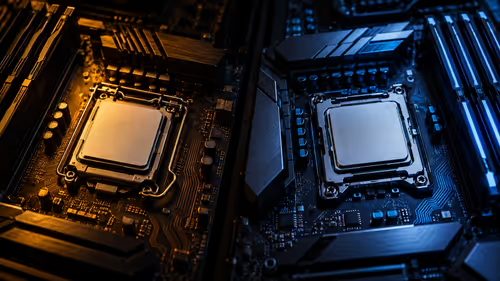
Setting up this environment is straightforward, but it needs a machine that can handle compiling code and running multiple processes. A modern PC with a decent CPU and at least 16GB of RAM is a solid starting point.
Essential AI & Machine Learning Libraries
With your Python environment ready, it's time to install the heavy lifters. These libraries provide the building blocks for creating and training neural networks.
PyTorch or TensorFlow?
This is the classic debate. Both are powerful frameworks for building deep learning models.
- PyTorch: Often favoured in research for its flexibility and more "Pythonic" feel. It's become incredibly popular for LLM projects.
- TensorFlow: Backed by Google, it's known for its robust production-level deployment tools (TensorFlow Serving).
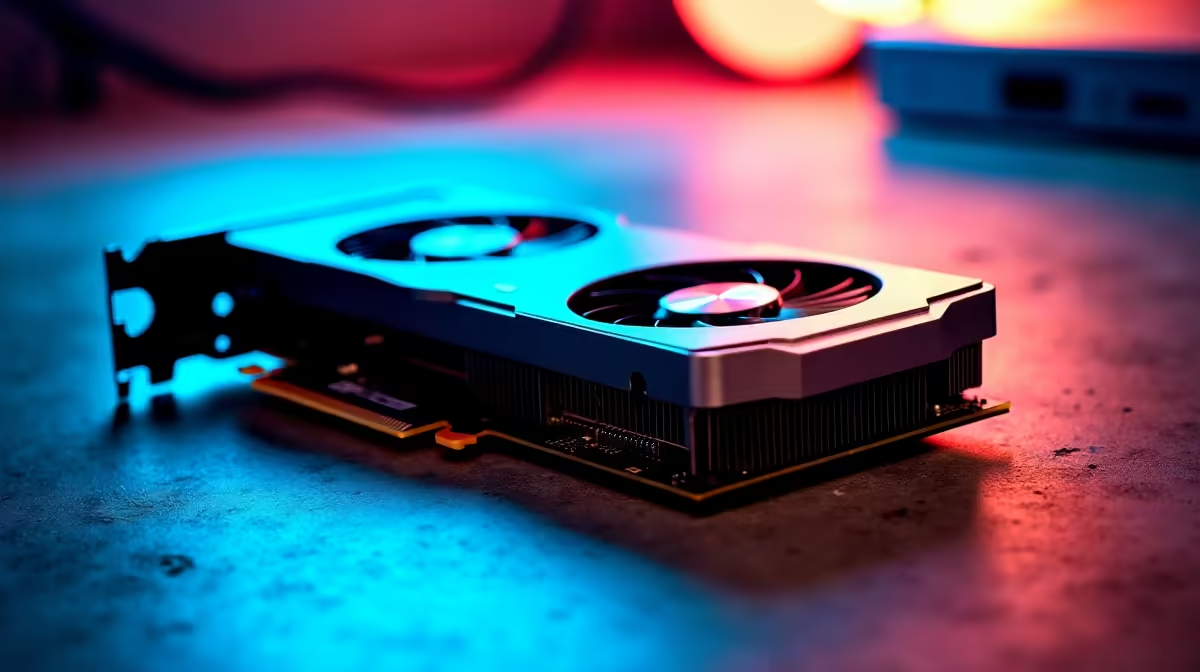
For starting out with local LLM development, many find PyTorch's learning curve a bit gentler. You can't go wrong with either, but picking one and mastering it is key. The processing power of a great GPU is crucial here; the CUDA cores found in powerful NVIDIA GeForce gaming PCs can accelerate training times dramatically.
The Hugging Face Ecosystem 🤗
Hugging Face has completely revolutionised the AI space. Their transformers library gives you easy access to thousands of pre-trained models that you can fine-tune for your specific needs. This is the secret sauce for accessible local LLM development. Instead of training a massive model from scratch (which costs millions), you can adapt an existing one. Their other libraries, like datasets and accelerate, simplify the entire workflow.
VRAM Pro Tip ⚡
Running out of GPU memory is a common problem when fine-tuning LLMs. Use the bitsandbytes library to load your model in 8-bit or even 4-bit precision (a technique called quantization). This drastically reduces VRAM usage, allowing you to work with larger models on consumer-grade graphics cards without sacrificing too much performance. It's a must-have tool for your toolkit.
Data Processing and Experiment Tracking
An LLM is only as good as the data it's trained on. You'll need tools to clean, prepare, and manage your datasets.
- Pandas & NumPy: These are fundamental Python libraries for data manipulation and numerical operations. You'll use them to prepare your text data before feeding it to the model. The strong multi-core performance of modern CPUs, like those in many AMD Radeon gaming PCs, can make short work of large data-wrangling tasks.
- Weights & Biases (W&B): When you run experiments, you need to track your results. W&B is a fantastic tool for logging metrics, comparing different training runs, and visualising your model's performance.
As your projects grow in complexity and your datasets become larger, the demands on your hardware will increase. While a high-end gaming PC is a brilliant starting point, serious or commercial local LLM development often requires the sustained performance and reliability found in dedicated workstation PCs, which are built for 24/7 heavy workloads. ✨
Ready to Build Your AI Development Rig? Local LLM development is an exciting frontier, but it demands serious computational power. Whether you're starting with a powerful gaming PC or a dedicated workstation, Evetech has the hardware to fuel your ambition. Explore our range of custom-built PCs and find the perfect machine to bring your AI projects to life.