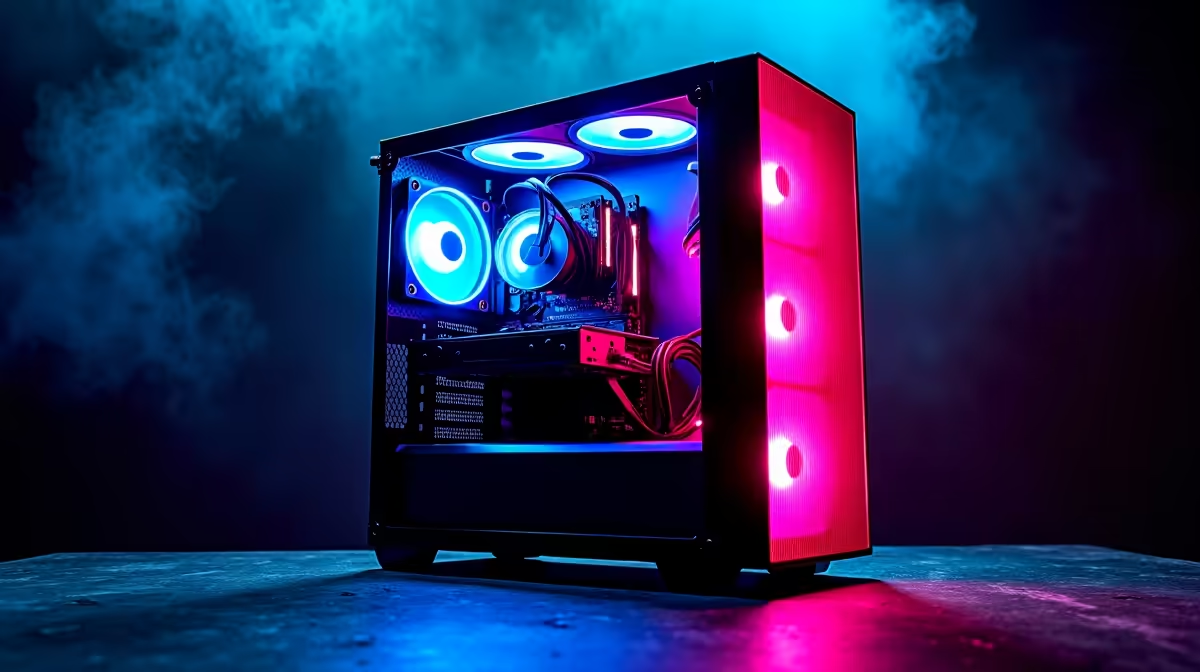
Building a beast of a PC for AI but stuck on which OS to use? While Windows is king for gaming, the world of artificial intelligence plays by different rules. For South African tech heads diving into this space, choosing Linux for Deep Learning isn't just a preference... it's a strategic advantage. It’s the optimal foundation for building powerful DeepSeek PCs that can truly push the boundaries of what's possible. Let's explore why.
The Raw Performance Edge
When you're training a complex neural network, every bit of performance counts. This is where using Linux for deep learning provides its first major win. Unlike other operating systems that have layers of background processes and graphical overhead, a streamlined Linux distribution runs closer to the metal. This means more of your CPU cycles and system RAM are dedicated to the task at hand… training your model.
This direct access to hardware is especially critical for GPU-intensive tasks. Key technologies like NVIDIA's CUDA and cuDNN often see better performance and stability on Linux. The drivers are mature, and the entire software stack is built with this environment in mind. When you're running multi-day training sessions on one of Evetech's powerful NVIDIA GeForce gaming PCs, that stability and efficiency make all the difference. 🚀
An Unmatched Software and Tooling Ecosystem
The entire global deep learning community primarily builds, tests, and deploys on Linux. This means that when a new version of TensorFlow, PyTorch, or JAX is released, it's guaranteed to work flawlessly on Linux first. You get instant access to the latest tools, libraries, and dependencies without wrestling with compatibility issues.
Furthermore, the command-line interface (CLI) in Linux is an incredibly powerful tool for automation and resource management. Setting up complex environments with Docker, managing packages, and monitoring system resources is simply faster and more efficient. It’s a workflow built for developers and researchers who need complete control.
GPU Monitoring Pro Tip ⚡
Keep a close eye on your GPU's performance directly from the terminal. Run watch -n 1 nvidia-smi to get a live, second-by-second update on GPU utilisation, memory usage, and temperature. It's the perfect way to ensure your model is training efficiently and your hardware isn't overheating during those long sessions.
This robust ecosystem makes the platform ideal for any high-performance hardware, including the latest high-performance AMD Radeon PCs, which benefit from the open-source driver improvements within the Linux kernel.
Cost-Effective and Infinitely Customisable
Let's talk rands and cents. Most Linux distributions, like Ubuntu or Arch Linux, are completely free. This eliminates the licensing cost of Windows Pro for Workstations, allowing you to invest that money where it really matters… better hardware. You can build a lean, mean, deep learning machine without paying a cent for the OS.
This customisability is another key reason why Linux for deep learning is the professional's choice. You can install a minimal version of the OS with no unnecessary software... no bloatware, no forced updates interrupting a critical process. You control every single package on your system, creating a perfectly tailored environment for your specific workflow. It's this level of control that makes building custom workstation PCs on Linux so powerful for dedicated AI research. ✨
So, is Windows Still an Option?
Of course! With the Windows Subsystem for Linux (WSL), you can run a Linux environment directly within Windows. It's a fantastic tool for development and smaller-scale experiments. However, for serious, performance-critical training, WSL introduces an abstraction layer that can impact performance and I/O speeds.
For maximum power, stability, and access to the latest tools, running a native Linux for deep learning installation is still the undisputed champion for any dedicated DeepSeek PC.
Ready to Build Your AI Powerhouse? The right OS needs the right hardware. For serious AI work in South Africa, matching Linux with a purpose-built machine is the key to unlocking true performance. Use our PC builder to configure your ultimate DeepSeek rig and start training the next big thing.