Quick Answer
Finding a quality ASUS motherboard under R1,000 in SA in 2026 means looking at entry-level ASUS Prime boards in the H610 (Intel) and A520 (AMD) chipset range. These boards support current-generation CPUs on a budget, though features like PCIe 4.0 support, overclocking, and M.2 slot count may be limited compared to mid-range options.
What ASUS Offers in the Sub-R1,000 Motherboard Bracket
ASUS has a long history of producing reliable entry-level boards under its Prime sub-brand. In 2026, the South African retail landscape for sub-R1,000 ASUS motherboards is centred around H610 chipset boards for Intel LGA1700 CPUs and A520 boards for AMD AM4 CPUs. Both offer a solid foundation for budget gaming and student builds without the premium of higher chipset tiers.
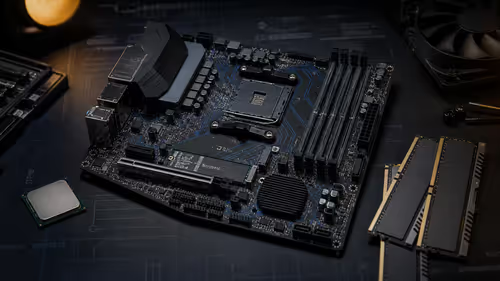
The ASUS Prime H610M-K and similar H610 boards target Intel Core i3 and i5 builders who do not need overclocking. These boards support DDR4 memory, have at least one M.2 slot for NVMe storage, and include basic I/O for most home setups. For AMD users, A520 boards like the ASUS Prime A520M-K support Ryzen 3000 and 5000 series CPUs with PCIe 3.0 support across M.2 and primary PCIe slots.
South African pricing in this segment is competitive. Import cycles and Rand fluctuations affect stock availability, but these boards have remained consistently available through the first half of 2026.
Key Features to Look for Under R1,000
At this price point, focus on the essentials. Confirm the board supports your chosen CPU without a BIOS update requirement. On Intel H610 boards, 12th and 13th generation Core CPUs are typically supported out of the box. On A520 boards, most Ryzen 5000 series CPUs require a BIOS update that was shipped to retail stock well before 2026, so this is rarely an issue on boards purchased today.
Check the M.2 slot specification. Some sub-R1,000 boards include an M.2 slot that is SATA-only rather than NVMe-capable. For a gaming or student build in 2026, NVMe M.2 is strongly preferable for OS drive speed. Read the board specification sheet carefully before purchasing.
Memory slot count matters too. Boards with two DIMM slots limit future upgrade paths compared to four-slot boards. If you plan to expand from 8GB to 16GB or 16GB to 32GB later, a four-slot board gives more flexibility even at entry level.
ASUS Prime vs. Other ASUS Entry Lines
ASUS organises its consumer motherboards into Prime (entry), TUF Gaming (mid-range with gaming aesthetics), ROG Strix (enthusiast), and ProArt (creative professional). Under R1,000 in SA, the Prime line is the relevant tier. Prime boards prioritise stability and compatibility over features like RGB, multiple M.2 slots, or robust power delivery for overclocking.
For SA students using a NSFAS-funded build or a budget PC for university work, ASUS Prime boards represent a reliable choice. They support standard DDR4 speeds, come with ASUS's UEFI BIOS (which is among the more user-friendly implementations at this price point), and have proven long-term reliability in the local market.
Loadshedding and Power Considerations
SA-specific concern: budget motherboards sometimes have less robust power protection circuits than mid-range alternatives. With loadshedding still a reality for many South Africans, pairing a budget board with a quality surge protector or UPS is advisable. ASUS Prime boards generally include basic surge and ESD protection, but a UPS adds a meaningful layer of safety for your entire system investment.
Frequently Asked Questions
What is the best ASUS motherboard under R1,000 for a budget Intel build in SA? The ASUS Prime H610M-K or similar H610 DDR4 boards are the most commonly recommended options at this price point for Intel LGA1700 builds targeting Core i3 or i5 CPUs.
Can I overclock a CPU on an ASUS Prime board under R1,000? No. H610 and A520 chipset boards do not support CPU overclocking. For overclocking, you would need at minimum a B660 (Intel) or B550 (AMD) board, which typically starts above R1,500 in SA.
Does the ASUS Prime A520M-K support Ryzen 5000 CPUs? Yes, with a BIOS update that is pre-applied on most retail stock available in 2026. Verify with your local retailer if purchasing older stock.
How many M.2 slots do sub-R1,000 ASUS boards have? Most include one M.2 slot. Check the specification sheet to confirm it supports NVMe (PCIe) rather than SATA-only, as this varies between SKUs in this price bracket.
Also at Evetech: All Motherboards | Graphics Card Deals
Ready to Find Your Perfect Match? Shop ASUS Motherboards at Evetech