Quick Answer
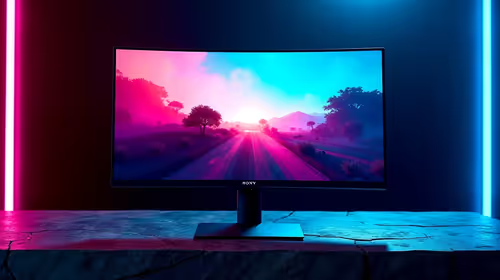
The best budget 240Hz monitor under R8,000 in SA for 2026 is a 24 or 27-inch 1080p IPS or Fast VA panel with sub-1ms response and FreeSync support. Expect to pay R5,500 to R7,800 for solid options from MSI, Gigabyte, ASUS, and AOC at this tier.
Why 240Hz at Budget Pricing Is a Real Thing in 2026
Five years ago, 240Hz meant R12,000 minimum and TN panels with mediocre colours. In 2026, panel manufacturing has matured enough that 240Hz IPS and Fast VA panels land below R8,000 with respectable image quality. For competitive SA gamers playing Valorant, CS2, Apex, Fortnite, and PUBG, this matters: the gap between 144Hz and 240Hz is real, especially in flick-shot moments where a frame either lands or doesn't. You're not paying for marketing, you're paying for response time and frame pacing that lets your reactions actually translate to clicks on target.
Resolution: Why 1080p Is Right at This Budget
Under R8,000 you have a choice: 1440p at 165Hz or 1080p at 240Hz. For competitive shooters, 1080p 240Hz wins. Hitting 240fps in Valorant or CS2 requires a GPU like an RX 7600, RTX 4060, or better, which is achievable for SA gamers on R12,000 to R18,000 mid-range builds. Push to 1440p and your fps drops well below 200 in most titles, defeating the point of the high refresh panel. If you're primarily playing single-player AAA games, skip 240Hz entirely and go for a 1440p 165Hz monitor instead. 240Hz pays off only when you're chasing frames in competitive play.
Panel Tech Trade-offs at This Price
IPS panels at this tier give you the best colours and viewing angles, with 99% sRGB coverage typical, but contrast ratios sit around 1000:1 and blacks look more grey than truly black. Fast VA panels deliver deeper contrast around 3000:1 and richer blacks, perfect for darker games like Hunt: Showdown or Tarkov, but viewing angles narrow at the edges. TN panels still exist at the lowest end of this bracket, skip them, the colour shift is genuinely worse and the savings aren't meaningful. Look for Fast IPS specifically, the response time on these matches TN now without the colour penalty.
Loadshedding and Monitor Power Draw
A 27-inch 240Hz monitor draws roughly 35 to 50 watts in active use, which matters for UPS sizing in SA. A 1000VA UPS comfortably runs your PC plus a 240Hz display through stage 4 and 6 cuts. If you're running a dual-monitor setup with two 240Hz panels, you want to size up to 1500VA for any reasonable runtime. Look for monitors with a hard power switch on the back, not just a soft button on the front, so a sudden cut doesn't leave them in a weird half-on state when power returns.
SA Pricing and Models to Watch
The R5,500 to R6,500 band gives you solid 24-inch 240Hz Fast IPS panels from AOC, MSI, and Gigabyte. R6,500 to R7,800 unlocks 27-inch options with the same refresh and slightly better build quality, plus often HDR400 certification that's nicer in marketing than in real life but doesn't hurt. Stick with brands that have local SA RMA support, an out-of-warranty monitor sent overseas for repair is a six-week story you don't want. Three-year warranties are standard at this price, accept nothing less.
Frequently Asked Questions
What GPU do I need to actually hit 240fps in modern games?
For esports titles like Valorant, CS2, and Overwatch 2 at 1080p competitive settings, an RX 7600, RTX 4060, or better will push 240+ fps reliably. AAA single-player games at high settings won't hit 240fps even on an RTX 4080, so set those to medium or use upscaling like FSR or DLSS Performance.
Is 240Hz noticeable coming from 144Hz?
Yes, but with caveats. The jump from 60Hz to 144Hz is dramatic. The jump from 144Hz to 240Hz is subtle: smoother motion in fast camera turns, slightly clearer tracking in flick shots. If you're a competitive player, the difference matters. If you're casual, 144Hz is already great and the upgrade is hard to justify.
Do I need DisplayPort or is HDMI 2.1 fine for 240Hz at 1080p?
HDMI 2.0 and DisplayPort 1.2 both handle 1080p at 240Hz comfortably. DisplayPort is the more reliable choice for high-refresh use because it handles G-Sync and FreeSync more consistently. Use the cable that comes in the monitor box, those are usually fine.
Ready to Find Your Perfect Match? Ready to upgrade to true 240Hz gameplay? Shop our monitor range