

Quick Answer
For under R20,000 in SA, a Ryzen 5 7600 with 32GB DDR5, a 1TB NVMe SSD and integrated Radeon graphics handles pandas, scikit-learn and Jupyter workloads beautifully. You skip the dGPU at this budget and pour the cash into RAM and storage where data science actually lives.
Why RAM and Storage Beat GPU at R20K
Most entry-level data science work, think Kaggle notebooks, EDA in pandas, classical ML in scikit-learn, lives in CPU and memory, not VRAM. A 32GB DDR5-5600 kit lets you load a 5GB CSV without swap thrashing, and a 1TB Gen4 NVMe means parquet reads finish in seconds rather than minutes. We see varsity students at Wits and UCT picking this exact balance because their coursework rarely touches deep learning until honours year. Spend the GPU money on a second monitor instead, your eyes will thank you during long cleaning sessions where you're sat in front of dataframes for hours. The Ryzen 5 7600's six Zen 4 cores comfortably handle XGBoost training on a million-row tabular dataset in under sixty seconds, faster than any laptop in the same price bracket.
The Recommended R20K Build for SA Buyers
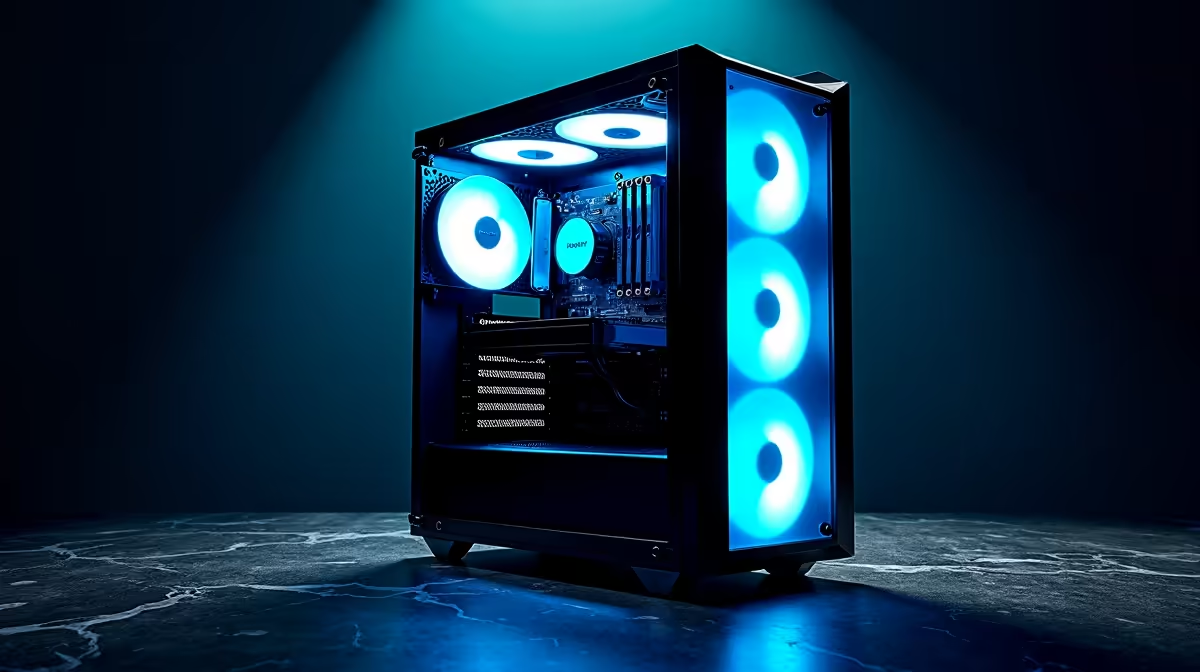
Pair the Ryzen 5 7600 with a B650 motherboard, 32GB DDR5-5600 (2x16GB), a 1TB Gen4 NVMe and a quality 650W 80+ Bronze PSU. Stick it in a mid-tower with three intake fans because Joburg and Durban summers will cook poorly ventilated rigs. A budget-friendly Cooler Master MasterBox or Corsair 4000D Airflow does the job nicely. Total lands around R19,500 with a basic case, leaving wiggle room for a Wi-Fi 6 dongle if your res or digs lacks ethernet. Evetech ships nationwide with three to five day delivery to most metros, and orders to Cape Town typically arrive within 72 hours of dispatch. Make sure your PSU is 80+ Bronze or better, generic units with no certification waste 15 to 20 percent of the wall power as heat.
NSFAS, Loadshedding and Real-World Practicality
The R5,200 NSFAS laptop allowance won't cover this build, but if you've saved up over a gap year or have part-time tutoring income, it's a far better long-term investment than a sub-R6K laptop that throttles after ten minutes. Loadshedding matters too, run the rig on a 1500VA line-interactive UPS so a Stage 4 cut doesn't corrupt your training notebook mid-epoch. A modest UPS adds about R1,800 but saves countless hours of redoing feature engineering work on your favourite Kaggle dataset. Stellenbosch and UP students often pair the UPS with a small inverter trolley for longer Stage 6 cuts, total backup time around 90 minutes for a desktop plus monitor.
Software Stack That Pairs With This Hardware
Install Ubuntu 24.04 LTS or stick with Windows 11 plus WSL2, both run Anaconda, JupyterLab and VS Code without issue. Use mamba instead of conda for faster environment solves, and keep your datasets on the NVMe rather than an external drive. Polars is rapidly displacing pandas for serious tabular work, and your Ryzen 5 7600 will fly through Polars lazy evaluation pipelines on multi-gigabyte CSVs. For visualisation, Plotly and Seaborn run native, no GPU required. The 32GB RAM headroom also lets you spin up two or three concurrent Jupyter kernels for cross-validation without your machine grinding to a halt.
Future-Proofing Your Data Science Rig
Plan for a three-year lifecycle on this build. The AM5 socket lasts at least until 2027 per AMD's roadmap, meaning a future Ryzen 9000 series drop-in upgrade is realistic. Add a second 1TB NVMe down the line for raw dataset storage separated from your OS drive, and consider a small 2.5GbE network card if you start running models against an in-home NAS. The Joburg and Pretoria second-hand market for Ryzen 5 CPUs is healthy, you can offload your 7600 in 2028 for a meaningful chunk of a 9700X upgrade. Keep the box, manuals and accessories, the resale premium for boxed components on local marketplaces is genuinely worth the cupboard space.
Frequently Asked Questions
Can I add a GPU later for deep learning?
Yes, the 650W PSU and B650 board comfortably accept an RTX 4060 or RTX 5060 down the line. Budget around R8,000 to R10,000 when you're ready to start playing with PyTorch and CUDA seriously.
Is 16GB RAM enough if I want to save R1,500?
For a serious data science rig in 2026, no. Modern pandas operations and even moderate joins will spill to disk on 16GB, costing you hours over a semester. Stick with 32GB.
Will this build run Tableau and Power BI smoothly?
Absolutely. Both BI tools are CPU and memory bound, and the Ryzen 5 7600 with 32GB DDR5 handles dashboards on multi-million row datasets without breaking a sweat.
Ready to Find Your Perfect Match? Lock in your data science rig with a tailored R20K build today. Browse SA-priced gaming PC deals











