



Fix Monitor stuck at 60Hz checks on DDR5 build
Monitor stuck at 60Hz on DDR5 build needs careful display-chain checks, not a single-part blame. Test the screen, cable, port, scaling, drivers, and setup context before replacing hardware.
Read moreTop Intel Storage Under R1000 picks evaluated on performance, value & SA availability with current Rand pricing from Evetech.
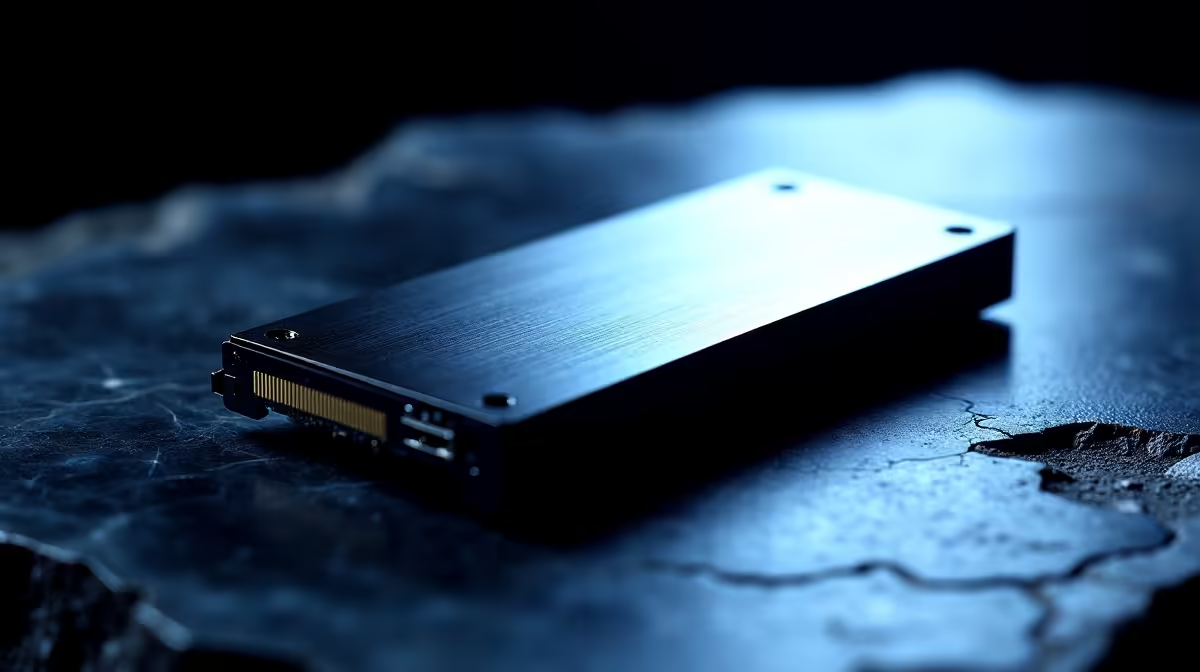
The best Intel-branded storage options under R1,000 in South Africa in 2026 include Intel's 670p and 660p NVMe SSDs available in 512GB configurations. For the budget, Intel storage offers solid sequential read speeds and decent endurance for everyday computing and light gaming tasks.
Finding quality storage under R1,000 in South Africa is genuinely possible in 2026, and Intel's SSD lineup has historically offered competitive value at the entry and mid-tier price points. Whether you're upgrading an older laptop, adding a secondary drive to a desktop, or building a budget PC from scratch, knowing what Intel storage can deliver at this price makes the decision much easier.
In the South African market, the Intel 670p and 660p series in 512GB capacities have consistently landed in the R600 to R950 range depending on the retailer and current Rand exchange rate. These are M.2 NVMe drives using QLC (Quad-Level Cell) NAND, which means they deliver respectable sequential speeds - the 670p hits around 3,500 MB/s read and 2,700 MB/s write on the spec sheet - but sustained write performance drops once the SSD's cache fills, which matters for large file transfers.
For most users doing office work, web browsing, streaming, and light gaming, the cache rarely fills during typical usage patterns. Where Intel's budget NVMe drives show their limits is in workloads like video editing where you're constantly writing large files.
The Intel 670p in 512GB is a capable boot drive and application storage solution. Windows 11 boots in 10 to 15 seconds, applications launch quickly, and game load times are meaningfully faster than any SATA SSD or spinning hard drive. In benchmarks, the 670p scores around 3,400 MB/s sequential read in CrystalDiskMark, which is competitive for its price tier.
Where QLC drives like Intel's budget line differ from TLC alternatives is in write endurance. The Total Bytes Written (TBW) rating on a 512GB 670p sits at 185 TBW, which for average consumer use translates to many years of normal operation. If you're writing terabytes of data regularly, look at higher endurance drives, but for the target buyer under R1,000 this is rarely a concern.
Honestly, Intel's standalone SSD business has seen significant changes in recent years. Intel sold its NAND division to SK Hynix, which now markets under the Solidigm brand. Some drives still carry Intel branding on the SA market, but new production is Solidigm-branded. This means inventory availability of true Intel SSDs at retail is shrinking.
At the sub-R1,000 price point in South Africa, competing QLC and TLC NVMe options from other brands often offer similar or better performance. The smart approach is to check current local pricing and compare on a per-gigabyte basis. A 1TB drive from another brand might land just at or slightly above R1,000, offering double the capacity for marginally more spend - worth considering if your storage needs are growing.
This price range suits students, office workers, and anyone upgrading from a hard drive who wants a significant real-world performance boost without significant spend. If you're putting together a budget desktop or refreshing an older system that currently has a mechanical drive, dropping R700-900 on a 512GB NVMe SSD delivers one of the best upgrade-to-cost ratios in PC building.
For South African students receiving NSFAS allowances or building within tight budgets, entry-level NVMe storage at this price point transforms a slow machine into something genuinely usable for daily academic work.
Q: Are Intel SSDs reliable for long-term use? A: Yes. Intel SSDs have a strong reliability track record. The 670p and 660p carry 5-year warranties, and their TBW ratings are adequate for everyday consumer use well beyond that period under normal usage.
Q: Can I use an Intel NVMe SSD in any laptop or desktop? A: Intel's M.2 NVMe SSDs require an M.2 slot with NVMe support (M-key connector). Most modern laptops and desktops from 2018 onwards have this. Older systems may only support SATA M.2, which is a different standard - check your motherboard or laptop specs before buying.
Q: Is a 512GB SSD enough storage under R1,000? A: For most users it is sufficient as a boot and application drive. If you run many games, store large media libraries, or do video editing, pair it with a larger secondary storage option. A 512GB drive fills faster than most people expect once Windows, apps, and a few games are installed.
Q: Will Intel SSD prices drop further in 2026? A: Storage prices globally have been declining year on year. In South Africa, Rand fluctuations can offset some of these reductions, but the general trend favors buyers. Prices at the sub-R1,000 tier are likely to see capacity increases rather than dramatic price drops.
Ready to Find Your Perfect Match? Browse Evetech's full range of gaming PC deals and find the right storage upgrade for your build.
Best Intel Storage Under R1000 in SA 202 available at Evetech.co.za with local warranty and fast delivery.
Best Intel Storage Under R1000 in SA 202 - check Evetech for latest stock and SA pricing.
Depends on your use case. Best Intel Storage Under R1000 offers good value at current Rand pricing.
Monitor stuck at 60Hz on DDR5 build needs careful display-chain checks, not a single-part blame. Test the screen, cable, port, scaling, drivers, and setup context before replacing hardware.
Read more
Recommended build for Genshin Impact at R60 000 should justify the spend with high-end parts that help beyond one title. SA buyers should prioritise GPU headroom, large SSD space, reliable power and quiet cooling for long-term use.
Read more
Atomic Heart stuttering on RX 9070 XT points to frame pacing, driver, or settings issues first. Check display mode, shader cache, overlays, background load, and thermals before replacing parts.
Read more
Cell C Fibre Polokwane packet loss can come from Wi-Fi, drivers, router settings, Ethernet, line faults, or game-server routing. Start with local checks before replacing parts or escalating support.
Read more
University of Cape Town residence: compact should be shortlisted around the job it must do. South African buyers should compare wattage, efficiency, protection, and connector support, warranty path, and upgrade room before treating any pick as best.
Read more
Setting up a running local LLMs rig in Hermanus should be shortlisted around the job it must do. South African buyers should compare fit, performance, compatibility, and upgrade room, warranty path, and upgrade room before treating any pick as best.
Read more
Windows 11 spatial sound greyed out needs an output-device check before a headset purchase. Select the intended playback device and look for Windows Sonic for Headphones. Speaker, HDMI and headphone routes can expose different spatial sound options.
DisplayPort 2.1 vs DisplayPort 1.4 for aAA single-player gaming Difference explained is mostly about compatibility, budget, upgrade path, and setup fit. SA buyers should check device support and real needs before expecting a clear win from either.
RTX 4080 too expensive? Cheaper SA alternatives should solve the exact workload without overbuying. Compare nearby options by GPU tier, VRAM, cooling, and PSU headroom, local warranty path, and total build balance before moving to a product page.

Recommended build for Hollow Knight Silksong at R100 000 SA buyer's guide frames a dream-class PC around more than one game. Balance flagship graphics, premium CPU, 32GB or more RAM, fast SSDs, quiet cooling and power quality.

Windows 11 Ethernet unidentified network needs a cable, router and PC comparison before a reset. Test a second device and run the network troubleshooter. Save adapter drivers and custom settings before using network reset as the final step.

Steam processing Vulkan shaders is graphics preparation rather than a normal game download. On Linux, compare progress and repeat launches before deleting caches. A driver or game change can alter the work, so gather evidence before paying for a new GPU.

Steam discounts and events are moving towards personalised recommendations in early 2027. A firm start date is still pending. The change concerns promotional visibility, so compare the actual rand price and game requirements before making a purchase.
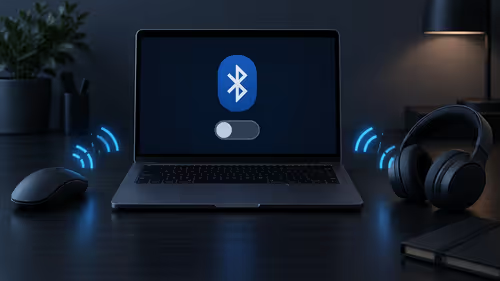
Windows 11 Bluetooth toggle missing can mean the radio is not being detected or enabled. Start with a complete power-off, then check the adapter and drivers. Pairing a new mouse cannot repair an absent Bluetooth control, so isolate the PC first.
Steam game recording black screen needs a fresh capture and export test before a hardware upgrade. Check the recording mode, free space and whether another game records correctly. Community reports suggest testing broadcasting settings, but that is not a universal fix.

Windows 11 two finger scroll not working needs a gesture and driver check first. Test pointer movement and scrolling in more than one app, inspect Touchpad settings and use Windows Update or the laptop maker's driver. A new mouse is only a workaround.
MSI Stealth 16 RTX 5070 specs need an exact SKU check because current listings disagree on GPU memory. One UK listing says 12GB while MSI's family table says 8GB. Confirm the supplied configuration rather than assuming either describes every machine.
Windows 11 Insider 26220.9587 is a Beta preview released on 2 October. Microsoft lists Unicode text support, Settings performance work and a Cloud Rebuild entry point. These are preview changes, not a reason to move your only working PC onto a test build.