

Quick Answer
Building a home theatre PC (HTPC) for your South African living room means balancing silent operation, compact size, 4K playback capability, and a budget that makes sense in ZAR. A well-built HTPC using an AMD APU or a low-power Intel chip with a small form factor case can be assembled for R6,000 to R12,000 and will outperform a smart TV's built-in apps in every meaningful way.
What an HTPC Does That a Smart TV Cannot
A smart TV's built-in software is limited to the apps pre-installed by the manufacturer and is notoriously slow to receive updates. An HTPC running Windows or a lightweight Linux distribution gives you access to every streaming service, full Kodi or Plex media server capabilities, local file playback of any format, retro gaming through emulators, and the full flexibility of a PC in a living room package.
For South African living rooms, the HTPC also solves a loadshedding management problem. A small HTPC consumes far less power than a full gaming desktop while still delivering 4K HDR playback. Running on a UPS during load shedding, an efficient HTPC drawing 15 to 35W can stay operational for two to three hours on a modest battery backup, keeping your entertainment system alive through most loadshedding stages.
Choosing the Right Components for a South African HTPC
The processor is your most important choice. For a purely media-focused HTPC, an AMD Ryzen APU (such as the Ryzen 5 or Ryzen 7 with integrated Radeon graphics) handles 4K H.265 and AV1 hardware decoding without needing a dedicated GPU. Intel's current-generation processors with integrated Iris Xe graphics are another solid option and are widely available in South Africa at competitive ZAR pricing.
Avoid budget-tier CPUs that lack hardware video decode acceleration. These force the processor to decode video in software, consuming significantly more power and causing playback stutter on 4K content.
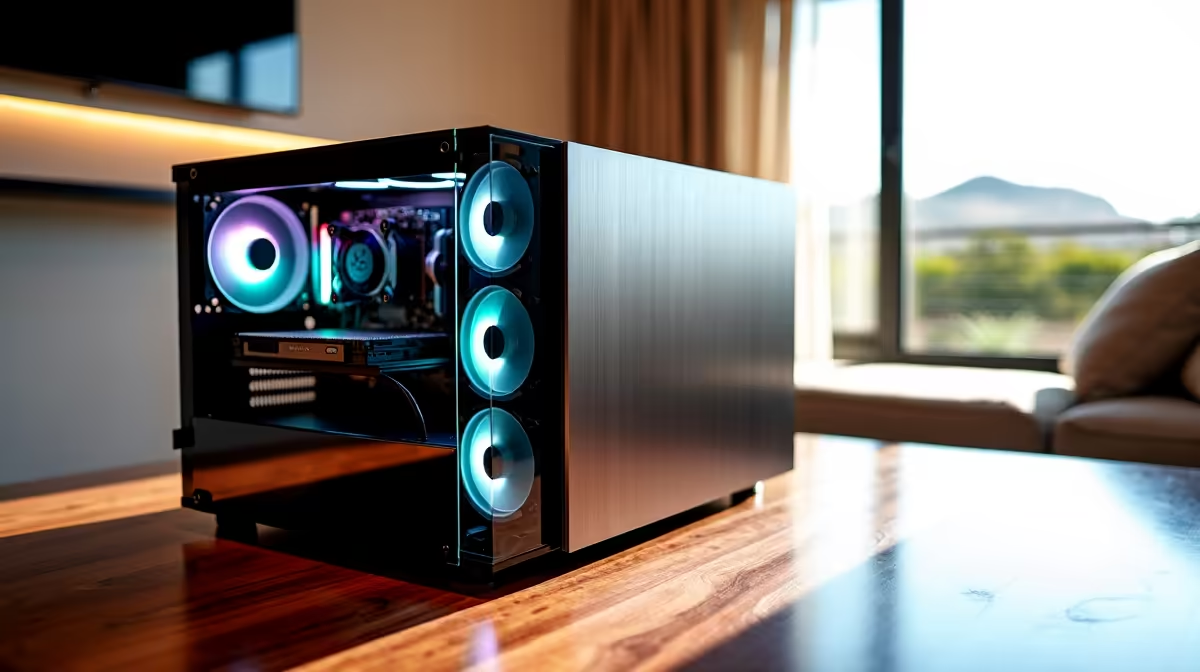
For the case, a mini-ITX build is the standard HTPC form factor. These cases are designed to sit horizontally next to or beneath your TV, match the aesthetic of AV equipment, and often include front IR receiver support for universal remote compatibility. Mini-ITX cases from brands stocked locally in South Africa range from R700 to R2,000.
RAM requirements for a media HTPC are modest. 8GB DDR4 or DDR5 dual-channel is the minimum for smooth operation. 16GB is worth adding for R300 to R500 more if you plan to run Plex Media Server, a NAS application, or light gaming alongside media duties.
Storage depends on whether you are streaming or playing local files. A 500GB M.2 NVMe SSD for the operating system and apps combined with a 4TB 3.5-inch HDD for media storage is a practical combination for a SA living room setup. Alternatively, a NAS on your home network eliminates the need for internal storage beyond the OS drive.
Display and Audio Output Setup
Connect the HTPC to your TV via HDMI 2.1 for 4K HDR passthrough. Most modern South African TV sets have at least one HDMI 2.1 port. If your TV only has HDMI 2.0, you are still covered for 4K 60Hz HDR without issue.
For audio, HDMI carries both video and audio including Dolby Atmos and DTS:X bitstreaming if your TV or AV receiver supports it. A dedicated sound card is unnecessary for most HTPC builds. If your TV does not have good speakers (most do not), an HDMI ARC or optical connection to a soundbar or AV receiver completes the setup.
Controlling Your HTPC From the Couch
The last piece of the living room experience is input. A wireless keyboard and touchpad combination is the standard solution and works for everything from web browsing to setup tasks. For daily media playback, a Flirc USB IR receiver paired with your existing TV remote eliminates the need for a separate keyboard entirely, allowing you to control the HTPC with whatever remote is already on your coffee table.
Frequently Asked Questions
How much does it cost to build a basic HTPC in South Africa?
A capable HTPC for 4K media playback can be built for R6,000 to R9,000 using an AMD APU, 16GB RAM, a 500GB NVMe SSD, a mini-ITX case, and an 80W power supply. Adding a small dedicated GPU for light gaming pushes the cost to R10,000 to R14,000.
Can I use an HTPC during loadshedding?
Yes. An HTPC with a power draw of 15 to 35W at idle can run for two to four hours on a 650VA UPS, making it one of the most loadshedding-resilient home entertainment setups available. Pair it with a UPS and you keep watching through most standard loadshedding stages.
Is Windows or Linux better for an HTPC?
Windows is the easier choice for South African users who want full app compatibility and straightforward setup. Linux with Kodi is a popular option for pure media playback and consumes less system resources, but requires more technical comfort to configure. Most local buyers stick with Windows.
Ready to Find Your Perfect Match? Start planning your HTPC build with quality components from Evetech. Browse gaming PC deals and components











