Don't Let a Motherboard CPU Bottleneck Cripple Your Gaming Rig 🇿🇦
South African gamers crave peak performance. Imagine upgrading your CPU, only for your frames to barely budge… frustrating, right? That’s often a sign of a motherboard CPU bottleneck, a common pitfall where your motherboard unknowingly holds back your processing power. Understanding this can save you cash and boost your gaming. Let's decode how your choice affects performance and ensure your rig truly flies.
What Exactly is a Motherboard CPU Bottleneck? 🔧
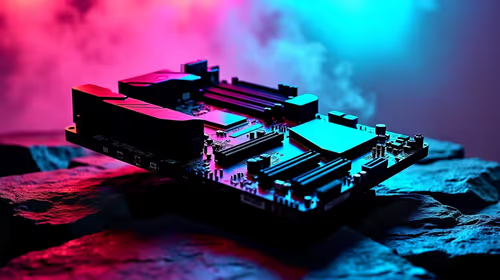
Simply put, a motherboard CPU bottleneck occurs when your motherboard's capabilities aren't quite up to the task of fully supporting your chosen processor. It’s not just about the socket type fitting; it’s about the underlying architecture, power delivery, and connectivity. Think of it like putting a powerful engine in a chassis that can’t handle its speed or weight. Your CPU might be a beast, but a mismatched motherboard can prevent it from delivering all those glorious FPS or crunching complex tasks efficiently. This imbalance leads to wasted potential and a less-than-optimal user experience.
Key Factors Creating a Performance Bottleneck
Several critical components on your motherboard can contribute to a CPU performance bottleneck. Knowing these helps you make smarter buying decisions.
Voltage Regulator Module (VRM) Quality
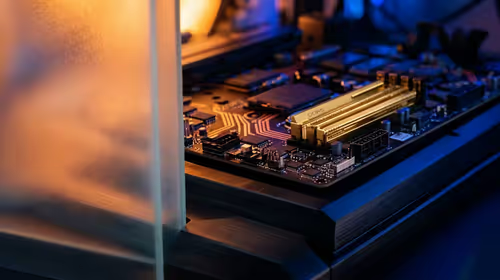
The VRM is your motherboard’s power station for the CPU. It converts and delivers clean, stable power. A low-quality or under-engineered VRM, often found on budget motherboards, simply cannot provide enough consistent power for high-end or overclocked CPUs. This results in thermal throttling (the CPU slowing itself down to prevent overheating), instability, or even crashes. For powerful processors, a robust VRM with sufficient phases and good heatsinks is non-negotiable.
Chipset Limitations
The chipset acts as the central hub, managing communication between the CPU, RAM, GPU, storage, and peripherals. Older or entry-level chipsets might lack sufficient PCIe lanes, support for the latest PCIe generations (like PCIe 5.0), or high-speed USB ports. This can create a bottleneck for modern GPUs, NVMe SSDs, and other high-bandwidth components, even if your CPU is top-tier. Always check chipset compatibility with your desired components.
RAM Speed and Support
While not strictly a "motherboard CPU bottleneck," the motherboard's RAM support profoundly impacts CPU performance. A fast CPU thrives on fast RAM. If your motherboard only supports slower RAM speeds or has limited slots, your CPU might be waiting on data, leading to a performance hit. Ensure your motherboard supports the RAM speed and capacity that your CPU can effectively utilise.
BIOS/UEFI Optimisation
A well-optimised BIOS/UEFI firmware from the motherboard manufacturer is crucial. It dictates how efficiently the CPU communicates with other components and how effectively power management and overclocking features are implemented. Regular BIOS updates can often improve stability and even unlock better performance from your CPU.
Check the QVL List
Before buying RAM, always check your motherboard's QVL (Qualified Vendor List) on the manufacturer's website. This ensures compatibility and optimal XMP EXPO profile support for your chosen memory modules. It’s a simple step that prevents many headaches!
Identifying and Preventing a Motherboard CPU Bottleneck ⚡
Spotting a motherboard CPU bottleneck can be tricky. Look for signs like your CPU usage consistently low while your GPU usage is also low during gaming (when neither should be limiting the other). Inconsistent frame rates or unexpected stuttering, despite having a powerful CPU, can also be a clue.
The best way to prevent this performance bottleneck is through careful planning and component pairing. Don't cheap out on the motherboard if you're investing in a high-end processor. Research your CPU's power requirements and match it with a motherboard known for its solid VRM and feature set.
Considering an AMD build that truly maximises your processing power? Explore Evetech's range of AMD CPUs to find the perfect match for a capable motherboard. Or perhaps Team Blue is more your style? Evetech offers a wide selection of Intel CPUs ready for your next build, ensuring you can pair them with boards that unleash their full potential.
Ultimately, your goal is a balanced system. Investing a little more in a motherboard that complements your CPU can unlock significantly better overall performance and stability. It's about getting the most out of every Rand you spend on your dream PC.
Build Your Dream PC, Bottleneck-Free!
Don't let a hardware mismatch cripple your performance. Invest in components that work together, delivering the seamless gaming and productivity you deserve. Shop CPU processors online at Evetech and build a system free from frustrating bottlenecks.