Buying a monitor in South Africa involves more than just picking a screen size - panel type, refresh rate, resolution, and local warranty support all play a role in whether you'll be happy with your purchase a year down the line. With a wide price range from budget 1080p displays to ultra-wide 4K panels, it pays to go in informed. Here are 20 essential things every SA buyer should know before spending a cent.
Quick Answer
Before buying a monitor in SA, prioritise panel type (IPS for colour accuracy, VA for contrast, TN for speed), refresh rate (144Hz minimum for gaming), and whether the resolution matches your GPU's capability. Always check local warranty terms and buy from a retailer with SA-based support.
🖥️ 20 Things Every SA Monitor Buyer Must Know
1. Panel type determines your experience. IPS panels offer the best colour accuracy and viewing angles. VA panels have deeper blacks and higher contrast ratios. TN panels are fastest but have poor viewing angles and colour reproduction.
2. 1080p is still viable at 24 inches. At 27 inches or larger, 1440p (QHD) is the sweet spot in 2026 for sharpness without excessive GPU demand.
3. Refresh rate matters for gaming. 144Hz is the entry point for a smooth gaming experience. 165Hz and 240Hz are worth it if your GPU can sustain those frame rates.
4. Response time is measured differently by different brands. GtG (grey-to-grey) is the most common metric but can be advertised in optimistic conditions. Look for independently tested response times, not just spec sheet numbers.
5. FreeSync vs G-Sync. AMD FreeSync is open standard and supported on most modern monitors. NVIDIA G-Sync requires a certified display with a proprietary module. FreeSync Premium and G-Sync Compatible are essentially the same technology - check your GPU brand before paying extra.
6. HDR certification varies wildly. "HDR400" is the minimum and barely noticeable. DisplayHDR 600 and above deliver meaningful HDR. Most budget monitors advertising HDR are HDR400 at best.
7. VESA mounting matters. If you plan to use a monitor arm, confirm the display has standard VESA holes (100x100mm is most common). Some ultraslim monitors omit VESA entirely.
8. Check the stand before buying. Budget monitors often ship with stands that only tilt. Height adjustment and pivot (portrait rotation) are valuable ergonomic features, especially for long work sessions.
9. Input lag is not response time. Input lag measures the delay between your action and the display showing it. Gaming monitors aim for under 5ms input lag regardless of quoted response time.
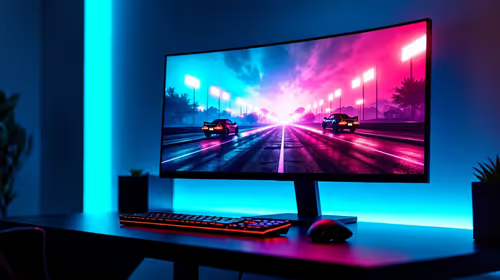
10. Ultrawide (21:9) is great for productivity and immersive gaming, but some titles still don't support the aspect ratio natively. Check your most-played games before committing.
11. USB-C with power delivery is increasingly useful. If you use a laptop at your desk, a monitor with USB-C PD lets you charge and display with a single cable - a significant convenience upgrade.
12. Built-in speakers are almost always underwhelming. Budget for a headset or speakers separately if audio quality matters.
13. SA voltage (220–240V) is fine. Most modern monitors are dual-voltage and ship with SA-compatible plugs. Confirm before importing.
14. Local warranty typically ranges from 1 to 3 years. Dead-pixel policies vary - some manufacturers replace panels with even one dead pixel; others require five or more.
15. Colour accuracy matters for content creators. Look for Delta E ratings below 2 and sRGB coverage above 99% if you edit photos or video.
16. Blue light filters and flicker-free backlights reduce eye strain. Worth prioritising for anyone spending 6+ hours daily at a screen.
17. 4K at 27 inches requires a powerful GPU. Gaming at 4K/60fps needs at minimum an RTX 4070 or RX 7800 XT equivalent.
18. Curved monitors are personal preference. They work well at ultrawide sizes; curvature on a standard 27-inch monitor is subtle and not universally liked.
19. Check Evetech's monitor range for current SA pricing. International prices and SA retail prices can differ significantly due to import duties and the rand exchange rate.
20. Buy from a retailer with SA-based after-sales support. Returns and warranty claims on locally purchased monitors are far simpler than international grey imports.
❓ FAQ
Q: What refresh rate should I prioritise for competitive gaming in SA? A: 144Hz minimum for a competitive edge; 240Hz if you play titles like Valorant or CS2 and your GPU can sustain 200+ fps.
Q: Is 1440p worth it over 1080p in 2026? A: Yes, at screen sizes of 27 inches or larger. At 24 inches, the pixel density difference is less visible and 1080p 144Hz+ monitors offer better value.
Q: Do I need G-Sync if I have an NVIDIA GPU? A: Not necessarily. G-Sync Compatible (FreeSync Premium) monitors work with NVIDIA cards and offer near-identical adaptive sync performance at a lower price.
Shop All Monitors and Graphics Card Deals at Evetech for fast delivery across South Africa.
Ready to Find Your Perfect Match? Build or buy your ideal gaming setup at Evetech - monitors, GPUs, and full rigs available.