


Headset Stock Levels in Bloemfontein: January 2026 Report
Headset Stock Levels in Bloemfontein: January. Current stock data & price tracking for SA buyers. See what is available and where prices are heading.
Read more5 Things You Need to Know Before Buying PSU. Comprehensive checklist covering every spec and feature you should verify before buying in SA.
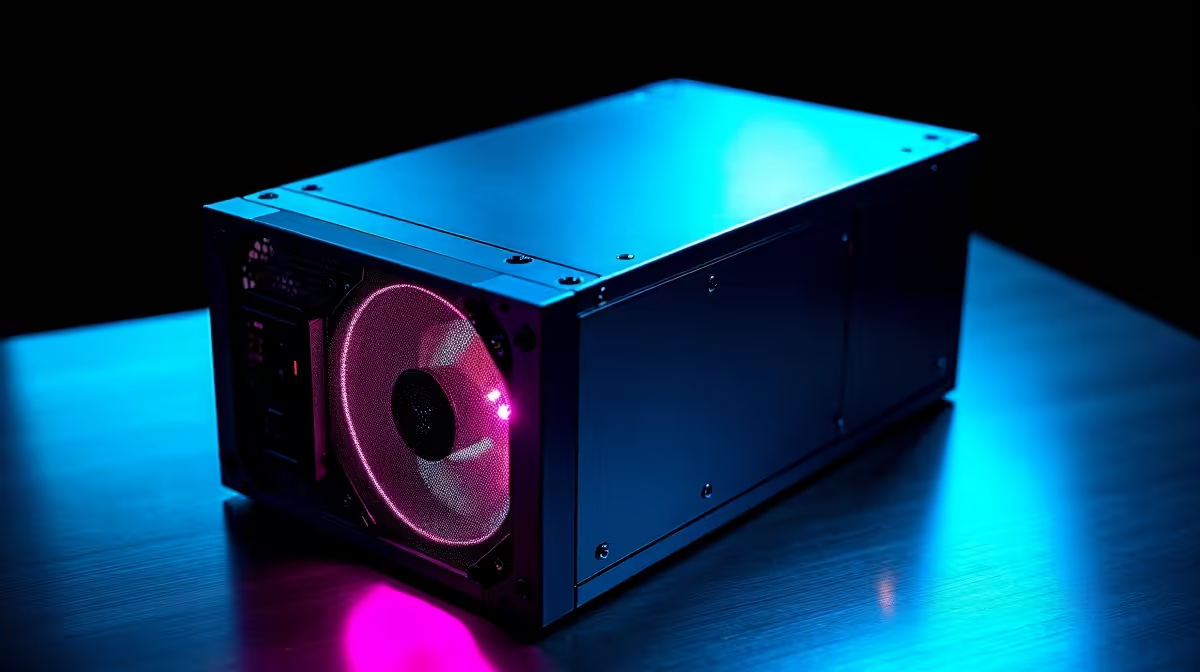
Before buying a PSU in South Africa, you need to know the correct wattage for your build, verify the efficiency rating, confirm the form factor fits your case, check the modular cable type, and understand why 80 Plus Gold or better is especially important in SA given power quality challenges.
Overbuying wattage is common but wastes money. Underbuying risks system instability and component damage. A practical rule: add up your CPU TDP and GPU TDP, then add 100-150W for the rest of the system (drives, fans, RAM, motherboard), and buy a PSU rated 20-30% above that total.
For example, a system with a Ryzen 5 7600 (65W TDP) and an RTX 4060 (115W TDP) totals 180W for the key components. Add 120W headroom and you need roughly 300W of real-world draw. A 550W or 650W PSU is the right choice here, not a 1000W unit.
South Africa's power grid can have voltage fluctuations during loadshedding stage transitions, and electricity costs in rands have risen significantly. An 80 Plus Bronze PSU wastes 15-20% of drawn power as heat. An 80 Plus Gold unit wastes only 8-10%, and 80 Plus Platinum cuts this further.
The efficiency difference translates directly to your monthly electricity bill and to how hot your PSU runs. A cooler PSU lasts longer and generates less heat inside your case. In SA, 80 Plus Gold is the minimum worth buying for any build above R8,000.
PSUs come in three cable configurations:
For South African builds in mid-tower or larger cases, semi-modular is the sweet spot for value. Fully modular is ideal if cable management matters to you.
Standard ATX PSUs fit the vast majority of mid-tower and full-tower cases. Small form factor (SFX) PSUs are required for mini-ITX and some compact ATX cases. TFX and Flex-ATX are used in very slim OEM systems. Check your case specifications before purchasing. An SFX PSU physically will not mount in a standard ATX bay.
High-end GPUs from 2023 onward may require a 16-pin 12VHPWR connector (used by NVIDIA RTX 40 and 50 series). Older cards use 6-pin or 8-pin PCIe connectors. Verify your GPU's power connector requirement and confirm the PSU either includes the correct cable natively or through an adapter. Using daisy-chained 8-pin adapters for a 16-pin requirement is a fire risk and voids warranties.
Is a 650W PSU enough for most gaming builds in SA? For mid-range builds with a GPU up to the RTX 4070 or RX 7800 XT tier, yes. High-end builds with flagship GPUs benefit from 750W or 850W.
Does loadshedding damage PSUs? Stage transitions cause brief voltage spikes and drops. A quality 80 Plus Gold PSU with active PFC handles these better than budget units. A UPS adds an extra layer of protection and is strongly recommended for SA desktop users.
What does 80 Plus Gold actually mean? 80 Plus Gold certifies that the PSU operates at 87-90% efficiency at 20%, 50%, and 100% load. This means less heat and lower electricity waste compared to Bronze or unrated units.
Also at Evetech: All Power Supplies | Graphics Card Deals
Ready to Find Your Perfect Match? Shop Quality PSUs and PC Components at Evetech
5 Things You Need to Know Before Buying available at Evetech.co.za with local warranty and fast delivery.
5 Things You Need to Know Before Buying - check Evetech for latest stock and SA pricing.
Depends on your use case. 5 Things You Need to Know Befo offers good value at current Rand pricing.
Headset Stock Levels in Bloemfontein: January. Current stock data & price tracking for SA buyers. See what is available and where prices are heading.
Read more
iMac for Medical Practice: Patient Management. SA-focused analysis with local pricing data, real-world insights & actionable buying advice.
Read more
RTX 5060 Fortnite Ultra Settings at 1080p: FPS. Real-world benchmark data, FPS numbers & performance analysis. What SA gamers can actually expect.
Read more
Headset Stock Levels in Cape Town: August Report. Current stock data & price tracking for SA buyers. See what is available and where prices are heading.
Read more
Eskom Load Shedding During Video Call: Solutions. SA-focused analysis with local pricing data, real-world insights & actionable buying advice.
Read more
LoL Performance on Extreme Gaming PC. Real-world benchmark data, FPS numbers & performance analysis. What SA gamers can actually expect.
Read more
Is a Ultra Short Throw Projector Good for Gaming?. Diagnosis steps, proven fixes & when to seek professional help. SA-specific support info included.

Is a Short Throw Projector Good for Gaming? Input. Diagnosis steps, proven fixes & when to seek professional help. SA-specific support info included.

Top Mouse Settings for Competitive FPS: Sensitivity picks evaluated on performance, value & SA availability with current Rand pricing from Evetech.

Top Speakers for MacBook Desk Setup picks evaluated on performance, value & SA availability with current Rand pricing from Evetech.

Is a Ergonomic Chair Better Than a Standard Office Chair for Gaming Detailed answer with SA data, expert analysis & practical recommendations for local buyers.

Use Spotlight Search Like a Pro on macOS. Step-by-step instructions with SA-specific tips, common pitfalls to avoid & expert recommendations.

wireless keyboard Fan Noise Too Loud: Quiet. Everything you need to know with SA pricing, step-by-step instructions & expert recommendations.

Connection Timeout: Troubleshooting Guide #2. Diagnosis steps, proven fixes & when to seek professional help. SA-specific support info included.
Headset Stock Levels in Bloemfontein: January. Current stock data & price tracking for SA buyers. See what is available and where prices are heading.
iMac for Medical Practice: Patient Management. SA-focused analysis with local pricing data, real-world insights & actionable buying advice.
RTX 5060 Fortnite Ultra Settings at 1080p: FPS. Real-world benchmark data, FPS numbers & performance analysis. What SA gamers can actually expect.
Headset Stock Levels in Cape Town: August Report. Current stock data & price tracking for SA buyers. See what is available and where prices are heading.