


Headset Stock Levels in Bloemfontein: January 2026 Report
Headset Stock Levels in Bloemfontein: January. Current stock data & price tracking for SA buyers. See what is available and where prices are heading.
Read moreCan't Get 720p 240Hz: Display Setup. Clear setup instructions with SA-specific considerations, troubleshooting tips & recommended components.
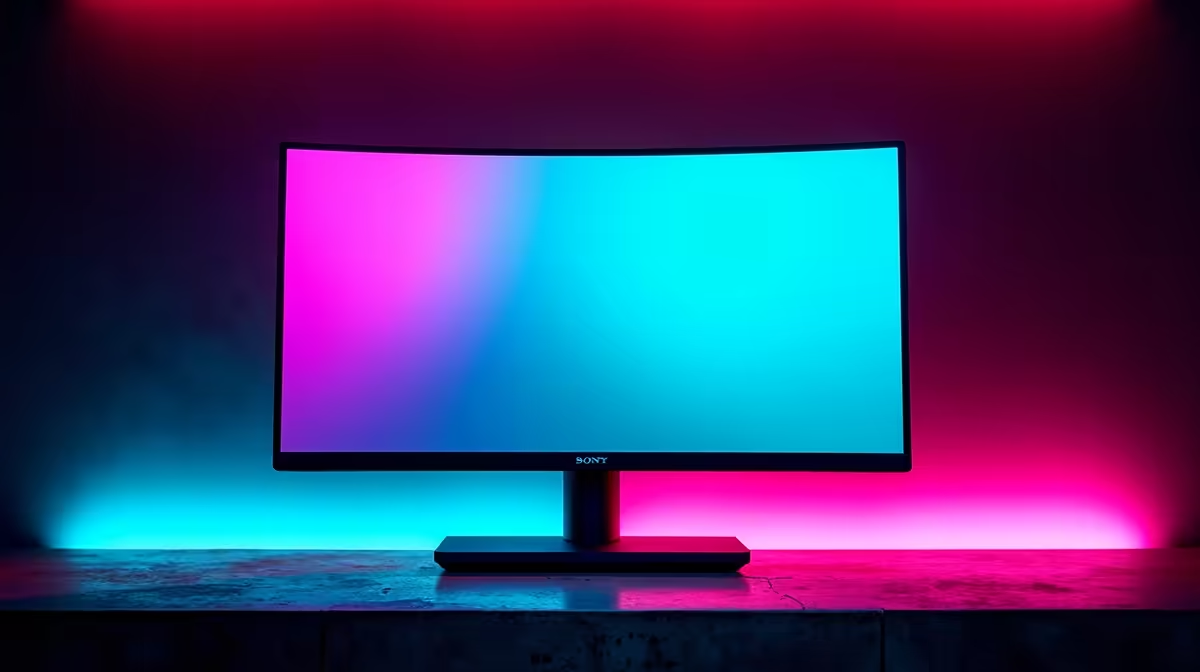
If you cannot get 720p at 240 Hz on your display, the issue is almost always cable type, port selection, or a monitor that does not actually support that resolution-refresh combination. Check your cable (DisplayPort 1.4 or HDMI 2.0 minimum), confirm your GPU's output port, and verify the monitor's spec sheet for supported modes.
720p at 240 Hz sounds like a modest resolution but the refresh rate requirement is what causes problems. The bottleneck is usually not the GPU but the display connection. Not all cables and ports carry enough bandwidth for 240 Hz even at lower resolutions like 720p.
HDMI 1.4, which is still found on older monitors and some budget cables, tops out at 1080p 120 Hz. It cannot carry 240 Hz at any resolution reliably. HDMI 2.0 handles 1080p 240 Hz. DisplayPort 1.4 handles 1440p 240 Hz and higher. If you are using an older HDMI cable or plugging into the wrong port on a monitor with multiple inputs, the display will default to a lower refresh rate rather than throwing an error.
First, identify your cable and ports. Look at both ends of your cable and check what version of HDMI or DisplayPort it supports. Many cables are not labelled but a cable listed as high-speed HDMI supports 2.0, while standard HDMI supports only 1.4.
Second, check the GPU port you are using. If your GPU has both HDMI and DisplayPort outputs, try DisplayPort if you have been using HDMI. DisplayPort almost always has better bandwidth headroom for high refresh rate modes.
Third, check the monitor's manual or spec sheet. Not every 240 Hz monitor supports 240 Hz at all resolutions. Some budget 240 Hz displays are rated for 1080p 240 Hz only and will cap at lower refresh rates if you set 720p. The display may simply not list 720p 240 Hz as a supported mode.
Fourth, add a custom resolution. In Nvidia Control Panel or AMD Radeon Software you can create a custom resolution and refresh rate. Go to Display, Change Resolution, then Customise. Add 1280x720 at 240 Hz. Your GPU and monitor will negotiate whether this is possible. If the monitor rejects it, it confirms the panel does not support that mode.
Many gaming monitors that advertise 240 Hz are validated specifically at their native resolution. A 1080p 240 Hz monitor may or may not accept a 720p 240 Hz signal depending on the scaler chip inside it. If troubleshooting cables and ports does not help, the display simply may not support the requested combination.
In competitive gaming contexts where 720p is sometimes chosen to maximise fps on lower-tier GPUs, the better approach is often running 1080p 240 Hz natively and relying on in-game render scale to reduce GPU load rather than trying to change the display resolution below native.
Yes, DisplayPort 1.4 has more than enough bandwidth for 720p 240 Hz. If you are on DisplayPort and still cannot get the mode, the limitation is the monitor's internal scaler not accepting that combination.
This is a monitor-side limitation. Many panels are only validated by the manufacturer for their native resolution at maximum refresh rate. Lower resolutions may be capped by the display's firmware at lower refresh rates even if the cable bandwidth would support more.
You can attempt to add a custom resolution via Nvidia Control Panel or AMD Radeon Software. Success depends entirely on whether your monitor's scaler accepts the timing. If the screen goes black and reverts after 15 seconds, the monitor rejected the mode.
Ready to Find Your Perfect Match? Upgrade to a monitor that fully supports your desired refresh rate. Browse PC Monitors
Can't Get 720p 240Hz: Display Setup available at Evetech.co.za with local warranty and fast delivery.
Can't Get 720p 240Hz: Display Setup - check Evetech for latest stock and SA pricing.
Depends on your use case. Can't Get 720p 240Hz: Display offers good value at current Rand pricing.
Headset Stock Levels in Bloemfontein: January. Current stock data & price tracking for SA buyers. See what is available and where prices are heading.
Read more
iMac for Medical Practice: Patient Management. SA-focused analysis with local pricing data, real-world insights & actionable buying advice.
Read more
RTX 5060 Fortnite Ultra Settings at 1080p: FPS. Real-world benchmark data, FPS numbers & performance analysis. What SA gamers can actually expect.
Read more
Headset Stock Levels in Cape Town: August Report. Current stock data & price tracking for SA buyers. See what is available and where prices are heading.
Read more
Eskom Load Shedding During Video Call: Solutions. SA-focused analysis with local pricing data, real-world insights & actionable buying advice.
Read more
LoL Performance on Extreme Gaming PC. Real-world benchmark data, FPS numbers & performance analysis. What SA gamers can actually expect.
Read more
Is a Ultra Short Throw Projector Good for Gaming?. Diagnosis steps, proven fixes & when to seek professional help. SA-specific support info included.

Is a Short Throw Projector Good for Gaming? Input. Diagnosis steps, proven fixes & when to seek professional help. SA-specific support info included.

Top Mouse Settings for Competitive FPS: Sensitivity picks evaluated on performance, value & SA availability with current Rand pricing from Evetech.

Top Speakers for MacBook Desk Setup picks evaluated on performance, value & SA availability with current Rand pricing from Evetech.

Is a Ergonomic Chair Better Than a Standard Office Chair for Gaming Detailed answer with SA data, expert analysis & practical recommendations for local buyers.

Use Spotlight Search Like a Pro on macOS. Step-by-step instructions with SA-specific tips, common pitfalls to avoid & expert recommendations.

wireless keyboard Fan Noise Too Loud: Quiet. Everything you need to know with SA pricing, step-by-step instructions & expert recommendations.

Connection Timeout: Troubleshooting Guide #2. Diagnosis steps, proven fixes & when to seek professional help. SA-specific support info included.
Headset Stock Levels in Bloemfontein: January. Current stock data & price tracking for SA buyers. See what is available and where prices are heading.
iMac for Medical Practice: Patient Management. SA-focused analysis with local pricing data, real-world insights & actionable buying advice.
RTX 5060 Fortnite Ultra Settings at 1080p: FPS. Real-world benchmark data, FPS numbers & performance analysis. What SA gamers can actually expect.
Headset Stock Levels in Cape Town: August Report. Current stock data & price tracking for SA buyers. See what is available and where prices are heading.