


Headset Stock Levels in Bloemfontein: January 2026 Report
Headset Stock Levels in Bloemfontein: January. Current stock data & price tracking for SA buyers. See what is available and where prices are heading.
Read moreCan't Run CS2 at 720p Ultra: Optimization. Game-specific hardware & settings optimised for SA conditions. Competitive edge with local pricing.
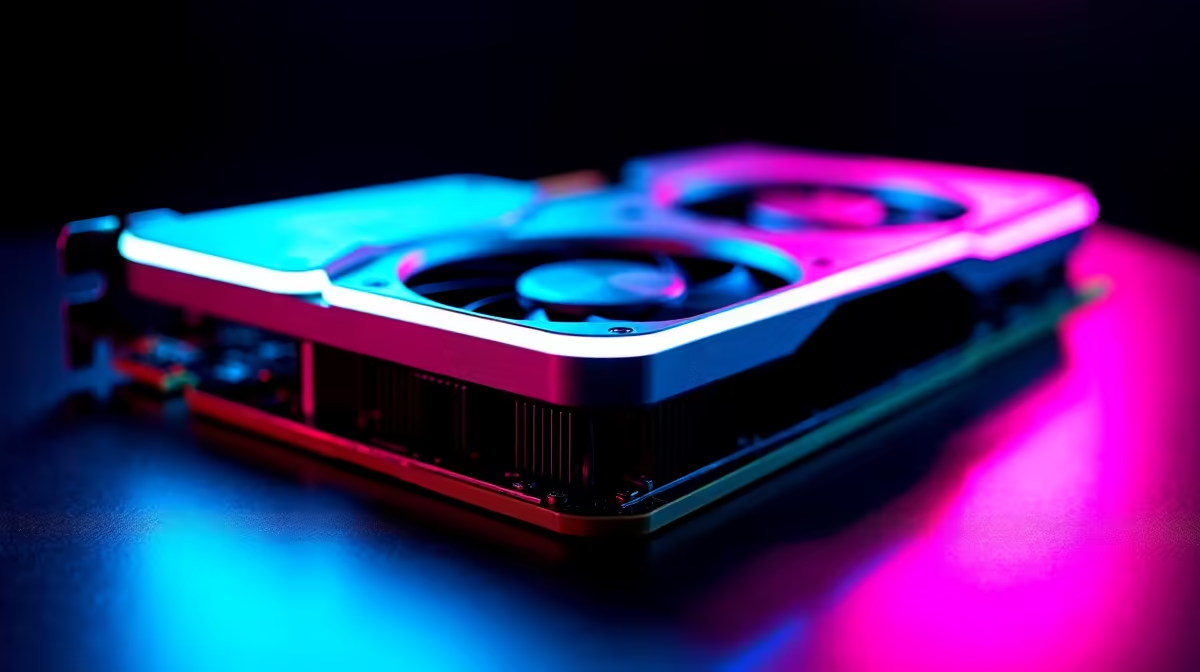
If CS2 cannot run smoothly at 720p Ultra, the problem is usually not resolution. Ultra settings can still overload an older CPU, weak GPU, limited RAM, slow storage, or messy driver setup. For competitive play, drop unnecessary visual settings and aim for stable frame times instead of maximum image quality.
Start with drivers, launch options, background apps, and in-game settings before buying new hardware.
720p sounds easy, but Ultra settings can still be heavy. Counter-Strike 2 uses a newer engine than CS:GO, with more demanding lighting, shadows, particles, and map detail. If your PC is older, the game can feel rough even at a low resolution.
The key point is that low resolution reduces pixel load, but it does not remove every bottleneck. CPU performance, memory, shader compilation, background processes, and storage speed still matter.
If the game stutters, freezes, or feels delayed, the fix is not always a stronger GPU. Sometimes the CPU is struggling. Sometimes RAM is full. Sometimes drivers or overlays are causing inconsistent frame pacing.
Before changing hardware, clean up the basics:
Overlays are a common problem. Discord, Steam, Xbox Game Bar, GPU recording tools, and monitoring apps can all add overhead. Disable them while testing so you can isolate the real issue.
Ultra settings are not the best target for CS2. Competitive players usually prefer clarity, low input latency, and stable FPS over visual extras.
Try this baseline:
If your FPS improves immediately, Ultra was the problem. If FPS is still poor, move to system checks.
Do not tune CS2 by average FPS only. Watch for stutter, input delay, and sudden drops during smokes, fights, and busy bombsite retakes. Stable frame times matter more than one high number in an empty area.
CS2 can expose weak CPUs because high-refresh competitive play depends on fast frame delivery. If your GPU usage is low but FPS is still bad, the CPU may be the bottleneck.
RAM can also hurt performance. If you have 8GB system memory and several apps open, Windows may start paging data to storage. That causes hitching. For modern gaming, 16GB is a better practical floor, and 32GB is comfortable for users who multitask.
Storage matters during loading and shader-related stutter. An SSD will not create more FPS, but it can reduce loading delays and make the system feel more responsive.
If you are using integrated graphics or a very old 2GB or 4GB GPU, 720p Ultra may still be too much. Lower textures, shadows, and shader detail first. If the game becomes smooth only at very low settings, a GPU upgrade may be the real fix.
For entry-level esports PCs, the target should be smooth competitive settings, not Ultra. A budget GPU that handles CS2 well at tuned settings can feel better than chasing Ultra on weak hardware.
You can compare all graphics cards, graphics card deals, and Counter Strike 2 gaming PCs if the PC is genuinely below spec for the experience you want.
Some players call every problem lag, but CS2 has different kinds of lag:
Do not replace hardware for a network issue. Check FPS and ping separately. If FPS is stable but shots feel delayed, inspect network and input settings. If FPS is dropping, fix the PC side first.
Upgrade only after testing. A new GPU helps if the graphics card is maxed out. A CPU upgrade helps if GPU usage stays low and frame rates still drop. More RAM helps if memory is full. An SSD helps if loading and system responsiveness are poor.
For a simple route, compare budget gaming PCs and best gaming PC deals. A balanced prebuilt can be easier than replacing one part in a very old system.
Why does CS2 run badly at 720p?
Because resolution is only one part of performance. CPU speed, RAM, storage, drivers, and game settings can still limit smoothness.
Should I use Ultra settings in CS2?
Not for competitive play. Use tuned settings that prioritise visibility, low latency, and stable frame times.
Is 8GB RAM enough for CS2?
It can run, but 16GB is a better target for smoother gaming, especially with Discord, Steam, and a browser open.
If you cannot run CS2 at 720p Ultra, stop chasing Ultra first. Tune the game for competitive smoothness, clean up drivers and overlays, then check CPU, RAM, storage, and GPU usage. Upgrade only when testing shows a real hardware bottleneck.
Need a Better CS2 Setup? Compare Counter Strike 2 gaming PCs, graphics cards, and gaming PC deals at Evetech for a smoother competitive setup.
Can't Run CS2 at 720p Ultra: Optimizatio available at Evetech.co.za with local warranty and fast delivery.
Can't Run CS2 at 720p Ultra: Optimizatio - check Evetech for latest stock and SA pricing.
Depends on your use case. Can't Run CS2 at 720p Ultra: O offers good value at current Rand pricing.
Headset Stock Levels in Bloemfontein: January. Current stock data & price tracking for SA buyers. See what is available and where prices are heading.
Read more
iMac for Medical Practice: Patient Management. SA-focused analysis with local pricing data, real-world insights & actionable buying advice.
Read more
RTX 5060 Fortnite Ultra Settings at 1080p: FPS. Real-world benchmark data, FPS numbers & performance analysis. What SA gamers can actually expect.
Read more
Headset Stock Levels in Cape Town: August Report. Current stock data & price tracking for SA buyers. See what is available and where prices are heading.
Read more
Eskom Load Shedding During Video Call: Solutions. SA-focused analysis with local pricing data, real-world insights & actionable buying advice.
Read more
LoL Performance on Extreme Gaming PC. Real-world benchmark data, FPS numbers & performance analysis. What SA gamers can actually expect.
Read more
Is a Ultra Short Throw Projector Good for Gaming?. Diagnosis steps, proven fixes & when to seek professional help. SA-specific support info included.

Is a Short Throw Projector Good for Gaming? Input. Diagnosis steps, proven fixes & when to seek professional help. SA-specific support info included.

Top Mouse Settings for Competitive FPS: Sensitivity picks evaluated on performance, value & SA availability with current Rand pricing from Evetech.

Top Speakers for MacBook Desk Setup picks evaluated on performance, value & SA availability with current Rand pricing from Evetech.

Is a Ergonomic Chair Better Than a Standard Office Chair for Gaming Detailed answer with SA data, expert analysis & practical recommendations for local buyers.

Use Spotlight Search Like a Pro on macOS. Step-by-step instructions with SA-specific tips, common pitfalls to avoid & expert recommendations.

wireless keyboard Fan Noise Too Loud: Quiet. Everything you need to know with SA pricing, step-by-step instructions & expert recommendations.

Connection Timeout: Troubleshooting Guide #2. Diagnosis steps, proven fixes & when to seek professional help. SA-specific support info included.
Headset Stock Levels in Bloemfontein: January. Current stock data & price tracking for SA buyers. See what is available and where prices are heading.
iMac for Medical Practice: Patient Management. SA-focused analysis with local pricing data, real-world insights & actionable buying advice.
RTX 5060 Fortnite Ultra Settings at 1080p: FPS. Real-world benchmark data, FPS numbers & performance analysis. What SA gamers can actually expect.
Headset Stock Levels in Cape Town: August Report. Current stock data & price tracking for SA buyers. See what is available and where prices are heading.