


Headset Stock Levels in Bloemfontein: January 2026 Report
Headset Stock Levels in Bloemfontein: January. Current stock data & price tracking for SA buyers. See what is available and where prices are heading.
Read moreCooler Technology: Before 2020 Evolution in Gaming. Technology trajectory, what it means for SA buyers & how to future-proof your next purchase.
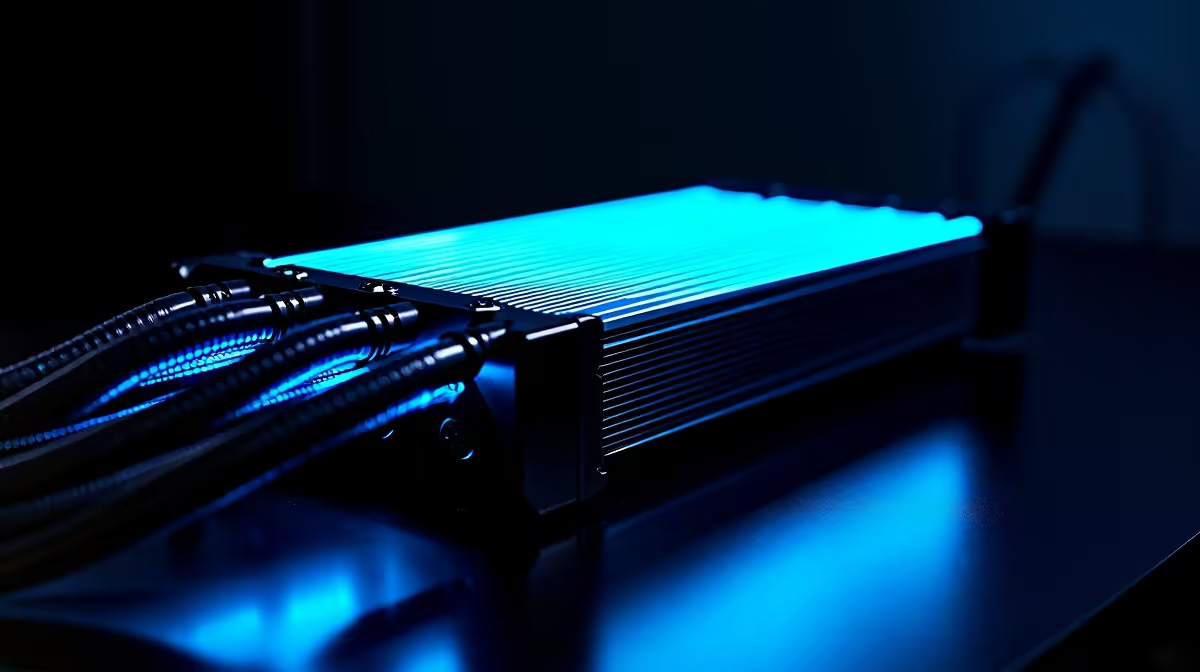
Before 2020, CPU cooler technology evolved dramatically from basic stock heatsinks with noisy fans to refined all-copper tower coolers and the early generation of closed-loop liquid coolers. The key milestones were the shift from aluminium fins to copper heat pipes in the early 2000s, the rise of direct-contact heatpipe coolers around 2010, and the mainstream arrival of 120mm AIO liquid coolers as the decade closed.
Before 2005, the dominant CPU cooling solution was a simple aluminium heatsink with a single fan. These coolers were inexpensive and functional for the modest TDPs (Thermal Design Power) of CPUs at the time. The Pentium 3 and early Athlon XP era saw stock coolers that were adequate but offered limited headroom for overclocking.
The primary limitation was materials. Aluminium conducts heat reasonably well but not as effectively as copper. Fans on early heatsinks were often small-diameter, high-RPM units that generated significant noise to compensate for limited airflow efficiency. A gaming system of this era was notably louder than modern equivalents.
Aftermarket cooling began in earnest here. Companies like Zalman and Thermalright began offering large all-copper coolers aimed at enthusiasts. These tower coolers used thick copper fins and low-speed, larger-diameter fans to achieve better cooling with significantly less noise. The Zalman CNPS7000 series, with its flower-shaped copper fin design, became iconic in LAN party culture of the early 2000s.
The introduction of copper heat pipe technology into mainstream aftermarket coolers transformed cooling performance without requiring fans to spin faster. Heat pipes use a sealed tube containing a working fluid that evaporates at the hot end (near the CPU) and condenses at the cool end (the heatsink fins), carrying heat away passively and efficiently.
Coolers like the Thermalright Ultra-120 and the Noctua NH-U12P established the tower heatsink with multiple heat pipes as the benchmark for high-end air cooling. These designs offered performance that matched or exceeded the early 120mm all-in-one liquid coolers of the same period.
Direct-contact heat pipes arrived around 2009 to 2010. Instead of routing heat pipes through a copper base plate, direct-contact designs placed the heat pipes in direct contact with the CPU IHS (Integrated Heat Spreader). This reduced the thermal resistance between the CPU and the cooling loop. Coolers like the Hyper 212 from Cooler Master popularised this approach at budget price points, and the Hyper 212 became one of the best-selling aftermarket coolers of all time.
Closed-loop liquid coolers (now commonly called AIOs) entered the consumer market in meaningful numbers around 2012 with the Corsair H60 and H100 series. The H100 introduced the 240mm dual-fan radiator format and established the AIO category as a mainstream premium cooling option.
By 2015, the 240mm AIO was well-established and 360mm triple-fan radiator AIOs began appearing for the enthusiast segment. RGB lighting integration became widespread by 2017, with ARGB variants following as RGB header standards matured on motherboards.
Pre-2020 AIO technology used pump designs borrowed from industrial cooling systems, scaled down for consumer use. Pump noise was a common criticism of early AIOs, with some units generating an audible hum. By 2018 to 2019, manufacturers had refined pump designs significantly, and modern AIOs from this period were noticeably quieter than first-generation units.
The pre-2020 era also saw the rise of dual-tower air coolers. The be quiet! Dark Rock Pro and Noctua NH-D15 proved that premium air cooling could match or exceed 240mm AIO performance while avoiding the failure point of a pump. This competition between high-end air and AIO liquid cooling remains a relevant debate in 2026.
When did 360mm AIOs become mainstream in gaming PCs? 360mm AIOs were available before 2020 but were considered high-end enthusiast products. They became more mainstream from 2020 onward as case support improved and prices dropped. Pre-2020, 240mm AIOs dominated the liquid cooling mainstream.
Were pre-2020 AIO coolers less reliable than modern ones? First-generation AIOs (2012 to 2015) had higher failure rates, primarily from pump wear and tubing that dried or cracked over time. Coolers from 2017 onward improved significantly in pump longevity and tubing quality. A well-maintained AIO from 2018 to 2019 can still be in service in 2026.
Was air cooling or liquid cooling better before 2020? At the enthusiast level, it depended on the tier. A premium dual-tower air cooler like the NH-D15 matched or beat a 240mm AIO in many benchmarks. For systems where noise and space were primary concerns, 240mm and 360mm AIOs had the advantage. For most mainstream gaming builds, a good tower cooler with heat pipes was the practical choice.
Cooler Technology: Before 2020 Evolution available at Evetech.co.za with local warranty and fast delivery.
Cooler Technology: Before 2020 Evolution - check Evetech for latest stock and SA pricing.
Depends on your use case. Cooler Technology: Before 2020 offers good value at current Rand pricing.
Headset Stock Levels in Bloemfontein: January. Current stock data & price tracking for SA buyers. See what is available and where prices are heading.
Read more
iMac for Medical Practice: Patient Management. SA-focused analysis with local pricing data, real-world insights & actionable buying advice.
Read more
RTX 5060 Fortnite Ultra Settings at 1080p: FPS. Real-world benchmark data, FPS numbers & performance analysis. What SA gamers can actually expect.
Read more
Headset Stock Levels in Cape Town: August Report. Current stock data & price tracking for SA buyers. See what is available and where prices are heading.
Read more
Eskom Load Shedding During Video Call: Solutions. SA-focused analysis with local pricing data, real-world insights & actionable buying advice.
Read more
LoL Performance on Extreme Gaming PC. Real-world benchmark data, FPS numbers & performance analysis. What SA gamers can actually expect.
Read more
Is a Ultra Short Throw Projector Good for Gaming?. Diagnosis steps, proven fixes & when to seek professional help. SA-specific support info included.

Is a Short Throw Projector Good for Gaming? Input. Diagnosis steps, proven fixes & when to seek professional help. SA-specific support info included.

Top Mouse Settings for Competitive FPS: Sensitivity picks evaluated on performance, value & SA availability with current Rand pricing from Evetech.

Top Speakers for MacBook Desk Setup picks evaluated on performance, value & SA availability with current Rand pricing from Evetech.

Is a Ergonomic Chair Better Than a Standard Office Chair for Gaming Detailed answer with SA data, expert analysis & practical recommendations for local buyers.

Use Spotlight Search Like a Pro on macOS. Step-by-step instructions with SA-specific tips, common pitfalls to avoid & expert recommendations.

wireless keyboard Fan Noise Too Loud: Quiet. Everything you need to know with SA pricing, step-by-step instructions & expert recommendations.

Connection Timeout: Troubleshooting Guide #2. Diagnosis steps, proven fixes & when to seek professional help. SA-specific support info included.
Headset Stock Levels in Bloemfontein: January. Current stock data & price tracking for SA buyers. See what is available and where prices are heading.
iMac for Medical Practice: Patient Management. SA-focused analysis with local pricing data, real-world insights & actionable buying advice.
RTX 5060 Fortnite Ultra Settings at 1080p: FPS. Real-world benchmark data, FPS numbers & performance analysis. What SA gamers can actually expect.
Headset Stock Levels in Cape Town: August Report. Current stock data & price tracking for SA buyers. See what is available and where prices are heading.