Quick Answer
The Intel Core i7-14700K is an excellent choice for music production in 2026, delivering 20 cores (8 Performance plus 12 Efficient) that handle large plugin loads, real-time processing, and multi-track recording without breaking a sweat. In the South African market it offers strong value relative to its performance tier, though context matters.
Why Core Count Matters for Music Production
Music production software, including Digital Audio Workstations like Ableton Live, FL Studio, Reaper, and Logic, relies heavily on CPU performance for two distinct workloads: real-time audio processing and rendering or bouncing tracks offline. Real-time performance, where you are recording, playing back, and running plugins simultaneously, depends on single-core speed and low latency scheduling. Offline rendering benefits from multi-core performance, as the DAW distributes processing across available threads to complete the job faster.
The Core i7-14700K excels at both. Its P-cores (Performance cores) run at up to 5.6GHz boost frequency, providing outstanding single-core responsiveness for real-time plugin performance. The 12 additional E-cores (Efficiency cores) handle background threads and batch processing tasks, contributing meaningfully to offline render times in projects with many tracks. In practical terms, a 20-core i7-14700K will handle a 200-track project with dozens of heavy virtual instrument plugins like Kontakt libraries or Omnisphere patches without choking the audio engine.
SA Value Rating for the i7-14700K in Music Production Contexts
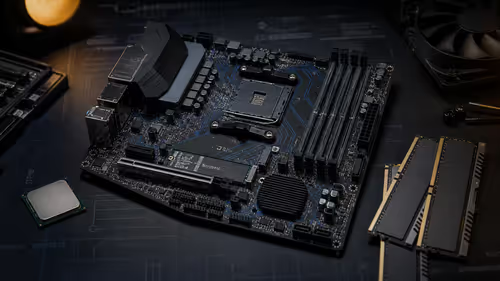
In South Africa in 2026, the Core i7-14700K typically retails in the R8,000 to R10,000 range, placing it firmly in the professional workstation segment. For context, South African music producers working professionally in studios or releasing commercial tracks should consider this a sound investment that will remain relevant for five or more years. The platform requires an LGA 1700 motherboard and DDR5 or DDR4 RAM depending on board choice, so factor in total system cost when budgeting.
For NSFAS-funded students studying music technology at institutions like AFDA, Damelin, or SAE Institute Johannesburg, the i7-14700K system is likely beyond the R5,200 NSFAS laptop allowance. However, for a self-build desktop PC funded over time, this CPU represents a long-term investment in a professional-grade production machine. Paired with 32GB of DDR5 RAM and a fast NVMe SSD, a music production workstation built around the i7-14700K will handle anything from bedroom producer work to full commercial studio sessions.
Thermal Considerations and Power Requirements
The i7-14700K is an unlocked overclocking chip with a base TDP of 125W and a Maximum Turbo Power of 253W, meaning it draws significant power under sustained load. For South African music producers who run their systems during loadshedding on a UPS or inverter, this power draw is an important consideration. A system with the i7-14700K, a mid-range audio interface, monitor, and storage could draw 300 to 400W under heavy DAW loads, requiring a substantial UPS capacity, ideally 1500VA or higher with a pure sine wave output, to maintain stable operation during power cuts.
Cooling the i7-14700K adequately requires at minimum a 240mm AIO liquid cooler or a high-end air cooler. In South African summer ambient temperatures, adequate cooling is essential for maintaining sustained boost clocks during long recording or mixing sessions.
FAQs
Is the Core i7-14700K overkill for home music production?
For casual bedroom producers working with small projects and light plugin loads, the i7-14700K is more CPU than necessary. For professional-level production with large virtual instrument libraries, heavy effects chains, and multi-track recording, it hits a sweet spot of performance and longevity.
What DAW buffer size should I use with the i7-14700K?
For real-time recording with the i7-14700K, 64 to 128 samples is achievable with a good audio interface. For mixing and playback sessions, 256 or 512 samples provides headroom for heavy plugin loads without dropouts.
Does the i7-14700K support DDR5 RAM for music production?
The i7-14700K supports both DDR4 and DDR5 depending on the motherboard. DDR5 offers higher bandwidth which can benefit DAW performance in large projects, but DDR4 remains functional and cost-effective for most music production workloads.
Ready to Find Your Perfect Match? Explore high-performance components to build your professional music production PC. Shop Components at Evetech