Quick Answer
The Ryzen 7 9700X does not bottleneck the RTX 5060 in most gaming scenarios, making it a well-matched pairing for 1080p and 1440p gaming in 2026.
Understanding CPU-GPU Bottlenecks in Gaming
A bottleneck happens when one component holds back another - your GPU sits idle waiting for the CPU to finish processing frames, or your CPU maxes out while the GPU has headroom to spare. For gaming, a CPU bottleneck typically shows up as low GPU utilisation percentages (below 90%) while the CPU runs at near 100% on all threads. Conversely, a GPU bottleneck means the processor is doing its job but the graphics card is the limiting factor.
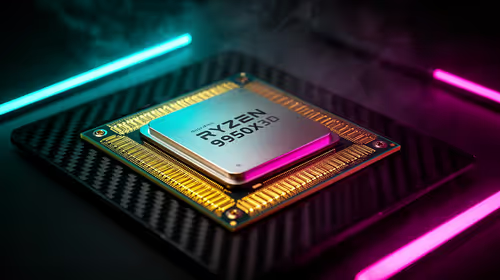
The Ryzen 7 9700X is based on AMD's Zen 5 architecture, featuring 8 cores and 16 threads with a boost clock of up to 5.4GHz. It brings strong single-threaded performance improvements over previous generations, which is exactly what game engines depend on for physics calculations, AI scripting, and world streaming. This positions the 9700X as one of the better mid-to-high-end gaming CPUs on the market today.
How the RTX 5060 Performs With the 9700X
The RTX 5060 slots in as a capable 1080p and 1440p graphics card built on NVIDIA's Blackwell architecture. It features hardware ray tracing acceleration, DLSS 4 with Multi Frame Generation support, and solid rasterisation performance for its price tier. At 1080p in demanding titles like Cyberpunk 2077 or Alan Wake 2, GPU utilisation on the RTX 5060 typically sits between 95-99% when paired with the 9700X - a clear sign the GPU is the limiting factor, which is the ideal scenario.
At 1440p, this pairing becomes even more GPU-bound, with the RTX 5060 working hard across nearly all modern titles. The 9700X feeds frames fast enough that the GPU never starves for draw calls. In lighter esports titles like Valorant or CS2, you may encounter a slight CPU limitation at very high framerates (300fps+), but this is not a practical bottleneck for most South African gamers who play at 144Hz or 165Hz refresh rates.
SA Gaming Context and Value
For South African PC builders, this combination represents a high-performance mid-range build. The Ryzen 7 9700X is typically priced in the R7,000 to R8,500 range locally, while the RTX 5060 sits around the R8,000 to R10,000 mark depending on board partner and stock availability. Combined with a quality B650 or X670 motherboard, 32GB DDR5, and a reliable UPS for loadshedding protection, you are looking at a complete gaming rig well above the entry-level bracket.
The pairing is particularly strong for South African content creators who game on the side - the 9700X handles streaming or screen recording without visibly impacting in-game frame rates, and the RTX 5060 handles NVENC encoding efficiently. If your workflow involves rendering or video editing alongside gaming, this CPU-GPU duo handles the workload without compromise.
Frequently Asked Questions
Q: What percentage bottleneck does the Ryzen 7 9700X cause with the RTX 5060?
A: In most gaming scenarios at 1080p and 1440p, the bottleneck is less than 5%, which is within the acceptable margin for optimal pairings. Online bottleneck calculators may show a theoretical percentage, but real-world game performance shows the 9700X feeding the RTX 5060 efficiently without meaningful frame loss.
Q: Should I upgrade to a Ryzen 9 9900X to eliminate any bottleneck?
A: Not for gaming purposes. The Ryzen 9 9900X adds cores that games rarely use, and its single-threaded performance gain over the 9700X is marginal. The extra spend is better directed toward a higher-tier GPU or more storage if gaming is your primary use case.
Q: Does DLSS 4 Multi Frame Generation help reduce CPU bottleneck concerns?
A: Yes. DLSS 4 Multi Frame Generation on the RTX 5060 can multiply output frame rates by generating additional frames, which further shifts workload toward the GPU. This effectively makes the CPU-GPU pairing even more balanced for high-refresh-rate gaming.
Also at Evetech: RTX 5060 Gaming PCs | All Graphics Cards
Ready to Find Your Perfect Match? Shop at Evetech