


Headset Stock Levels in Bloemfontein: January 2026 Report
Headset Stock Levels in Bloemfontein: January. Current stock data & price tracking for SA buyers. See what is available and where prices are heading.
Read moreDragon Age Performance on Premium Gaming PC. Real-world benchmark data, FPS numbers & performance analysis. What SA gamers can actually expect.
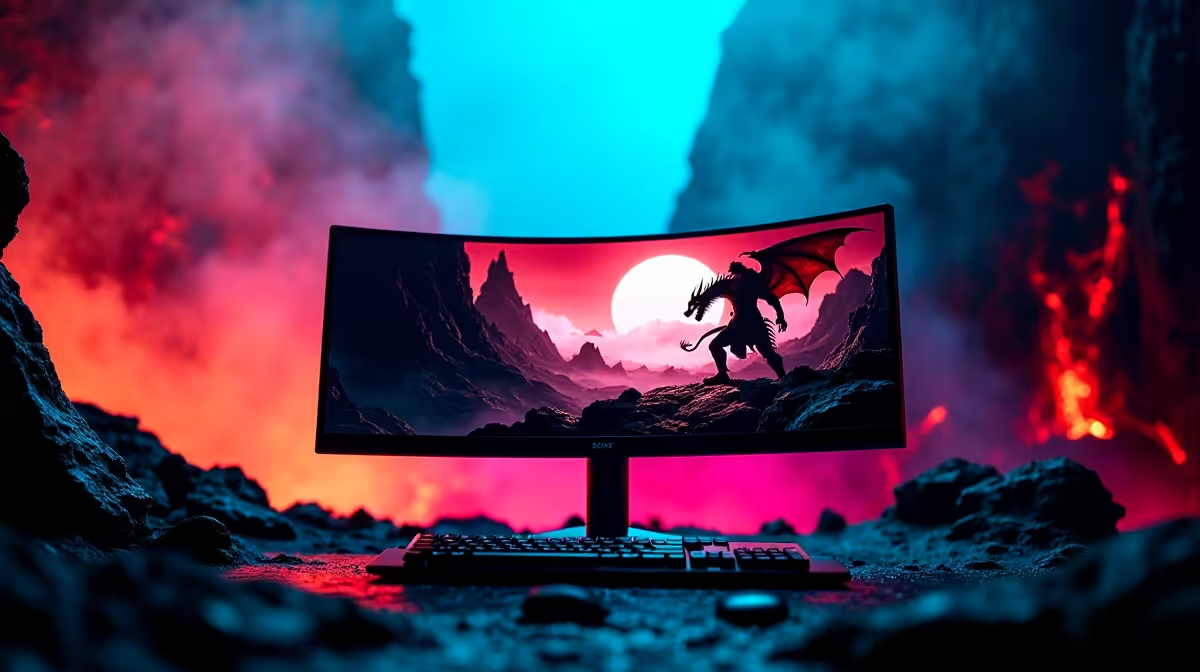
Dragon Age: The Veilguard runs smoothly on a premium South African gaming PC with an RTX 4070 or better, delivering 60fps-plus at 1440p Ultra settings with minimal configuration required out of the box.
BioWare's Dragon Age: The Veilguard launched as a well-optimised title by modern AAA standards. Its rendering pipeline leans on rasterisation with selective use of ray traced ambient occlusion and reflections, meaning GPU architecture generation matters less than raw shader performance. A premium SA gaming PC built around a mid-to-high-end GPU from either NVIDIA or AMD handles this game without difficulty at 1440p.
At Ultra settings with 1440p resolution, an RTX 4070 or RX 9070 class card produces consistent frame rates above 70fps in most scenes, including the demanding Crossroads area and the city of Treviso where environmental density is highest. The game responds well to DLSS Quality and FSR Quality upscaling, making it accessible on slightly older hardware too without visible quality loss.
On a premium SA gaming PC configured around an RTX 4080 Super or RX 9070 XT at 1440p Ultra, Dragon Age: The Veilguard delivers above 90fps averages with 1% lows rarely dipping below 70fps during intense combat sequences. Enabling ray traced reflections costs roughly 10 to 15% of that frame rate budget, which a premium build absorbs comfortably while staying above 60fps minimums even in the most demanding outdoor environments.
At 4K with DLSS Quality enabled, the RTX 4080 Super maintains smooth 60fps+ in Dragon Age across the vast majority of gameplay scenarios. Only the densest particle effects during high-intensity companion ability combos push the frame rate into the low 50s momentarily. CPU-side, the game scales well on modern 8-core processors and does not exhibit the CPU bottleneck behaviour seen in some other open-world titles - Ryzen 7 10800X3D and Core Ultra 5 245K builds both perform within a few percent of each other.
For SA gamers running Dragon Age on a premium build, a few setup choices make a meaningful difference. Enabling the in-game frame generation (available on NVIDIA via DLSS Frame Generation and on AMD via FSR 3 Frame Generation) adds perceived smoothness without significant latency cost at the ping levels typical of single-player play. Since Dragon Age has no competitive online component, the minor input latency increase from frame generation is irrelevant and purely adds to visual fluency.
Loadshedding is worth planning for if you are deep in a main quest or in the middle of a Fade boss encounter. Dragon Age autosaves at zone transitions and before major story decisions, but the save interval can be longer during extended dungeon sequences. SA players should manually save before committing to long play sessions during uncertain loadshedding schedules, particularly if playing on a rig without UPS backup.
A: Yes. At 1080p with High settings, cards in the RTX 4060 or RX 7700 class deliver frame rates well above 100fps, often hitting the 144fps cap of a standard gaming monitor with DLSS or FSR Performance mode enabled.
A: The game supports 21:9 ultrawide resolutions natively with correct aspect ratio UI scaling. SA gamers with ultrawide monitors can enjoy full panoramic gameplay without black bars or distortion.
A: Dragon Age is more GPU-bound than CPU-bound at most settings. A Ryzen 5 or Core i5 class processor is sufficient for smooth performance when paired with an appropriate GPU - premium CPU choices show minimal gains over mid-range options in this title.
Also at Evetech: Graphics Card Deals | Evetech Best Sellers
Ready to Find Your Perfect Match? Shop at Evetech
Dragon Age Performance on Premium Gaming available at Evetech.co.za with local warranty and fast delivery.
Dragon Age Performance on Premium Gaming - check Evetech for latest stock and SA pricing.
Depends on your use case. Dragon Age Performance on Prem offers good value at current Rand pricing.
Headset Stock Levels in Bloemfontein: January. Current stock data & price tracking for SA buyers. See what is available and where prices are heading.
Read more
iMac for Medical Practice: Patient Management. SA-focused analysis with local pricing data, real-world insights & actionable buying advice.
Read more
RTX 5060 Fortnite Ultra Settings at 1080p: FPS. Real-world benchmark data, FPS numbers & performance analysis. What SA gamers can actually expect.
Read more
Headset Stock Levels in Cape Town: August Report. Current stock data & price tracking for SA buyers. See what is available and where prices are heading.
Read more
Eskom Load Shedding During Video Call: Solutions. SA-focused analysis with local pricing data, real-world insights & actionable buying advice.
Read more
LoL Performance on Extreme Gaming PC. Real-world benchmark data, FPS numbers & performance analysis. What SA gamers can actually expect.
Read more
Is a Ultra Short Throw Projector Good for Gaming?. Diagnosis steps, proven fixes & when to seek professional help. SA-specific support info included.

Is a Short Throw Projector Good for Gaming? Input. Diagnosis steps, proven fixes & when to seek professional help. SA-specific support info included.

Top Mouse Settings for Competitive FPS: Sensitivity picks evaluated on performance, value & SA availability with current Rand pricing from Evetech.

Top Speakers for MacBook Desk Setup picks evaluated on performance, value & SA availability with current Rand pricing from Evetech.

Is a Ergonomic Chair Better Than a Standard Office Chair for Gaming Detailed answer with SA data, expert analysis & practical recommendations for local buyers.

Use Spotlight Search Like a Pro on macOS. Step-by-step instructions with SA-specific tips, common pitfalls to avoid & expert recommendations.

wireless keyboard Fan Noise Too Loud: Quiet. Everything you need to know with SA pricing, step-by-step instructions & expert recommendations.

Connection Timeout: Troubleshooting Guide #2. Diagnosis steps, proven fixes & when to seek professional help. SA-specific support info included.
Headset Stock Levels in Bloemfontein: January. Current stock data & price tracking for SA buyers. See what is available and where prices are heading.
iMac for Medical Practice: Patient Management. SA-focused analysis with local pricing data, real-world insights & actionable buying advice.
RTX 5060 Fortnite Ultra Settings at 1080p: FPS. Real-world benchmark data, FPS numbers & performance analysis. What SA gamers can actually expect.
Headset Stock Levels in Cape Town: August Report. Current stock data & price tracking for SA buyers. See what is available and where prices are heading.