


Headset Stock Levels in Bloemfontein: January 2026 Report
Headset Stock Levels in Bloemfontein: January. Current stock data & price tracking for SA buyers. See what is available and where prices are heading.
Read moreHistory of Cooling Technology: Evolution in Gaming. Technology trajectory, what it means for SA buyers & how to future-proof your next purchase.
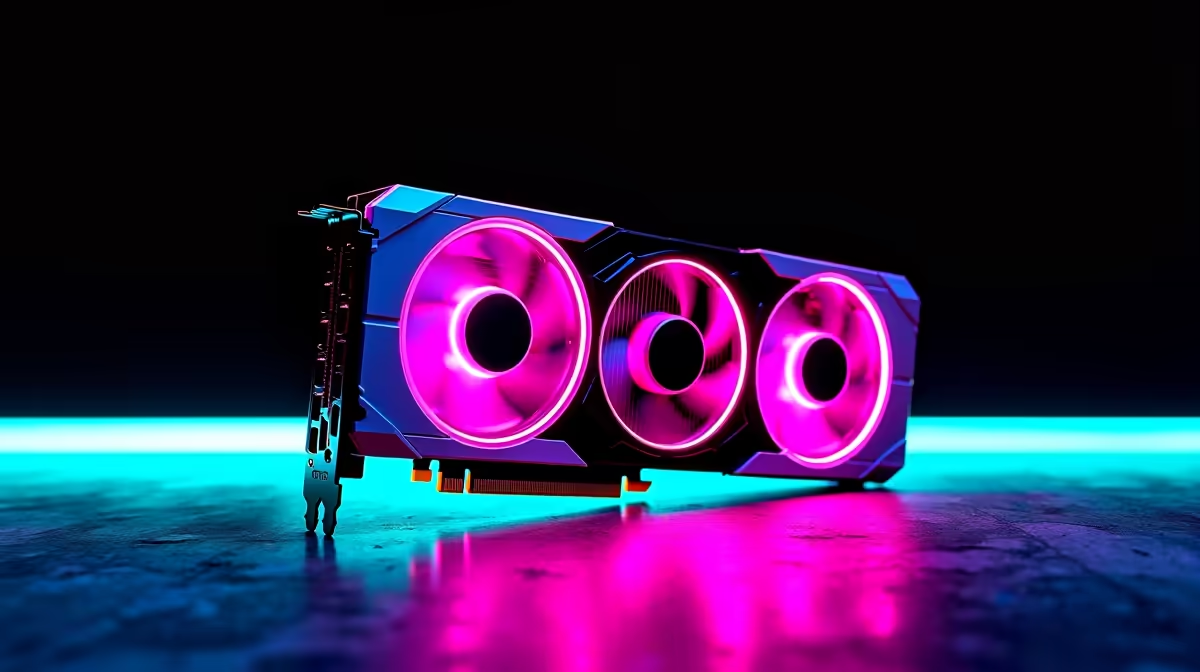
PC cooling has evolved from simple passive heatsinks in the early CPU era to today''s sophisticated air tower coolers, all-in-one liquid coolers, and custom water loops - with each generation driven by increasing processor heat output and the demand for quieter, more efficient thermal management.
Every time you hear your PC''s fans spin up under load, you''re experiencing the result of decades of engineering refinement. The history of PC cooling technology is a story of engineers racing to stay ahead of ever-hotter processors, and the solutions they developed have fundamentally shaped modern PC building culture.
In the earliest era of personal computing, processors ran at low enough power levels that passive cooling - a simple metal heatsink attached directly to the chip - was sufficient. As clock speeds climbed through the late 1980s and into the 1990s, passive heatsinks gave way to heatsink-fan combinations. These early cooler designs were basic: an aluminium block sitting atop the CPU with a small, loud fan blowing air across the fins. Noise and vibration were significant, and thermal performance by modern standards was modest. This era also established the basic heatsink-and-fan principle that still underlies air cooling today.
The introduction of heatpipe technology changed air cooling permanently. Heatpipes are sealed copper tubes containing a working fluid that vaporises at the hot end (the CPU contact point), carries heat to the fin stack, and condenses back to liquid - creating a passive, highly efficient heat transport mechanism. Combined with tall fin stacks and multiple fans, heatpipe tower coolers became capable of handling high-TDP processors with dramatically lower noise than earlier designs. Companies began competing on fin density, heatpipe count, and fan blade aerodynamics, and the modern tower cooler was born - a form still dominant today for its reliability, low cost, and absence of moving liquid under pressure.
Liquid cooling entered the mainstream PC market through two routes: sealed all-in-one (AIO) coolers and DIY custom water loops. AIO coolers contain a pump, tubing, water block, and radiator in a factory-sealed unit - no filling or maintenance required by the user. They offer excellent thermal performance relative to their size and are particularly useful in cases where tower coolers would conflict with RAM or motherboard components. Custom water loops, favoured by enthusiasts, allow multiple components (CPU, GPU, sometimes VRMs) to be cooled by a single liquid circuit with custom reservoirs, pumps, and radiators. In South Africa, AIOs have grown significantly in popularity as pricing has become more accessible, while custom loops remain a niche but passionate segment of the building community.
Q: Is liquid cooling always better than air cooling for PC builds? A: Not necessarily. High-end tower air coolers can match AIO liquid coolers in thermal performance for most CPUs. Liquid cooling''s advantages are often in noise levels at load, physical clearance in the case, and aesthetics rather than raw temperature differences.
Q: What was the first widespread use of liquid cooling in consumer PCs? A: Factory-sealed AIO coolers began appearing in the consumer market in the early 2000s, making liquid cooling accessible without requiring users to build custom loops. Adoption grew significantly through the 2010s as prices dropped and compatibility expanded.
Q: Are older air cooler designs still used today? A: Yes. The fundamental heatsink-and-fan design principle from the 1990s is still in use, greatly refined. Modern tower coolers use advanced heatpipe configurations, low-noise fans, and precision-machined contact plates, but the core physics are unchanged.
Ready to Find Your Perfect Match? Find your ideal PC cooling solution - air or liquid - at Evetech.
History of Cooling Technology: Evolution available at Evetech.co.za with local warranty and fast delivery.
History of Cooling Technology: Evolution - check Evetech for latest stock and SA pricing.
Depends on your use case. History of Cooling Technology: offers good value at current Rand pricing.
Headset Stock Levels in Bloemfontein: January. Current stock data & price tracking for SA buyers. See what is available and where prices are heading.
Read more
iMac for Medical Practice: Patient Management. SA-focused analysis with local pricing data, real-world insights & actionable buying advice.
Read more
RTX 5060 Fortnite Ultra Settings at 1080p: FPS. Real-world benchmark data, FPS numbers & performance analysis. What SA gamers can actually expect.
Read more
Headset Stock Levels in Cape Town: August Report. Current stock data & price tracking for SA buyers. See what is available and where prices are heading.
Read more
Eskom Load Shedding During Video Call: Solutions. SA-focused analysis with local pricing data, real-world insights & actionable buying advice.
Read more
LoL Performance on Extreme Gaming PC. Real-world benchmark data, FPS numbers & performance analysis. What SA gamers can actually expect.
Read more
Is a Ultra Short Throw Projector Good for Gaming?. Diagnosis steps, proven fixes & when to seek professional help. SA-specific support info included.

Is a Short Throw Projector Good for Gaming? Input. Diagnosis steps, proven fixes & when to seek professional help. SA-specific support info included.

Top Mouse Settings for Competitive FPS: Sensitivity picks evaluated on performance, value & SA availability with current Rand pricing from Evetech.

Top Speakers for MacBook Desk Setup picks evaluated on performance, value & SA availability with current Rand pricing from Evetech.

Is a Ergonomic Chair Better Than a Standard Office Chair for Gaming Detailed answer with SA data, expert analysis & practical recommendations for local buyers.

Use Spotlight Search Like a Pro on macOS. Step-by-step instructions with SA-specific tips, common pitfalls to avoid & expert recommendations.

wireless keyboard Fan Noise Too Loud: Quiet. Everything you need to know with SA pricing, step-by-step instructions & expert recommendations.

Connection Timeout: Troubleshooting Guide #2. Diagnosis steps, proven fixes & when to seek professional help. SA-specific support info included.
Headset Stock Levels in Bloemfontein: January. Current stock data & price tracking for SA buyers. See what is available and where prices are heading.
iMac for Medical Practice: Patient Management. SA-focused analysis with local pricing data, real-world insights & actionable buying advice.
RTX 5060 Fortnite Ultra Settings at 1080p: FPS. Real-world benchmark data, FPS numbers & performance analysis. What SA gamers can actually expect.
Headset Stock Levels in Cape Town: August Report. Current stock data & price tracking for SA buyers. See what is available and where prices are heading.