


Headset Stock Levels in Bloemfontein: January 2026 Report
Headset Stock Levels in Bloemfontein: January. Current stock data & price tracking for SA buyers. See what is available and where prices are heading.
Read moreNVIDIA Monitor: Product Range. Comprehensive coverage with SA insights, Rand pricing & practical recommendations for local buyers.
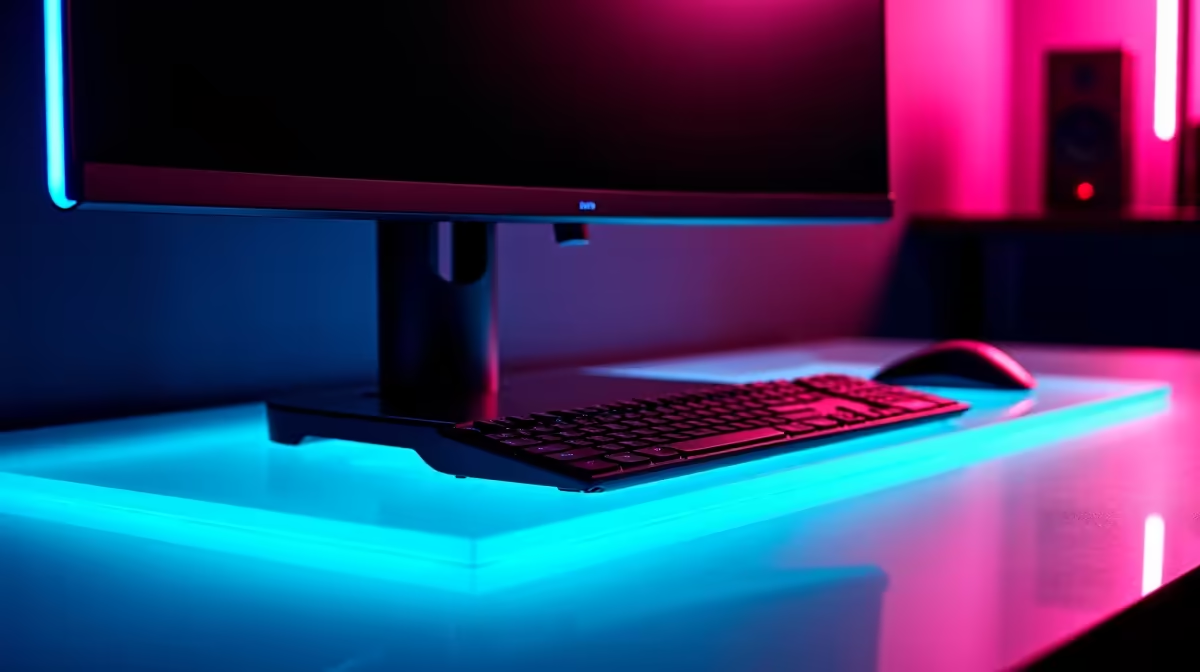
NVIDIA does not manufacture monitors. The NVIDIA monitor range in South Africa refers to displays from brands like ASUS, MSI, Acer, LG, and others that carry the G-Sync or G-Sync Compatible certification. These monitors are validated to work with NVIDIA GPUs for variable refresh rate gaming, reducing screen tearing and stutter.
NVIDIA's involvement in the monitor market is through its G-Sync technology ecosystem rather than direct hardware manufacturing. G-Sync monitors contain a proprietary NVIDIA module that manages variable refresh rate communication between the display and an NVIDIA GPU. G-Sync Compatible monitors achieve similar results using the VESA Adaptive-Sync standard validated by NVIDIA's testing programme. In South Africa in 2026, the G-Sync and G-Sync Compatible ecosystem covers screens from 24 to 27 inches at 1080p and 1440p, up to 32-inch 4K and ultrawide panels. The price range is broad: G-Sync Compatible entry-level panels start around R3,500 to R5,000, while true G-Sync Ultimate displays with full-array local dimming and HDR1000 certification push above R15,000. ## G-Sync vs G-Sync Compatible: The Key Difference for SA Buyers
True G-Sync monitors include a proprietary NVIDIA hardware module inside the panel. This module handles variable refresh rate processing independently and guarantees a specific minimum latency and visual quality standard. These displays are validated to NVIDIA's highest G-Sync standard and typically command a price premium of R2,000 to R4,000 over comparable non-G-Sync panels. G-Sync Compatible monitors use AMD's Adaptive-Sync standard but have been tested by NVIDIA to confirm they work correctly with NVIDIA GPUs in G-Sync mode. They deliver a very similar gaming experience at lower cost and are the practical recommendation for most SA buyers pairing a mid-range NVIDIA GPU with a new monitor. ## Popular NVIDIA-Compatible Monitor Picks Available in SA
For 1080p 144Hz to 165Hz gaming, the ASUS TUF Gaming VG249Q and MSI G241 are G-Sync Compatible panels available locally at R3,500 to R5,000. These suit entry and mid-range builds using RTX 4060 or RTX 3060 GPUs. At 1440p 165Hz, the LG UltraGear 27GP850-B and ASUS ROG Strix XG27AQM are well-regarded G-Sync Compatible options at R7,000 to R10,000 locally, pairing well with RTX 4070 builds. For 4K gaming, the ASUS ROG Swift PG32UQX is a true G-Sync Ultimate panel available in SA above R20,000, aimed at RTX 4080 and RTX 4090 builds. ## Frequently Asked Questions
Does NVIDIA make its own monitors? No. NVIDIA does not manufacture monitors. The company certifies G-Sync and G-Sync Compatible displays made by third-party brands including ASUS, MSI, Acer, and LG. Do I need a G-Sync monitor if I have an NVIDIA GPU? Not strictly. G-Sync and G-Sync Compatible monitors reduce screen tearing and improve frame pacing at variable frame rates. If you game at consistent high frame rates well above your monitor's refresh rate, G-Sync is less impactful. For most SA gamers playing at moderate frame rates on mid-range hardware, G-Sync Compatible monitors offer a meaningful gameplay quality improvement worth the modest price premium over non-certified panels. Will a G-Sync monitor work with an AMD GPU? G-Sync Compatible monitors use Adaptive-Sync and will function in variable refresh rate mode with AMD GPUs using FreeSync. True G-Sync monitors with the proprietary hardware module are designed for NVIDIA GPUs and may not activate VRR with AMD cards.
Ready to Find Your Perfect Match? Browse the full monitor range at Evetech and find the right G-Sync or FreeSync display for your gaming setup.
NVIDIA Monitor: Product Range in South A available at Evetech.co.za with local warranty and fast delivery.
NVIDIA Monitor: Product Range in South A - check Evetech for latest stock and SA pricing.
Depends on your use case. NVIDIA Monitor: Product Range offers good value at current Rand pricing.
Headset Stock Levels in Bloemfontein: January. Current stock data & price tracking for SA buyers. See what is available and where prices are heading.
Read more
iMac for Medical Practice: Patient Management. SA-focused analysis with local pricing data, real-world insights & actionable buying advice.
Read more
RTX 5060 Fortnite Ultra Settings at 1080p: FPS. Real-world benchmark data, FPS numbers & performance analysis. What SA gamers can actually expect.
Read more
Headset Stock Levels in Cape Town: August Report. Current stock data & price tracking for SA buyers. See what is available and where prices are heading.
Read more
Eskom Load Shedding During Video Call: Solutions. SA-focused analysis with local pricing data, real-world insights & actionable buying advice.
Read more
LoL Performance on Extreme Gaming PC. Real-world benchmark data, FPS numbers & performance analysis. What SA gamers can actually expect.
Read more
Is a Ultra Short Throw Projector Good for Gaming?. Diagnosis steps, proven fixes & when to seek professional help. SA-specific support info included.

Is a Short Throw Projector Good for Gaming? Input. Diagnosis steps, proven fixes & when to seek professional help. SA-specific support info included.

Top Mouse Settings for Competitive FPS: Sensitivity picks evaluated on performance, value & SA availability with current Rand pricing from Evetech.

Top Speakers for MacBook Desk Setup picks evaluated on performance, value & SA availability with current Rand pricing from Evetech.

Is a Ergonomic Chair Better Than a Standard Office Chair for Gaming Detailed answer with SA data, expert analysis & practical recommendations for local buyers.

Use Spotlight Search Like a Pro on macOS. Step-by-step instructions with SA-specific tips, common pitfalls to avoid & expert recommendations.

wireless keyboard Fan Noise Too Loud: Quiet. Everything you need to know with SA pricing, step-by-step instructions & expert recommendations.

Connection Timeout: Troubleshooting Guide #2. Diagnosis steps, proven fixes & when to seek professional help. SA-specific support info included.
Headset Stock Levels in Bloemfontein: January. Current stock data & price tracking for SA buyers. See what is available and where prices are heading.
iMac for Medical Practice: Patient Management. SA-focused analysis with local pricing data, real-world insights & actionable buying advice.
RTX 5060 Fortnite Ultra Settings at 1080p: FPS. Real-world benchmark data, FPS numbers & performance analysis. What SA gamers can actually expect.
Headset Stock Levels in Cape Town: August Report. Current stock data & price tracking for SA buyers. See what is available and where prices are heading.