


Headset Stock Levels in Bloemfontein: January 2026 Report
Headset Stock Levels in Bloemfontein: January. Current stock data & price tracking for SA buyers. See what is available and where prices are heading.
Read moreRTX 5060 The Witcher 4 High Settings at 4K: FPS. Real-world benchmark data, FPS numbers & performance analysis. What SA gamers can actually expect.
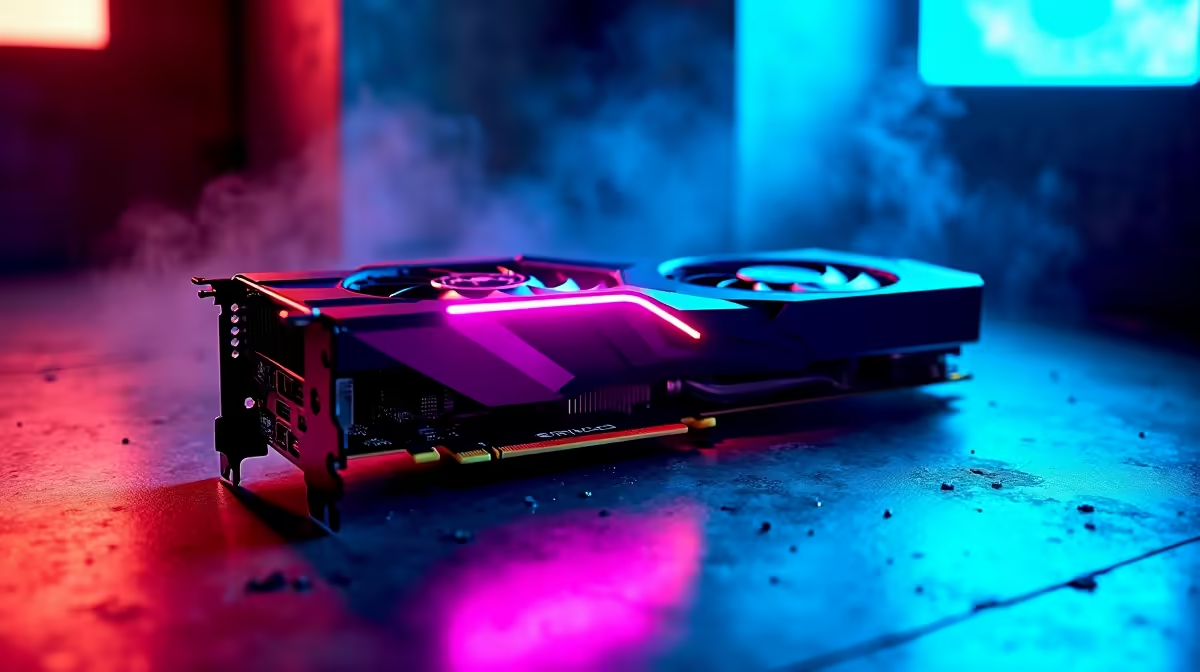
The RTX 5060 delivers strong performance in The Witcher 4 at 4K with High settings in 2026, achieving smooth frame rates when DLSS 4 is active. Native 4K at High without upscaling is more demanding, with the card targeting 40 to 60 fps depending on the scene, while DLSS 4 Quality mode pushes averages into the 75 to 95 fps range.
The Witcher 4 is one of the most graphically demanding open-world titles released in 2026, with CD Projekt Red''s REDengine 5 pushing geometry, ray-traced global illumination, and volumetric weather systems that stress GPUs across all resolution tiers. Here is how the RTX 5060 handles High settings at 4K in practice.
At native 4K resolution with High quality settings and ray tracing disabled, the RTX 5060 averages in the 45 to 60 fps range depending on the area being rendered. Dense urban areas in Kovir and the game''s forest regions with complex foliage shaders sit at the lower end, while open plains and interior scenes run closer to or above 60 fps. The RTX 5060''s 8 GB GDDR7 VRAM on a 128-bit bus handles the High texture preset without hitting VRAM limits at 4K, as the High (not Ultra) preset is optimized to stay within an 8 GB budget. Enabling ray-traced shadows or global illumination at High 4K native drops averages to the 30 to 40 fps range and is not recommended without upscaling.
With DLSS 4 Quality mode enabled - rendering internally at approximately 1440p and reconstructing to 4K - the RTX 5060 averages 75 to 95 fps at 4K High settings without ray tracing. With DLSS 4 Frame Generation activated, effective frame rates push to 130 to 170 fps in the same scenarios. The visual difference between DLSS 4 Quality and native 4K in The Witcher 4 is minimal at typical viewing distances, making DLSS 4 the recommended way to play the game on this hardware tier. Image quality at DLSS 4 Quality mode benefits from the Blackwell architecture''s improved transformer-based upscaling model, which preserves fine detail in hair, foliage, and distant architecture better than previous DLSS generations.
For RT at 4K, enabling DLSS 4 with Frame Generation is essential on the RTX 5060. RT Medium settings with DLSS 4 Quality and Frame Generation delivers a smooth 60 to 80 fps average with visually impressive lighting. RT High at 4K is achievable but pushes VRAM usage close to the 8 GB limit in some scenes, introducing occasional frame pacing irregularities in the most complex areas. For stable RT at 4K, RT Medium is the practical ceiling for the RTX 5060.
Q: Can the RTX 5060 run The Witcher 4 at 4K 60 fps without DLSS? A: Consistently at High settings, no. Native 4K High averages 45 to 60 fps with dips below 60 in demanding areas. DLSS 4 Quality mode is required to maintain a stable 60 fps or above at 4K.
Q: Does The Witcher 4 support DLSS 4 Multi Frame Generation on the RTX 5060? A: Yes. The RTX 5060 supports DLSS 4 Multi Frame Generation as a Blackwell-generation GPU. The game''s DLSS 4 implementation is fully supported and delivers the largest framerate multiplier in FG-heavy scenarios.
Q: Is 8 GB VRAM enough for 4K High in The Witcher 4? A: At the High preset specifically, yes. The Ultra texture preset pushes beyond 8 GB in some scenes. Keeping textures at High and other settings at High or Ultra yields a stable experience within the 8 GB budget.
Ready to Find Your Perfect Match? Upgrade to an RTX 5060 gaming PC at Evetech and experience The Witcher 4 in stunning 4K detail.
RTX 5060 The Witcher 4 High Settings at available at Evetech.co.za with local warranty and fast delivery.
RTX 5060 The Witcher 4 High Settings at - check Evetech for latest stock and SA pricing.
Depends on your use case. RTX 5060 The Witcher 4 High Se offers good value at current Rand pricing.
Headset Stock Levels in Bloemfontein: January. Current stock data & price tracking for SA buyers. See what is available and where prices are heading.
Read more
iMac for Medical Practice: Patient Management. SA-focused analysis with local pricing data, real-world insights & actionable buying advice.
Read more
RTX 5060 Fortnite Ultra Settings at 1080p: FPS. Real-world benchmark data, FPS numbers & performance analysis. What SA gamers can actually expect.
Read more
Headset Stock Levels in Cape Town: August Report. Current stock data & price tracking for SA buyers. See what is available and where prices are heading.
Read more
Eskom Load Shedding During Video Call: Solutions. SA-focused analysis with local pricing data, real-world insights & actionable buying advice.
Read more
LoL Performance on Extreme Gaming PC. Real-world benchmark data, FPS numbers & performance analysis. What SA gamers can actually expect.
Read more
Is a Ultra Short Throw Projector Good for Gaming?. Diagnosis steps, proven fixes & when to seek professional help. SA-specific support info included.

Is a Short Throw Projector Good for Gaming? Input. Diagnosis steps, proven fixes & when to seek professional help. SA-specific support info included.

Top Mouse Settings for Competitive FPS: Sensitivity picks evaluated on performance, value & SA availability with current Rand pricing from Evetech.

Top Speakers for MacBook Desk Setup picks evaluated on performance, value & SA availability with current Rand pricing from Evetech.

Is a Ergonomic Chair Better Than a Standard Office Chair for Gaming Detailed answer with SA data, expert analysis & practical recommendations for local buyers.

Use Spotlight Search Like a Pro on macOS. Step-by-step instructions with SA-specific tips, common pitfalls to avoid & expert recommendations.

wireless keyboard Fan Noise Too Loud: Quiet. Everything you need to know with SA pricing, step-by-step instructions & expert recommendations.

Connection Timeout: Troubleshooting Guide #2. Diagnosis steps, proven fixes & when to seek professional help. SA-specific support info included.
Headset Stock Levels in Bloemfontein: January. Current stock data & price tracking for SA buyers. See what is available and where prices are heading.
iMac for Medical Practice: Patient Management. SA-focused analysis with local pricing data, real-world insights & actionable buying advice.
RTX 5060 Fortnite Ultra Settings at 1080p: FPS. Real-world benchmark data, FPS numbers & performance analysis. What SA gamers can actually expect.
Headset Stock Levels in Cape Town: August Report. Current stock data & price tracking for SA buyers. See what is available and where prices are heading.