


Headset Stock Levels in Bloemfontein: January 2026 Report
Headset Stock Levels in Bloemfontein: January. Current stock data & price tracking for SA buyers. See what is available and where prices are heading.
Read moreRTX 6080 Power Requirements: Predicted PSU. Wattage requirements, recommended PSU models & efficiency ratings for SA buyers at Evetech.
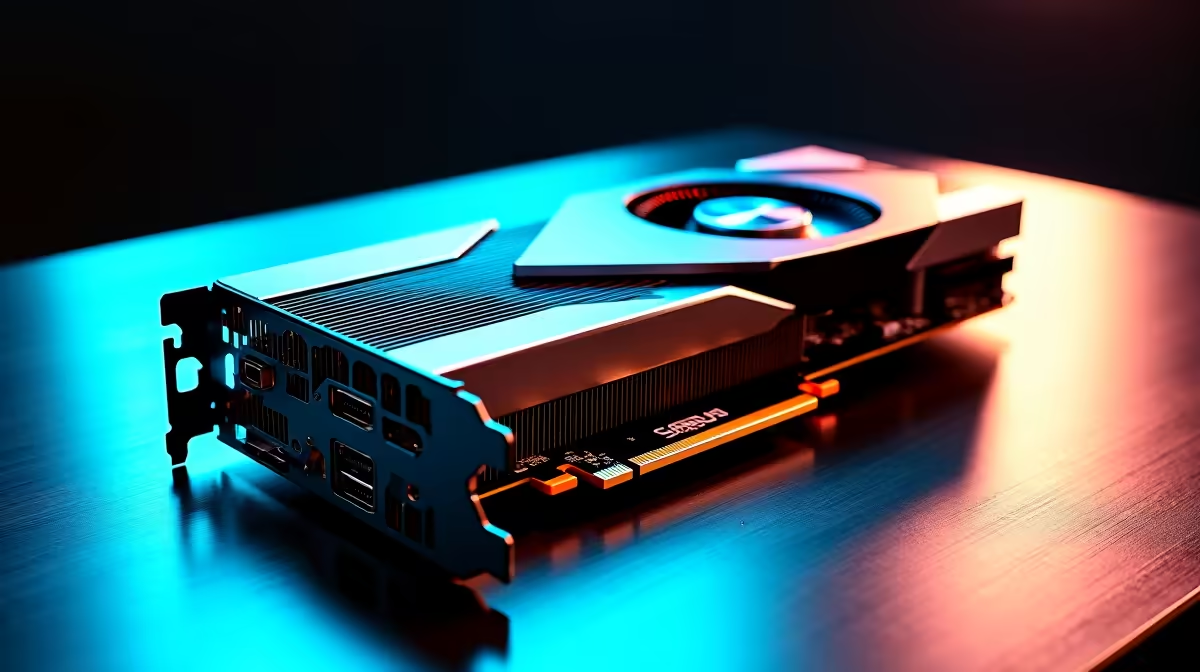
The RTX 6080 is anticipated to be one of NVIDIA's major Blackwell architecture cards in the next generation lineup, and SA builders planning ahead want to know what PSU and cooling infrastructure they'll need before the card launches. While official specs aren't confirmed, NVIDIA's design trajectory and architecture leaks give us a reliable framework for planning.
Based on Blackwell architecture trends and NVIDIA's power scaling from Ada Lovelace to Blackwell, the RTX 6080 is expected to carry a TDP between 320W and 380W, requiring a minimum 850W PSU in a typical gaming system and preferably a 1000W unit for headroom and efficiency. Active cooling with high-airflow case design will be essential.
NVIDIA's Blackwell generation has demonstrated higher absolute power demands than Ada Lovelace in exchange for significant performance-per-watt improvements at the top of the stack. The RTX 5090 draws up to 575W; the RTX 5080 draws approximately 360W. The RTX 6080, one rung below the 6090 in the next generation, is expected to fall in the 320W–380W TDP range under gaming load, potentially peaking above 400W in synthetic stress scenarios. For a full gaming system - CPU (125–150W), GPU (350W peak), motherboard, drives, RAM, and fans - total system draw could reach 600–650W under simultaneous load. A quality PSU rated at 850W gives roughly 30% headroom, the industry-recommended buffer for efficiency and longevity.
A card in the 350W class generates substantial heat that must exit the case efficiently. Three-fan GPU coolers on aftermarket RTX 6080 variants will manage the GPU itself, but they exhaust heat into the case rather than directly out - meaning poor case airflow causes GPU temperatures to climb beyond thermal targets, triggering throttling. Select a case with at least two 120mm intake fans at the front and one 120mm exhaust at the rear. A top-mounted exhaust fan is strongly recommended for cards above 300W TDP. CPU cooling also matters: if your CPU cooler is marginal, the additional case heat from the GPU pushes CPU temperatures up. Consider a 240mm or 360mm AIO for the CPU in any system housing an RTX 6080-class card. Browse CPU coolers rated for 250W+ TDP CPUs - they handle the thermal overhead with room to spare.
Current-generation high-end NVIDIA cards use the 16-pin 12VHPWR connector. The RTX 6080 will almost certainly continue this standard - plan your PSU purchase accordingly. Fully modular PSUs with native 12VHPWR support are the cleanest solution. If using a PSU with adapter cables, ensure the adapter is rated for the full amperage draw and that you're using the adapter that came with the GPU - third-party adapters have caused connector failures on high-draw cards. An 850W or 1000W 80+ Gold PSU from a reputable brand with native 12VHPWR output is the correct configuration for an RTX 6080 build.
Can an 850W PSU handle the RTX 6080? Based on predicted specifications, yes - an 850W unit from a quality brand gives sufficient headroom for most gaming systems. If your CPU has a 150W+ TDP or you're running multiple drives and high-RPM fans, a 1000W supply is the safer choice.
Will the RTX 6080 need two 8-pin adapters like the RTX 4090? It will likely use a single 16-pin 12VHPWR connector. The adapter that converts two 8-pin PCIe connectors to one 16-pin plug is common but requires both 8-pin leads to carry full current - ensure your PSU cables are rated for it.
Should I upgrade my case before buying the RTX 6080? If your current case has limited airflow - fewer than three fan mounting points - an upgrade is worthwhile before or alongside the GPU purchase. Thermal throttling on a R15,000+ GPU due to a poor case is an avoidable performance penalty.
Evetech stocks All Graphics Cards and All Power Supplies — browse current SA pricing and availability online.
Ready to Find Your Perfect Match? Prepare your build for next-gen GPU heat output with Evetech's range of high-performance CPU coolers and thermal management solutions.
RTX 6080 Power Requirements: Predicted P available at Evetech.co.za with local warranty and fast delivery.
RTX 6080 Power Requirements: Predicted P - check Evetech for latest stock and SA pricing.
Depends on your use case. RTX 6080 Power Requirements: P offers good value at current Rand pricing.
Headset Stock Levels in Bloemfontein: January. Current stock data & price tracking for SA buyers. See what is available and where prices are heading.
Read more
iMac for Medical Practice: Patient Management. SA-focused analysis with local pricing data, real-world insights & actionable buying advice.
Read more
RTX 5060 Fortnite Ultra Settings at 1080p: FPS. Real-world benchmark data, FPS numbers & performance analysis. What SA gamers can actually expect.
Read more
Headset Stock Levels in Cape Town: August Report. Current stock data & price tracking for SA buyers. See what is available and where prices are heading.
Read more
Eskom Load Shedding During Video Call: Solutions. SA-focused analysis with local pricing data, real-world insights & actionable buying advice.
Read more
LoL Performance on Extreme Gaming PC. Real-world benchmark data, FPS numbers & performance analysis. What SA gamers can actually expect.
Read more
Is a Ultra Short Throw Projector Good for Gaming?. Diagnosis steps, proven fixes & when to seek professional help. SA-specific support info included.

Is a Short Throw Projector Good for Gaming? Input. Diagnosis steps, proven fixes & when to seek professional help. SA-specific support info included.

Top Mouse Settings for Competitive FPS: Sensitivity picks evaluated on performance, value & SA availability with current Rand pricing from Evetech.

Top Speakers for MacBook Desk Setup picks evaluated on performance, value & SA availability with current Rand pricing from Evetech.

Is a Ergonomic Chair Better Than a Standard Office Chair for Gaming Detailed answer with SA data, expert analysis & practical recommendations for local buyers.

Use Spotlight Search Like a Pro on macOS. Step-by-step instructions with SA-specific tips, common pitfalls to avoid & expert recommendations.

wireless keyboard Fan Noise Too Loud: Quiet. Everything you need to know with SA pricing, step-by-step instructions & expert recommendations.

Connection Timeout: Troubleshooting Guide #2. Diagnosis steps, proven fixes & when to seek professional help. SA-specific support info included.
Headset Stock Levels in Bloemfontein: January. Current stock data & price tracking for SA buyers. See what is available and where prices are heading.
iMac for Medical Practice: Patient Management. SA-focused analysis with local pricing data, real-world insights & actionable buying advice.
RTX 5060 Fortnite Ultra Settings at 1080p: FPS. Real-world benchmark data, FPS numbers & performance analysis. What SA gamers can actually expect.
Headset Stock Levels in Cape Town: August Report. Current stock data & price tracking for SA buyers. See what is available and where prices are heading.