


Headset Stock Levels in Bloemfontein: January 2026 Report
Headset Stock Levels in Bloemfontein: January. Current stock data & price tracking for SA buyers. See what is available and where prices are heading.
Read moreRX 7800 XT Doom The Dark Ages Medium Settings. Real-world benchmark data, FPS numbers & performance analysis. What SA gamers can actually expect.
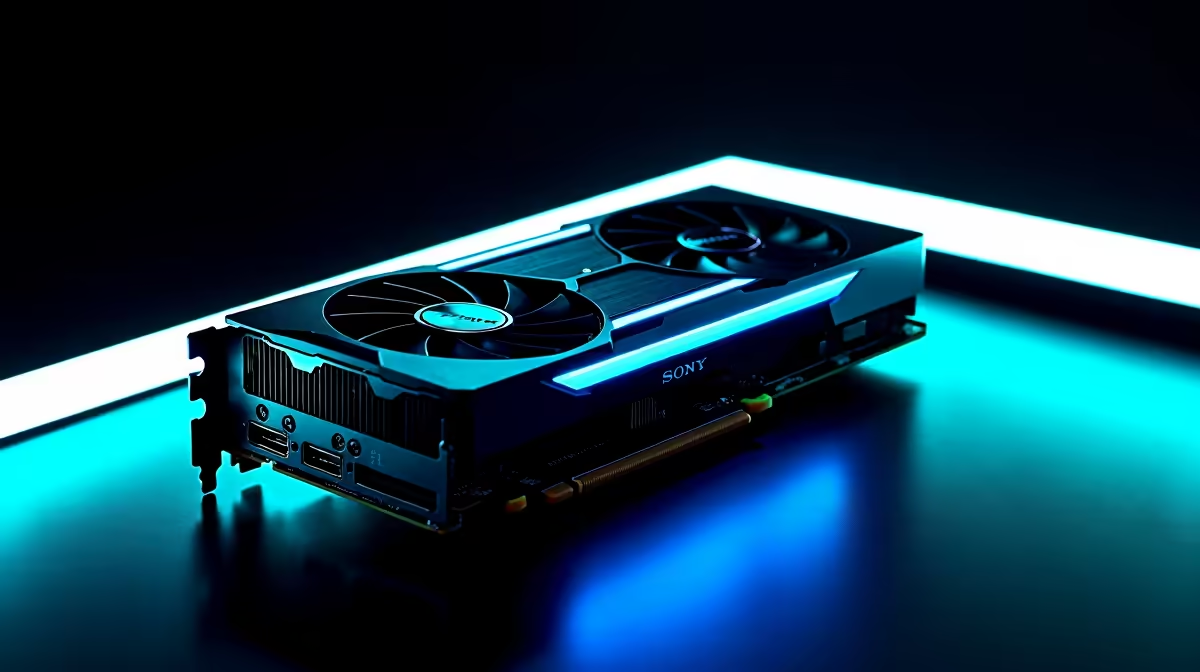
The RX 7800 XT at native 4K with medium settings in Doom: The Dark Ages delivers averages in the 55-75fps range depending on the scene, falling below the smooth 60fps threshold in the most demanding outdoor and combat-heavy sequences. Enabling FSR Quality mode at 4K pushes averages comfortably into the 75-100fps range, making it the recommended approach for 4K play on this GPU.
The RX 7800 XT is an RDNA 3 mid-to-high-range GPU featuring 60 Compute Units, 16GB of GDDR6 on a 256-bit bus, and peak memory bandwidth of 624 GB/s. It is designed as a 1440p performance card, and 4K gaming represents a stretch target rather than its native operating resolution. Understanding this going in sets realistic expectations. Doom: The Dark Ages, id Software's 2025 prequel to Doom Eternal, uses the id Tech 8 engine. Other local retailers may also carry similar options. Its PC performance is well-optimised relative to its visual quality, but it still makes heavy demands on mid-range GPUs at 4K. ## Medium Settings at 4K: What the Numbers Look Like
At native 4K with medium settings, the RX 7800 XT averages 58-68fps across a representative mix of indoor and outdoor areas. In tighter indoor corridors and arena-style combat zones with controlled enemy counts, averages stay closer to 65-75fps. In large outdoor areas with dense enemy spawns and extensive particle effects, frame rates dip to the 45-58fps range, creating noticeable inconsistency. Frame time consistency is where the medium setting trade-off matters most. At native 4K, 1% lows on the RX 7800 XT in The Dark Ages sit around 38-48fps during the heaviest combat, which creates a perceptible smoothness drop during the most demanding moments. This is the primary argument for using FSR rather than native 4K on this GPU. With FSR 3 at Quality mode (effectively rendering at 1440p and upscaling to 4K output), averages jump to 80-105fps and 1% lows improve dramatically to 60-75fps. Visual quality at FSR Quality mode at a 4K output resolution is genuinely difficult to distinguish from native at typical monitor viewing distances, making this the practical recommendation for RX 7800 XT owners targeting 4K. ## Comparing to Alternative Settings
Dropping to 1440p native with ultra settings on the RX 7800 XT is the alternative benchmark approach. At 1440p ultra, the card averages 90-115fps with 1% lows around 70-85fps, delivering a significantly smoother and more consistent experience than 4K medium native. For a 1440p 144Hz monitor, this configuration fully utilises the display. If a 4K monitor is already in your setup and you want to use it with the RX 7800 XT for Doom: The Dark Ages, FSR Quality mode at 4K is the correct configuration. If you are choosing between a 1440p and 4K display specifically for this GPU, 1440p gives better real-world smoothness for this title. Other local retailers may also carry similar options. Enabling Frame Generation at FSR Quality mode at 4K can push displayed frame rates above 120fps on the RX 7800 XT, though input latency increases with Frame Generation active. For single-player action gaming, the smoothness benefit typically outweighs the latency trade-off. Is the RX 7800 XT a good GPU for Doom: The Dark Ages overall? At 1440p, it is an excellent choice for this title. At 4K, it requires FSR to deliver a smooth experience. If 4K native performance at high frame rates is a priority, a step up to the RX 7900 GRE or RX 9070 XT provides more headroom. What CPU pairs best with the RX 7800 XT for Doom: The Dark Ages? Any modern CPU from Intel Core i5-13600K and above, or AMD Ryzen 5 7600X and above, will keep the CPU from bottlenecking the RX 7800 XT in this title. Doom: The Dark Ages is primarily GPU-bound in most scenarios, so CPU choice has minimal impact on frame rates compared to GPU selection.
Ready to Find Your Perfect Match? Shop AMD and NVIDIA graphics cards at Evetech to find the right GPU for your 4K gaming setup.
RX 7800 XT Doom The Dark Ages Medium Set available at Evetech.co.za with local warranty and fast delivery.
RX 7800 XT Doom The Dark Ages Medium Set - check Evetech for latest stock and SA pricing.
Depends on your use case. RX 7800 XT Doom The Dark Ages offers good value at current Rand pricing.
Headset Stock Levels in Bloemfontein: January. Current stock data & price tracking for SA buyers. See what is available and where prices are heading.
Read more
iMac for Medical Practice: Patient Management. SA-focused analysis with local pricing data, real-world insights & actionable buying advice.
Read more
RTX 5060 Fortnite Ultra Settings at 1080p: FPS. Real-world benchmark data, FPS numbers & performance analysis. What SA gamers can actually expect.
Read more
Headset Stock Levels in Cape Town: August Report. Current stock data & price tracking for SA buyers. See what is available and where prices are heading.
Read more
Eskom Load Shedding During Video Call: Solutions. SA-focused analysis with local pricing data, real-world insights & actionable buying advice.
Read more
LoL Performance on Extreme Gaming PC. Real-world benchmark data, FPS numbers & performance analysis. What SA gamers can actually expect.
Read more
Is a Ultra Short Throw Projector Good for Gaming?. Diagnosis steps, proven fixes & when to seek professional help. SA-specific support info included.

Is a Short Throw Projector Good for Gaming? Input. Diagnosis steps, proven fixes & when to seek professional help. SA-specific support info included.

Top Mouse Settings for Competitive FPS: Sensitivity picks evaluated on performance, value & SA availability with current Rand pricing from Evetech.

Top Speakers for MacBook Desk Setup picks evaluated on performance, value & SA availability with current Rand pricing from Evetech.

Is a Ergonomic Chair Better Than a Standard Office Chair for Gaming Detailed answer with SA data, expert analysis & practical recommendations for local buyers.

Use Spotlight Search Like a Pro on macOS. Step-by-step instructions with SA-specific tips, common pitfalls to avoid & expert recommendations.

wireless keyboard Fan Noise Too Loud: Quiet. Everything you need to know with SA pricing, step-by-step instructions & expert recommendations.

Connection Timeout: Troubleshooting Guide #2. Diagnosis steps, proven fixes & when to seek professional help. SA-specific support info included.
Headset Stock Levels in Bloemfontein: January. Current stock data & price tracking for SA buyers. See what is available and where prices are heading.
iMac for Medical Practice: Patient Management. SA-focused analysis with local pricing data, real-world insights & actionable buying advice.
RTX 5060 Fortnite Ultra Settings at 1080p: FPS. Real-world benchmark data, FPS numbers & performance analysis. What SA gamers can actually expect.
Headset Stock Levels in Cape Town: August Report. Current stock data & price tracking for SA buyers. See what is available and where prices are heading.