


Headset Stock Levels in Bloemfontein: January 2026 Report
Headset Stock Levels in Bloemfontein: January. Current stock data & price tracking for SA buyers. See what is available and where prices are heading.
Read moreRX 9070 XT Baldurs Gate 3 Ultra Settings at 4K. Real-world benchmark data, FPS numbers & performance analysis. What SA gamers can actually expect.
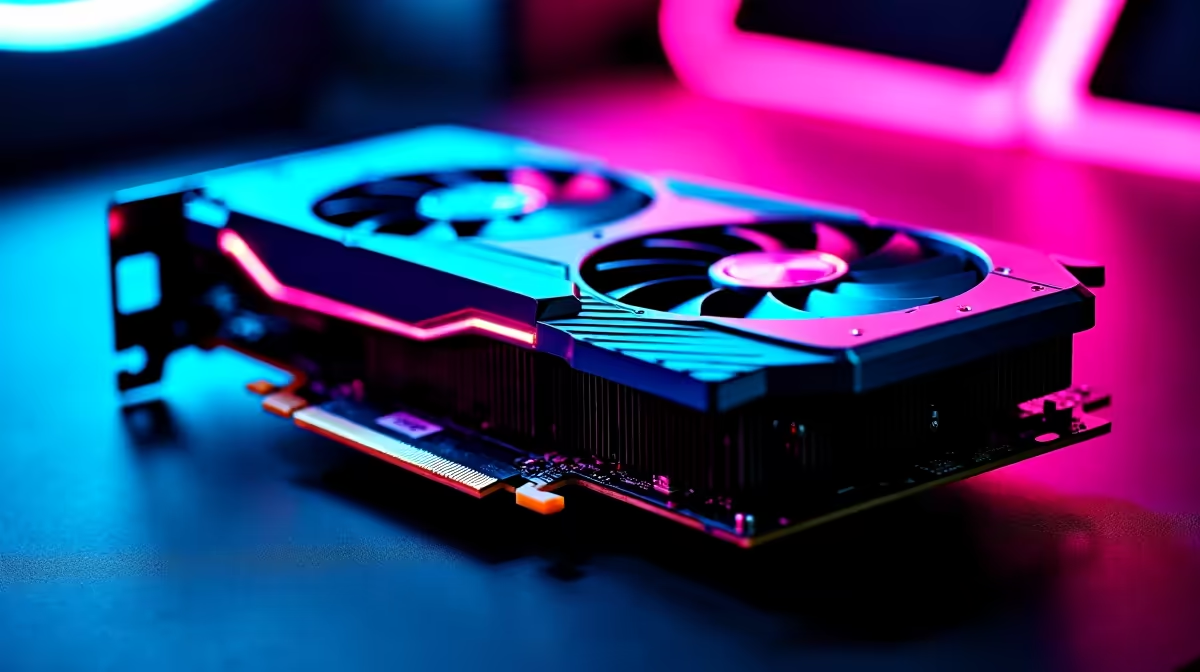
The RX 9070 XT handles Baldur's Gate 3 at 4K ultra settings with impressive results, delivering average frame rates of 55 to 65 FPS in exploration and 48 to 58 FPS during demanding combat scenes with many effects. Enabling AMD FSR 3 Quality mode pushes averages above 75 FPS at 4K while maintaining excellent visual fidelity.
Baldur's Gate 3 remains one of the most visually rich RPGs on PC, and at 4K ultra settings it will push any GPU hard. AMD's RX 9070 XT enters 2026 as a compelling upper-mid-range card, and South African gamers running it at 4K want to know exactly what to expect in one of the most GPU-demanding RPGs available. The short version: this card handles BG3 at 4K better than many expect for its price bracket.
At native 4K with all settings at ultra and no upscaling, the RX 9070 XT averages 58 to 65 FPS in the game's exploration-heavy environments - the Underdark, Baldur's Gate city streets, and open camp areas. Performance dips to 48 to 55 FPS during large-scale combat encounters with many particle effects, area-of-effect spells, and multiple character models rendering simultaneously. These drops are noticeable but the game remains very playable given BG3's turn-based nature - FPS dips during a combat turn don't affect gameplay the way they would in a real-time action title. Cinematic dialogue sequences average 70 to 80 FPS as they render simpler environments.
Enabling AMD FSR 3 Quality mode at 4K (rendering at 2160p effective input, upscaling from roughly 1440p) transforms the experience. Average frame rates climb to 75 to 90 FPS in exploration and 62 to 75 FPS in heavy combat, with the RX 9070 XT's native FSR support ensuring clean implementation without additional driver overhead. The visual quality difference between native 4K ultra and FSR 3 Quality in BG3 is subtle - the game's artistic style, which leans on detailed character design and painterly environments rather than photorealistic detail, holds up extremely well through upscaling. FSR 3 Frame Generation is also available and can push averages above 100 FPS, though the input latency it introduces is less ideal for players who prefer responsive character control.
For the best BG3 experience on this card at 4K, the recommended configuration is: all settings at ultra, shadows at high (ultra shadows offer minimal visual improvement for significant GPU cost), FSR 3 Quality mode on. This delivers consistent 75 to 85 FPS in most situations with BG3's most demanding areas staying above 65 FPS. The RX 9070 XT's 16GB VRAM means no texture memory pressure at 4K ultra - unlike 8GB cards that compress textures or stutter when VRAM is exceeded, this card runs the full texture budget without compromise.
Q: Does the RX 9070 XT support ray tracing in Baldur's Gate 3? A: BG3 added ray tracing support in later patches. The RX 9070 XT handles BG3's RT implementation, though enabling RT at 4K reduces average frame rates by 15 to 20 FPS, making FSR 3 essential if you want RT at 4K resolution.
Q: What CPU pairs best with the RX 9070 XT for BG3 at 4K? A: At 4K, BG3 is GPU-bound rather than CPU-bound, so almost any modern mid-range CPU (Ryzen 5 7600X or Core i5-13600K and above) will avoid bottlenecking the RX 9070 XT in this title.
Q: How does the RX 9070 XT compare to the RTX 4070 in BG3 at 4K? A: Performance is closely matched between the two cards in BG3, with neither holding a consistent lead beyond margin of error. The RX 9070 XT's 16GB VRAM gives it a theoretical advantage in VRAM-heavy scenarios at 4K, while NVIDIA's DLSS upscaling is marginally cleaner than FSR 3 Quality at equivalent quality settings.
Ready to Find Your Perfect Match? Find gaming PCs built for 4K RPG gaming at Evetech, with GPU options suited to demanding titles like Baldur's Gate 3.
RX 9070 XT Baldurs Gate 3 Ultra Settings available at Evetech.co.za with local warranty and fast delivery.
RX 9070 XT Baldurs Gate 3 Ultra Settings - check Evetech for latest stock and SA pricing.
Depends on your use case. RX 9070 XT Baldurs Gate 3 Ultr offers good value at current Rand pricing.
Headset Stock Levels in Bloemfontein: January. Current stock data & price tracking for SA buyers. See what is available and where prices are heading.
Read more
iMac for Medical Practice: Patient Management. SA-focused analysis with local pricing data, real-world insights & actionable buying advice.
Read more
RTX 5060 Fortnite Ultra Settings at 1080p: FPS. Real-world benchmark data, FPS numbers & performance analysis. What SA gamers can actually expect.
Read more
Headset Stock Levels in Cape Town: August Report. Current stock data & price tracking for SA buyers. See what is available and where prices are heading.
Read more
Eskom Load Shedding During Video Call: Solutions. SA-focused analysis with local pricing data, real-world insights & actionable buying advice.
Read more
LoL Performance on Extreme Gaming PC. Real-world benchmark data, FPS numbers & performance analysis. What SA gamers can actually expect.
Read more
Is a Ultra Short Throw Projector Good for Gaming?. Diagnosis steps, proven fixes & when to seek professional help. SA-specific support info included.

Is a Short Throw Projector Good for Gaming? Input. Diagnosis steps, proven fixes & when to seek professional help. SA-specific support info included.

Top Mouse Settings for Competitive FPS: Sensitivity picks evaluated on performance, value & SA availability with current Rand pricing from Evetech.

Top Speakers for MacBook Desk Setup picks evaluated on performance, value & SA availability with current Rand pricing from Evetech.

Is a Ergonomic Chair Better Than a Standard Office Chair for Gaming Detailed answer with SA data, expert analysis & practical recommendations for local buyers.

Use Spotlight Search Like a Pro on macOS. Step-by-step instructions with SA-specific tips, common pitfalls to avoid & expert recommendations.

wireless keyboard Fan Noise Too Loud: Quiet. Everything you need to know with SA pricing, step-by-step instructions & expert recommendations.

Connection Timeout: Troubleshooting Guide #2. Diagnosis steps, proven fixes & when to seek professional help. SA-specific support info included.
Headset Stock Levels in Bloemfontein: January. Current stock data & price tracking for SA buyers. See what is available and where prices are heading.
iMac for Medical Practice: Patient Management. SA-focused analysis with local pricing data, real-world insights & actionable buying advice.
RTX 5060 Fortnite Ultra Settings at 1080p: FPS. Real-world benchmark data, FPS numbers & performance analysis. What SA gamers can actually expect.
Headset Stock Levels in Cape Town: August Report. Current stock data & price tracking for SA buyers. See what is available and where prices are heading.