


Headset Stock Levels in Bloemfontein: January 2026 Report
Headset Stock Levels in Bloemfontein: January. Current stock data & price tracking for SA buyers. See what is available and where prices are heading.
Read moreRyzen 7 7800X3D for Photo Editing: Performance. Real-world benchmark data, FPS numbers & performance analysis. What SA gamers can actually expect.
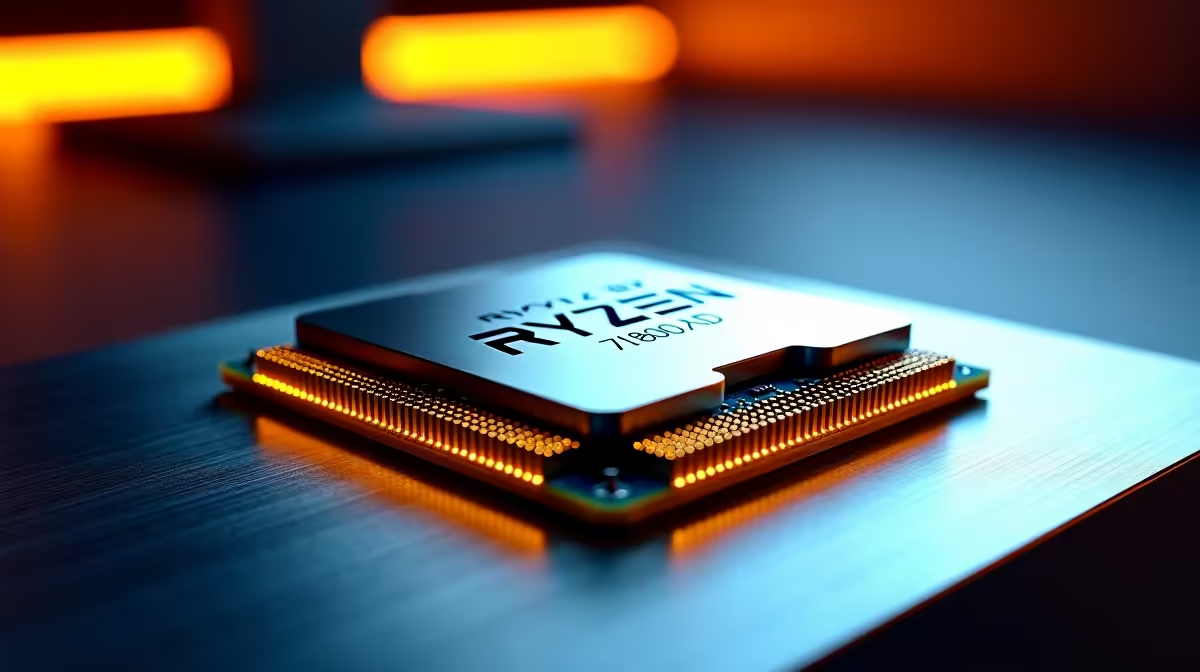
The Ryzen 7 7800X3D delivers strong photo editing performance, with fast single-threaded responsiveness in Lightroom and Capture One, though its advantage over non-3D Cache Ryzen CPUs in pure photo work is smaller than in gaming. For South African buyers, it offers excellent overall value as a dual-purpose gaming and creative workstation processor.
Photo editing applications like Adobe Lightroom Classic, Capture One, and DxO PhotoLab are predominantly single-threaded in their most common operations: applying edits, navigating catalogs, and generating previews. The Ryzen 7 7800X3D''s 3D V-Cache architecture, designed primarily to accelerate gaming through massive L3 cache capacity, offers a secondary benefit in photo work through improved data locality during catalog operations and AI-powered masking tasks.
In practical terms, Lightroom Classic catalog operations and subject masking via AI feel noticeably responsive on the 7800X3D. Generating smart previews for large RAW batches, a task that serialises heavily through the CPU, completes quickly. Capture One''s AI-powered culling and adjustment tools also benefit from the chip''s single-core speed. Export speeds, which do utilise multiple cores, are competitive though not class-leading compared to higher core count Ryzen 9 or Core Ultra 9 alternatives.
For photographers whose workflow centres on exporting large RAW batches, running multiple applications simultaneously, or using Photoshop with heavy filter stacks, the 7800X3D''s 8-core configuration becomes a limitation. The Ryzen 9 7950X3D''s 16-core design or Intel''s Core Ultra 9 285K export faster under sustained multicore loads. The 3D V-Cache does not add core count, and photo editing export scales with cores.
AI-powered noise reduction in tools like Lightroom Denoise, DxO DeepPRIME, and Topaz DeNoise AI also benefit from GPU acceleration far more than CPU speed. If heavy denoising is central to your workflow, investing in a stronger GPU alongside any CPU is the higher-impact decision.
In the South African market, the Ryzen 7 7800X3D sits in a compelling price-to-performance position. It eliminates the need for both a gaming CPU and a separate workstation chip if your work spans photo editing and gaming. The AM5 platform''s longevity means the chip has years of upgrade path ahead. For a South African photographer who also games, the 7800X3D is one of the most efficient single-purchase decisions available in the sub-R8,000 CPU category.
For photographers who do not game and whose workload is purely image processing, a Ryzen 9 7900X or Core Ultra 7 alternative may deliver better sustained export performance per Rand spent. The 7800X3D''s value proposition is strongest for the dual-use buyer.
Is the Ryzen 7 7800X3D faster than the Ryzen 5 7600X for photo editing? In single-threaded operations like applying edits and catalog navigation, the performance difference is modest. The 7800X3D''s 3D V-Cache advantage is more pronounced in gaming. For pure photo editing on a budget, the 7600X delivers excellent single-core speed at lower cost.
Does the 7800X3D support ECC memory for professional photo archiving? No. The Ryzen 7 7800X3D does not support ECC memory. For mission-critical archiving workflows requiring ECC, AMD EPYC or Threadripper platforms are the appropriate choice, at significantly higher cost.
How much RAM should I pair with a 7800X3D for photo editing? Minimum 32GB for comfortable Lightroom and Photoshop use with large catalogs and multiple applications open simultaneously. 64GB is beneficial for photographers maintaining libraries of 50,000 images or more and running AI denoising tools alongside editing software.
Ready to Find Your Perfect Match? Shop AMD Ryzen processors at Evetech
Ryzen 7 7800X3D for Photo Editing: Perfo available at Evetech.co.za with local warranty and fast delivery.
Ryzen 7 7800X3D for Photo Editing: Perfo - check Evetech for latest stock and SA pricing.
Depends on your use case. Ryzen 7 7800X3D for Photo Edit offers good value at current Rand pricing.
Headset Stock Levels in Bloemfontein: January. Current stock data & price tracking for SA buyers. See what is available and where prices are heading.
Read more
iMac for Medical Practice: Patient Management. SA-focused analysis with local pricing data, real-world insights & actionable buying advice.
Read more
RTX 5060 Fortnite Ultra Settings at 1080p: FPS. Real-world benchmark data, FPS numbers & performance analysis. What SA gamers can actually expect.
Read more
Headset Stock Levels in Cape Town: August Report. Current stock data & price tracking for SA buyers. See what is available and where prices are heading.
Read more
Eskom Load Shedding During Video Call: Solutions. SA-focused analysis with local pricing data, real-world insights & actionable buying advice.
Read more
LoL Performance on Extreme Gaming PC. Real-world benchmark data, FPS numbers & performance analysis. What SA gamers can actually expect.
Read more
Is a Ultra Short Throw Projector Good for Gaming?. Diagnosis steps, proven fixes & when to seek professional help. SA-specific support info included.

Is a Short Throw Projector Good for Gaming? Input. Diagnosis steps, proven fixes & when to seek professional help. SA-specific support info included.

Top Mouse Settings for Competitive FPS: Sensitivity picks evaluated on performance, value & SA availability with current Rand pricing from Evetech.

Top Speakers for MacBook Desk Setup picks evaluated on performance, value & SA availability with current Rand pricing from Evetech.

Is a Ergonomic Chair Better Than a Standard Office Chair for Gaming Detailed answer with SA data, expert analysis & practical recommendations for local buyers.

Use Spotlight Search Like a Pro on macOS. Step-by-step instructions with SA-specific tips, common pitfalls to avoid & expert recommendations.

wireless keyboard Fan Noise Too Loud: Quiet. Everything you need to know with SA pricing, step-by-step instructions & expert recommendations.

Connection Timeout: Troubleshooting Guide #2. Diagnosis steps, proven fixes & when to seek professional help. SA-specific support info included.
Headset Stock Levels in Bloemfontein: January. Current stock data & price tracking for SA buyers. See what is available and where prices are heading.
iMac for Medical Practice: Patient Management. SA-focused analysis with local pricing data, real-world insights & actionable buying advice.
RTX 5060 Fortnite Ultra Settings at 1080p: FPS. Real-world benchmark data, FPS numbers & performance analysis. What SA gamers can actually expect.
Headset Stock Levels in Cape Town: August Report. Current stock data & price tracking for SA buyers. See what is available and where prices are heading.