


Headset Stock Levels in Bloemfontein: January 2026 Report
Headset Stock Levels in Bloemfontein: January. Current stock data & price tracking for SA buyers. See what is available and where prices are heading.
Read moreRyzen 7 9800X3D Apex Legends Gaming Performance. Real-world benchmark data, FPS numbers & performance analysis. What SA gamers can actually expect.
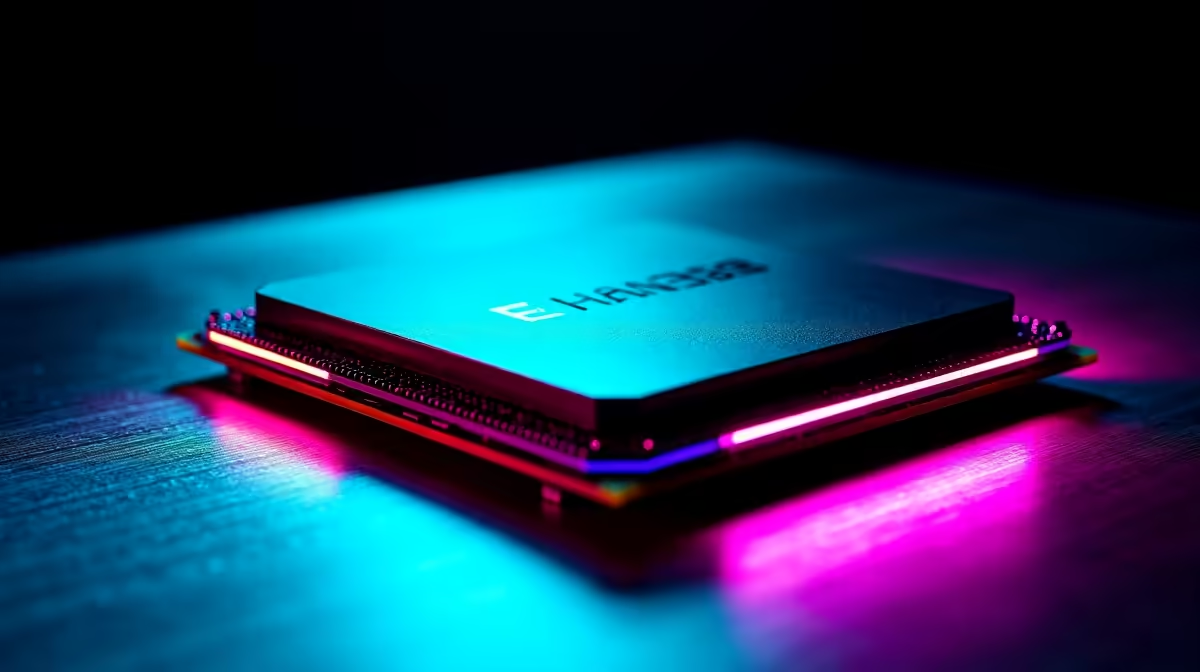
The Ryzen 7 9800X3D delivers a meaningful FPS uplift in Apex Legends compared to mainstream processors, thanks to its 3D V-Cache architecture that reduces CPU latency in frame generation. In high-competitive Apex play where CPU bottlenecking is real on weaker chips, the 9800X3D keeps GPU utilisation high and framerates consistent above 200 FPS in competitive configurations.
Apex Legends on PC scales significantly with CPU performance once you push past 144 FPS. The game's server tick rate, simulation thread, and audio engine all run on the CPU, and at high refresh rates -- 240Hz and above -- the GPU often waits on the processor to feed it frame data. This is the classic CPU bottleneck scenario that the Ryzen 7 9800X3D was designed to address.
The 9800X3D's 3D V-Cache stacks 64 MB of additional L3 cache on top of the standard die, reducing cache miss latency dramatically. Apex Legends is one of the games that benefits most from this architecture because its simulation and rendering pipeline produces frequent L3 cache hits during rapid scene changes -- exactly the scenario where 3D V-Cache shows gains over a standard processor.
In competitive Apex settings -- low shadows, low model detail, medium textures, 1080p or 1440p -- the 9800X3D consistently maintains 240-300+ FPS on capable GPU pairings like the RTX 4070 or higher. Mainstream processors in the same price bracket often see framerate drops into the 160-200 FPS range during intense team fights where particle effects, audio events, and simulation threads spike simultaneously.
The most visible benefit is not raw average FPS but 1% and 0.1% low framerate stability. Competitive Apex players know that a single stuttered frame during a firefight or while cresting a hill can mean the difference between landing a shot and missing. The 9800X3D's cache advantage reduces those micro-stutters compared to standard Zen 4 or competing architectures at equivalent clock speeds.
Paired with a high-refresh monitor and a GPU like the RTX 4080 or RX 7900 XTX, the 9800X3D allows the display hardware to do the work rather than waiting on the processor.
The 9800X3D runs on the AM5 platform, which requires a 600-series or 700-series AMD motherboard and DDR5 RAM. In South Africa, an AM5 build with the 9800X3D, a quality B650 board, and 32 GB DDR5-6000 typically totals R12,000 to R16,000 for the CPU and platform alone before the GPU. This is a genuine enthusiast investment for competitive Apex play.
For SA gamers experiencing loadshedding, the 9800X3D's power efficiency is a secondary benefit. Its base TDP is 120W, and it boosts intelligently rather than running flat-out like some competing high-end processors. A quality 650W to 750W PSU with an 80 Plus Gold rating handles the full system load efficiently.
The benefit is smaller at 144Hz because a standard mid-range CPU can typically sustain 144 FPS in Apex without significant bottlenecking. The 9800X3D's advantage is most pronounced at 240Hz and above.
If Apex is your primary game and you play at 240Hz or higher, yes -- it is one of the strongest performing CPUs for this title. If you play a wider variety of games including productivity and content creation, its workload performance is still strong, making it a well-rounded choice beyond just Apex.
An RTX 4070 Ti or higher ensures the GPU is not the bottleneck. The 9800X3D can sustain CPU frame delivery to support 240+ FPS, so you need a GPU that can actually render at that rate in Apex's engine.
Ready to Find Your Perfect Match? Build the CPU foundation for consistent competitive framerates. Browse processors at Evetech
Ryzen 7 9800X3D Apex Legends Gaming Perf available at Evetech.co.za with local warranty and fast delivery.
Ryzen 7 9800X3D Apex Legends Gaming Perf - check Evetech for latest stock and SA pricing.
Depends on your use case. Ryzen 7 9800X3D Apex Legends G offers good value at current Rand pricing.
Headset Stock Levels in Bloemfontein: January. Current stock data & price tracking for SA buyers. See what is available and where prices are heading.
Read more
iMac for Medical Practice: Patient Management. SA-focused analysis with local pricing data, real-world insights & actionable buying advice.
Read more
RTX 5060 Fortnite Ultra Settings at 1080p: FPS. Real-world benchmark data, FPS numbers & performance analysis. What SA gamers can actually expect.
Read more
Headset Stock Levels in Cape Town: August Report. Current stock data & price tracking for SA buyers. See what is available and where prices are heading.
Read more
Eskom Load Shedding During Video Call: Solutions. SA-focused analysis with local pricing data, real-world insights & actionable buying advice.
Read more
LoL Performance on Extreme Gaming PC. Real-world benchmark data, FPS numbers & performance analysis. What SA gamers can actually expect.
Read more
Is a Ultra Short Throw Projector Good for Gaming?. Diagnosis steps, proven fixes & when to seek professional help. SA-specific support info included.

Is a Short Throw Projector Good for Gaming? Input. Diagnosis steps, proven fixes & when to seek professional help. SA-specific support info included.

Top Mouse Settings for Competitive FPS: Sensitivity picks evaluated on performance, value & SA availability with current Rand pricing from Evetech.

Top Speakers for MacBook Desk Setup picks evaluated on performance, value & SA availability with current Rand pricing from Evetech.

Is a Ergonomic Chair Better Than a Standard Office Chair for Gaming Detailed answer with SA data, expert analysis & practical recommendations for local buyers.

Use Spotlight Search Like a Pro on macOS. Step-by-step instructions with SA-specific tips, common pitfalls to avoid & expert recommendations.

wireless keyboard Fan Noise Too Loud: Quiet. Everything you need to know with SA pricing, step-by-step instructions & expert recommendations.

Connection Timeout: Troubleshooting Guide #2. Diagnosis steps, proven fixes & when to seek professional help. SA-specific support info included.
Headset Stock Levels in Bloemfontein: January. Current stock data & price tracking for SA buyers. See what is available and where prices are heading.
iMac for Medical Practice: Patient Management. SA-focused analysis with local pricing data, real-world insights & actionable buying advice.
RTX 5060 Fortnite Ultra Settings at 1080p: FPS. Real-world benchmark data, FPS numbers & performance analysis. What SA gamers can actually expect.
Headset Stock Levels in Cape Town: August Report. Current stock data & price tracking for SA buyers. See what is available and where prices are heading.