Quick Answer
South African PC component prices are rising most sharply in the GPU and RAM categories in 2026, driven by rand weakness against the dollar and sustained global demand. Storage prices have stabilised, while CPU prices have softened slightly as older generation stock clears. The rand-dollar rate remains the dominant price driver for all imported components.
Which SA PC Components Are Rising in Price in 2026
Graphics cards have seen the steepest price increases in 2026. New GPU generations from both major GPU makers have launched at aggressive USD pricing, and when converted to ZAR at current exchange rates, the local price increases are amplified. A card that launched internationally at a given USD price lands in SA at a price that reflects both the hardware premium and the rand's performance against the dollar.
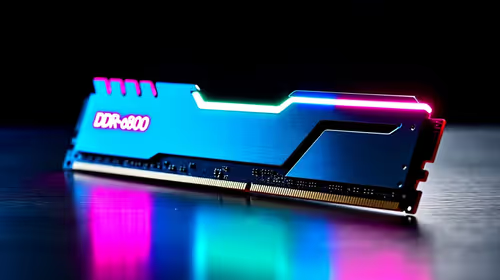
DDR5 RAM prices rose through the first half of 2026 as the AM5 and Intel LGA1851 platforms drove adoption. DDR4 pricing has been more stable, with some softening as older platform builds slow down. For SA builders, this means DDR4 upgrades are currently well-priced relative to 12 months ago, while DDR5 entry costs remain elevated.
SSD pricing has been the most stable category. Global NAND flash supply stabilised after two years of volatility, and 1TB NVMe SSD prices in SA are near their best value points of the last three years. This makes now a reasonable time to upgrade storage if you have been waiting.
CPU prices have moved depending on the segment. High-end desktop CPUs remain expensive. Mid-range and value CPUs -- particularly AM4 platform Ryzen 5000 series -- have become notably more accessible as new platforms push older stock through the channel. For budget builders in SA, this represents a genuine opportunity.
The Rand-Dollar Factor and SA Import Dynamics
Every PC component sold in South Africa is imported. There is no local silicon manufacturing, no local DRAM fabrication, no local GPU production. This means every price on every component reflects the ZAR/USD rate at the time of import, plus duty, VAT at 15%, shipping costs, and retailer margin.
When the rand weakens -- as it has during periods of domestic political uncertainty, global risk-off sentiment, and load shedding economic impact -- component prices rise with a 4-to-8 week lag as new stock arrives at post-devaluation import costs. When the rand strengthens, prices soften, but more slowly.
SA gamers and builders who track PC component pricing should watch the USD/ZAR exchange rate as a leading indicator. A sustained move above R19 to the dollar historically predicts price increases across the component range within 6 to 8 weeks.
Frequently Asked Questions
Are GPU prices rising or falling in South Africa in 2026?
GPU prices are rising in 2026, driven by new generation launches and rand weakness. Budget to mid-range GPUs have seen the sharpest percentage increases. High-end cards were already expensive and remain so.
Is it a good time to build a PC in South Africa in 2026?
Storage and mid-range CPUs are at good value points. RAM and GPUs are more expensive than 12 months ago. A selective build focusing on strong current-value components is possible -- prioritise categories where pricing is favourable.
How does loadshedding affect PC component prices in South Africa?
Loadshedding does not directly affect component import pricing, but its economic impact weakens the rand, which indirectly drives up the ZAR cost of all imported components over time.
Ready to Find Your Perfect Match? Find the best PC component deals with fast delivery across South Africa. Shop PC Deals