


Headset Stock Levels in Bloemfontein: January 2026 Report
Headset Stock Levels in Bloemfontein: January. Current stock data & price tracking for SA buyers. See what is available and where prices are heading.
Read moreUnisa Student Tech Preferences: Q2 Report. SA market intelligence with local buyer data, pricing shifts & actionable insights for smart purchasing.

Unisa students in Q2 2026 show strong preference for portable, affordable laptops under R10,000 with at least 8GB RAM and solid-state storage. Data-saving features, offline capability, and long battery life rank as top priorities given the distance-learning model and inconsistent home connectivity across South Africa.
Unisa's open-distance e-learning model means students rarely sit in a fixed computer lab environment. The average Unisa student in 2026 studies from home, from a library, or from a shared residence setting where connectivity can be patchy and power unreliable. This shapes tech preferences in ways that differ from contact-university students at UCT, Wits, or Stellenbosch.
The highest-rated device attributes among Unisa students this quarter are battery endurance beyond 8 hours, offline document access, and lightweight build. Many students upload assignments and download study materials during brief connectivity windows, then work offline the rest of the time. A machine that cannot handle 3-4 hours of offline productivity without a charge is a practical liability.
The R6,000-R9,000 bracket captures the majority of Unisa student laptop purchases in Q2 2026. Within that range, students prioritise 8GB RAM as a floor because myUnisa and the associated learning tools open multiple browser tabs simultaneously. SSD storage is now a baseline expectation rather than a premium feature, with 256GB being the minimum students find acceptable and 512GB the preferred option.
Students accessing NSFAS funding work within an R5,200 laptop allowance, which means they are actively looking for devices that deliver maximum capability within that ceiling. Many supplement NSFAS funds with a personal contribution to reach the R7,000-R8,000 range for a more capable device. Processors from the current AMD Ryzen 5 and Intel Core i5 generations handle all standard Unisa workloads comfortably.
Beyond the laptop itself, Unisa students in Q2 2026 increasingly pair their devices with portable mobile data solutions. Budget USB-C hubs with Ethernet ports are popular for students who rely on wired connections at libraries or community centres. External mice and compact keyboard covers appear frequently in student purchase bundles.
Software preferences lean toward the Microsoft 365 suite available through Unisa's student licensing, alongside open-source PDF readers and offline note-taking apps. Students report that devices with pre-installed Windows Home meet all their myUnisa compatibility requirements without additional software cost.
A minimum of 8GB RAM, 256GB SSD, and a processor from the current Ryzen 5 or Core i5 generation covers all Unisa coursework. Battery life above 8 hours is especially important for distance learners.
Yes. NSFAS provides a laptop allowance of R5,200 for qualifying students. Many students supplement this amount to reach the R7,000-R9,000 range for better specifications.
Most Unisa students report that a touchscreen is a low priority. Battery life, weight, and RAM matter more for the document-heavy, offline-friendly workflow that distance learning requires.
Ready to Find Your Perfect Match? Compare laptops and deals that work within NSFAS and student budgets. Browse Student PC Deals at Evetech
Unisa Student Tech Preferences: Q2 2026 available at Evetech.co.za with local warranty and fast delivery.
Unisa Student Tech Preferences: Q2 2026 - check Evetech for latest stock and SA pricing.
Depends on your use case. Unisa Student Tech Preferences offers good value at current Rand pricing.
Headset Stock Levels in Bloemfontein: January. Current stock data & price tracking for SA buyers. See what is available and where prices are heading.
Read more
iMac for Medical Practice: Patient Management. SA-focused analysis with local pricing data, real-world insights & actionable buying advice.
Read more
RTX 5060 Fortnite Ultra Settings at 1080p: FPS. Real-world benchmark data, FPS numbers & performance analysis. What SA gamers can actually expect.
Read more
Headset Stock Levels in Cape Town: August Report. Current stock data & price tracking for SA buyers. See what is available and where prices are heading.
Read more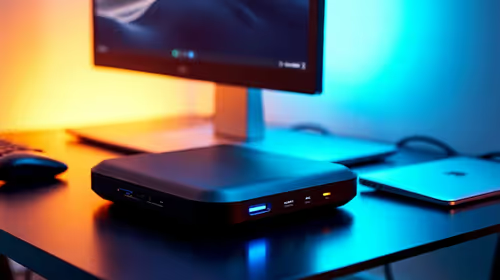
Eskom Load Shedding During Video Call: Solutions. SA-focused analysis with local pricing data, real-world insights & actionable buying advice.
Read more
LoL Performance on Extreme Gaming PC. Real-world benchmark data, FPS numbers & performance analysis. What SA gamers can actually expect.
Read more
Is a Ultra Short Throw Projector Good for Gaming?. Diagnosis steps, proven fixes & when to seek professional help. SA-specific support info included.

Is a Short Throw Projector Good for Gaming? Input. Diagnosis steps, proven fixes & when to seek professional help. SA-specific support info included.

Top Mouse Settings for Competitive FPS: Sensitivity picks evaluated on performance, value & SA availability with current Rand pricing from Evetech.

Top Speakers for MacBook Desk Setup picks evaluated on performance, value & SA availability with current Rand pricing from Evetech.

Is a Ergonomic Chair Better Than a Standard Office Chair for Gaming Detailed answer with SA data, expert analysis & practical recommendations for local buyers.

Use Spotlight Search Like a Pro on macOS. Step-by-step instructions with SA-specific tips, common pitfalls to avoid & expert recommendations.

wireless keyboard Fan Noise Too Loud: Quiet. Everything you need to know with SA pricing, step-by-step instructions & expert recommendations.

Connection Timeout: Troubleshooting Guide #2. Diagnosis steps, proven fixes & when to seek professional help. SA-specific support info included.
Headset Stock Levels in Bloemfontein: January. Current stock data & price tracking for SA buyers. See what is available and where prices are heading.
iMac for Medical Practice: Patient Management. SA-focused analysis with local pricing data, real-world insights & actionable buying advice.
RTX 5060 Fortnite Ultra Settings at 1080p: FPS. Real-world benchmark data, FPS numbers & performance analysis. What SA gamers can actually expect.
Headset Stock Levels in Cape Town: August Report. Current stock data & price tracking for SA buyers. See what is available and where prices are heading.