



Windows on Arm Apps: What 7,000 Verified Titles Mean for SA Buyers
Microsoft says Windows on Arm now has over 7,000 verified apps and games. SA buyers should still check each driver, game and work tool before switching.
Read moreZen 6 X3D With 288MB L3 Cache: The Largest Gaming. SA-focused analysis with local pricing data, real-world insights & actionable buying advice.

AMD's Zen 6 X3D architecture takes 3D V-Cache to its logical extreme with 288MB of L3 cache on a single die, the largest gaming cache ever shipped on a consumer processor. For gaming workloads that benefit from keeping large datasets close to the processor, this is a significant architectural milestone.
What does Zen 6 X3D's 288MB L3 cache mean for gaming performance? The 288MB L3 cache on Zen 6 X3D dramatically reduces the frequency of slow main memory accesses during gaming, particularly in open-world and CPU-intensive titles. This translates to higher average frame rates and notably improved 1% low frame rates compared to processors with smaller cache pools.
Modern game engines generate enormous volumes of data that the processor needs to access rapidly - game state, physics calculations, AI routines, and scene management all place heavy demands on the CPU. When these datasets fit within the on-chip L3 cache, the processor can retrieve them in nanoseconds. When they spill into main RAM, latency increases by an order of magnitude and frame pacing suffers. Previous X3D generations introduced the concept of stacked cache, and each generation has pushed the ceiling higher: from 96MB on Zen 3 X3D, to 144MB on Zen 4 X3D, and now to 288MB on Zen 6 X3D.
The cache advantage is most visible in titles with large, streaming open worlds and complex NPC simulation. Strategy games, simulation titles, and open-world RPGs show the largest frame rate improvements over non-X3D counterparts. In these genres, 1% low frame rates - the metric most directly tied to perceived smoothness - improve significantly because the processor is no longer waiting on memory fetches during complex scene transitions. Pure rasterisation-limited titles at very high resolutions show smaller relative gains since the GPU becomes the primary bottleneck. The sweet spot for Zen 6 X3D is high-refresh-rate 1080p and 1440p gaming where the CPU plays a larger role in determining output frame rates.
For a dedicated gaming build where maximum frame rates are the primary goal, Zen 6 X3D is the strongest argument AMD has ever made. The cache advantage is platform-agnostic - it benefits any GPU you pair with it. Workstation users doing video rendering, 3D modelling, or heavy compilation workloads may find that non-X3D Zen 6 chips offer better throughput per rand since those tasks benefit more from raw compute than cache depth. For a build that games hard and handles content creation on the side, Zen 6 X3D hits the broadest sweet spot in AMD's 2026 lineup.
Is 288MB of L3 cache useful outside of gaming? Some workloads like certain database queries and simulation software benefit from large caches. However, most professional productivity and creative applications benefit more from clock speed and core count, where non-X3D Zen 6 chips may have an advantage.
How does Zen 6 X3D compare to Intel's gaming CPUs in 2026? Zen 6 X3D's cache advantage places it at or near the top of gaming CPU benchmarks across most tested titles. Intel's competing architectures close the gap in some workloads but the sheer cache depth of X3D remains a strong differentiator in CPU-limited gaming scenarios.
Will Zen 6 X3D work with existing AM5 motherboards? Zen 6 X3D uses the AM5 platform. Compatibility depends on your motherboard manufacturer releasing the appropriate BIOS update. Check your board's CPU support list before purchasing.
Evetech stocks Graphics Card Deals and Evetech Best Sellers — shop online with fast delivery across South Africa.
Ready to Find Your Perfect Match? Shop at Evetech
Zen 6 X3D With 288MB L3 Cache: The Large available at Evetech.co.za with local warranty and fast delivery.
Zen 6 X3D With 288MB L3 Cache: The Large - check Evetech for latest stock and SA pricing.
Depends on your use case. Zen 6 X3D With 288MB L3 Cache: offers good value at current Rand pricing.
Microsoft says Windows on Arm now has over 7,000 verified apps and games. SA buyers should still check each driver, game and work tool before switching.
Read more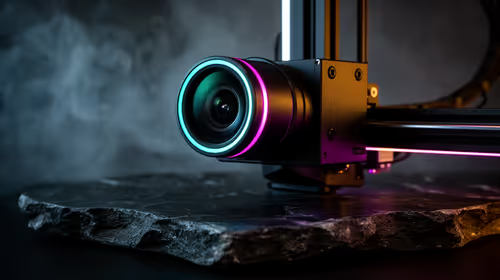
The Creality SPARKX i7 (CES 2026) includes an AI camera that detects filament tangling, air printing and bed-adhesion failures in real time. The system alerts users or pauses the printer before a failed print wastes a full spool of material.
Read more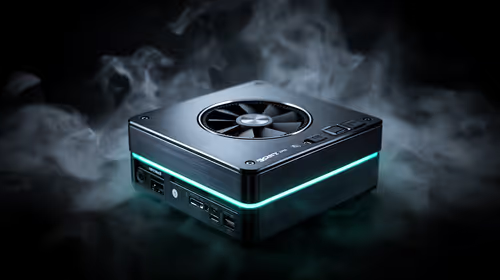
A Strix Halo mini-PC is a strong AI coding machine for large model capacity, with the Ryzen AI Max+ 395 allocating up to 96GB of its 128GB unified memory as VRAM at roughly 256 GB/s, enough to run 70B-class coding models at 4-bit on a single APU, though bandwidth caps.
Read more
Starting the new tax year on a fresh 2-in-1 makes sense when it carries 16GB RAM, a 512GB SSD and Windows 11 for smooth Pastel, Excel and eFiling. Windows 10 support ended on 14 October 2025. The ExpertBook P1 at R12,999 suits a small setup.
Read more
Festive-season laptop prep in SA is about travel protection, saved files and reliable access for holiday downtime or light work. Back up the machine, update Windows 11 and pack it properly before leaving home, especially if it will be used on the move.
Read more
Minisforum's M2 Pro pairs Core Ultra X7, Arc B390 graphics and 32GB onboard memory in 1.8 litres. SA buyers should weigh its fixed memory and $1,439 launch offer against local mini PCs.

Lenovo says Legion Go failures linked to BIOS N3CN42WW are not user error. Affected SA owners should stop retrying the update, preserve proof and open a support case.

Smart monitors can add apps and convenience, but they also add privacy settings and unwanted-software risk. SA buyers should audit the operating system before paying for extras.

A fake 113GB GTA VI ISO reportedly used empty padding around a small malware payload. SA gamers should delete unofficial builds, keep Windows security active and wait for official channels.

Shokz OpenFit Air 2 earbuds weigh 7.2g each and use a redesigned dual-driver open-ear layout. SA buyers should choose them for comfort and awareness, not maximum isolation.

AMD's current driver now lists a Radeon RX 9050 4GB, while product coverage details a narrowed memory system. SA buyers should weigh the low VRAM ceiling against current local Radeon options.

Samsung Display has demonstrated a 16-inch 2.5K OLED laptop panel running at 300Hz. SA buyers should wait for a named notebook, full panel specifications and a local price before planning an upgrade.

Microsoft says some Windows 11 game crashes after recent updates are linked to RGB-related drivers. Affected SA gamers should confirm the update and driver before using the published registry workaround.
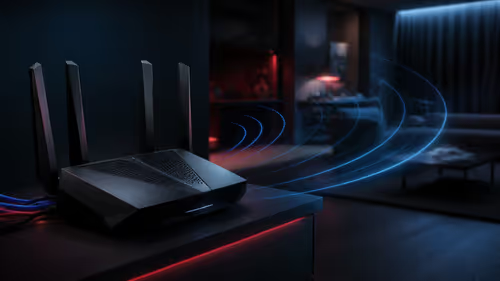
ASUS calls the ROG GT-BN98 the first Wi-Fi 8 gaming router. SA buyers should fix coverage and client limits before paying for a future wireless standard.
Microsoft says Windows on Arm now has over 7,000 verified apps and games. SA buyers should still check each driver, game and work tool before switching.
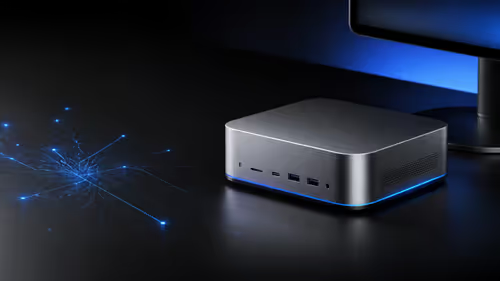
Apple's M6 Mac mini adds faster AI, graphics and networking in the same compact format. SA buyers should wait for a rand listing before comparing value.
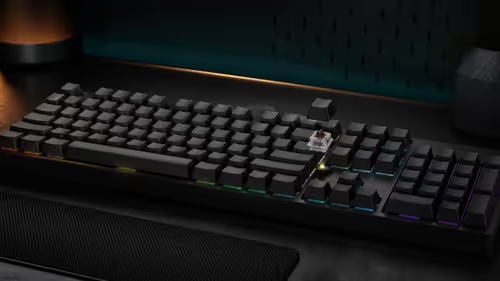
The Vulcan II XP adds hot-swappable switches, sound damping and gaming controls to a full-size wired board. SA buyers should compare feel before features.