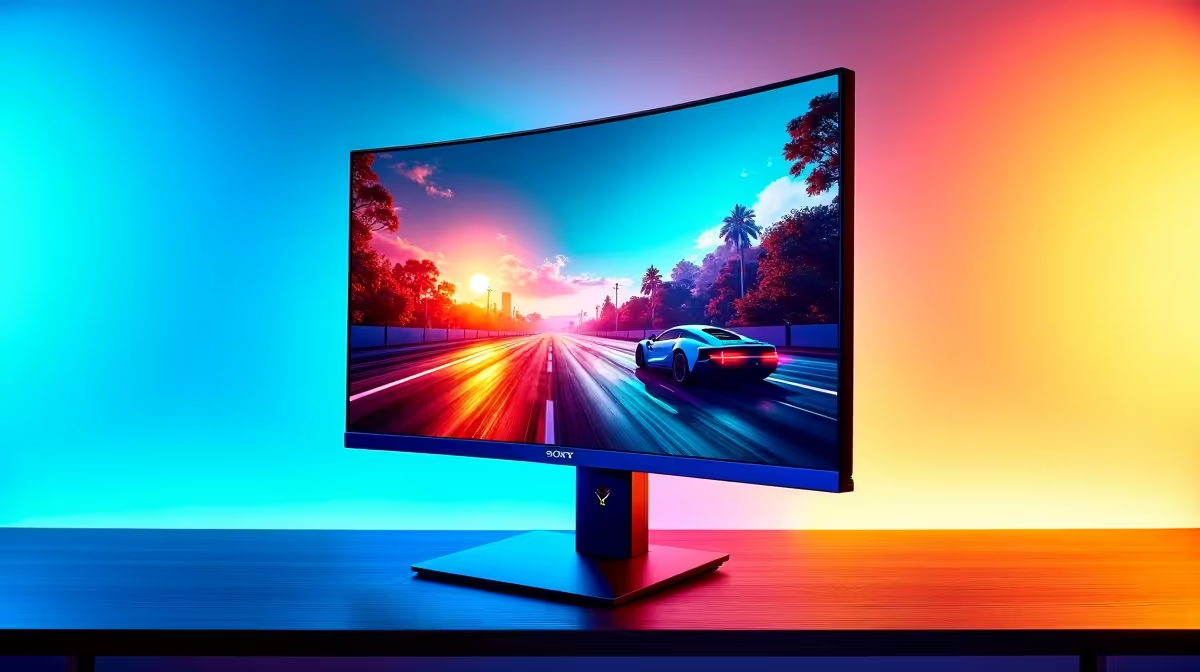
You've seen it plastered on every gaming monitor box: "1ms GtG Response Time!" For years, it's been the gold standard, the magic number that promises victory. But as we head into 2025, with monitor tech evolving at lightning speed, is that single spec still the be-all and end-all for a flawless gaming experience? Or are we clinging to an old metric while better technologies pass us by? Let's dig in. 🚀
Demystifying Response Time: What Does GtG Actually Mean?
Before we decide if it's essential, let's quickly break down what a 1ms GtG response time actually is. GtG stands for Grey-to-Grey. In simple terms, it’s the time, measured in milliseconds (ms), that it takes for a single pixel on your screen to change from one shade of grey to another. A faster GtG time means pixels can keep up with rapid on-screen action, reducing that blurry, smeared effect known as "ghosting."
This is crucial in fast-paced games where clarity is king. A low response time ensures the enemy you're tracking doesn't become a blurry mess as you whip your mouse around. It's a foundational spec you'll see featured across almost all of today's best PC monitors.
The 1ms GtG Difference: Can You Even See It?
Here’s the honest truth... it depends. For an esports pro playing Valorant or Counter-Strike 2 at 360Hz, the razor-thin advantage offered by a true 1ms GtG response time can genuinely be the difference between landing a headshot and staring at a respawn screen. At that elite level, every millisecond counts, and visual clarity is non-negotiable.
However, for the majority of gamers, the difference between 1ms and 4ms is practically invisible. If you're exploring the world of Starfield or commanding armies in Total War, you won't notice it. Panel technology has also come a long way. Modern IPS panels, like those found in many HP gaming monitors, now offer incredible colour accuracy and impressively low response times, closing the gap on older, faster TN panels. This means you no longer have to sacrifice visual fidelity for speed, a balance perfected by many popular choices from AOC. ✨
Beyond 1ms: The Other Specs That Define a Great Gaming Monitor
Focusing only on response time in 2025 is like choosing a car based solely on its 0-100 time. It's important, but it doesn't tell the whole story. Here are the other factors that create a truly immersive experience:
- Refresh Rate (Hz): This is how many times your screen updates per second. A high refresh rate (144Hz and above) makes motion feel incredibly smooth. It's arguably more impactful for most gamers than a super-low response time.
- Resolution & Panel Type: Do you want the crisp detail of 1440p or the immersive beauty of 4K? Do you prefer the vibrant colours of an IPS panel or the deep blacks of an OLED?
- Adaptive Sync: This is a big one. Screen tearing is a massive immersion-breaker. Technologies like NVIDIA's G-Sync and AMD's FreeSync synchronise your monitor's refresh rate with your GPU's frame output, eliminating stutter and tearing. Many monitors also support the open VESA Adaptive Sync standard, offering a buttery-smooth experience.
Pro Tip: Tame Your Overdrive 🔧
Most gaming monitors have an "Overdrive" or "Response Time" setting in their on-screen menu. While cranking this to the highest level seems logical to achieve the advertised 1ms, it can often cause "inverse ghosting" (a bright or dark halo effect). For most panels, the medium or "Fast" setting provides the best balance of speed and clarity without ugly visual artefacts.
The Verdict: Is 1ms GtG Still a Must-Have?
For the top 1% of competitive players, yes, a monitor with a verified 1ms GtG response time is still a key tool in their arsenal. It provides the ultimate motion clarity needed for professional play.
But for everyone else? It’s no longer the essential spec it once was. The market has matured. You'll likely get a far better and more enjoyable gaming experience by prioritising a balanced monitor: one with a great refresh rate (144Hz+), stunning colour accuracy, a solid resolution for your GPU, and, most importantly, adaptive sync. A modern 4ms IPS panel will feel just as responsive to 99% of gamers and will look significantly better. You can find incredible performance without breaking the bank with excellent value Dahua monitors.
The takeaway is simple: look beyond the 1ms hype and find a monitor that excels across the board.
Ready to See the Difference?
A great monitor is the window to your gaming world. Instead of chasing a single number, find a display that offers the perfect balance of speed, colour, and clarity for your favourite games. Explore our massive range of PC monitors and find the perfect upgrade for your setup.