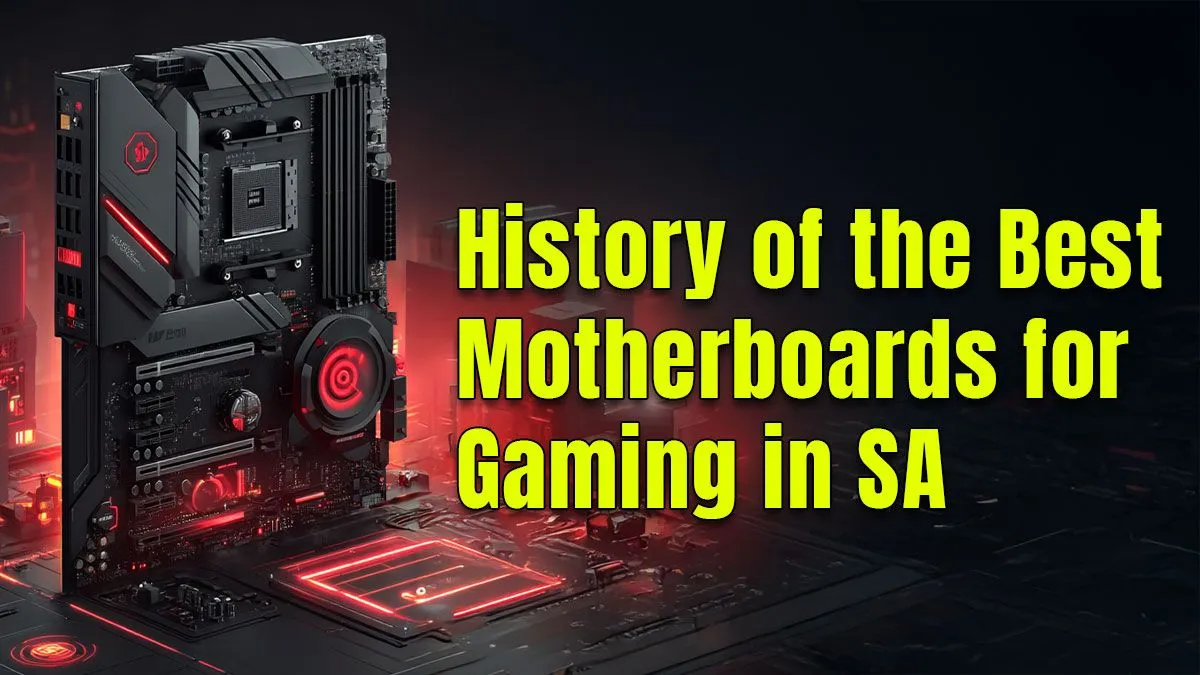
Remember lugging your beige PC tower to a friend's place for a LAN party? The thrill of a 1v1 in Quake or a co-op mission in Starcraft was unmatched. Back then, the motherboard was just the boring green board everything plugged into. But that board was the unsung hero, the foundation of every frag and every victory. This is a look back at the best gaming motherboards history, a uniquely South African retrospective. 🚀
The Early Days: From Beige Boxes to AGP Breakthroughs
In the late 90s and early 2000s, building a PC in South Africa was a real mission. You'd save up for months, sourcing parts from fledgling tech shops. The motherboard's job was simple: connect the CPU, RAM, and that screaming 56k modem. But then came the AGP (Accelerated Graphics Port) slot, a dedicated lane for graphics cards like the legendary 3dfx Voodoo. Suddenly, the motherboard wasn't just a circuit board; it was the key to unlocking 3D worlds.
This era defined the foundation of PC gaming. Choosing the right chipset, like Intel's 440BX, meant stability and performance. It was the first time many of us realised the motherboard's critical role in the evolution of gaming motherboards.
The Overclocking Era: Pushing Limits with SLI & CrossFire
Fast forward to the mid-2000s. The PC gaming scene was exploding, and enthusiasts wanted more power. This is where the best gaming motherboards history really gets exciting. Chipsets like NVIDIA's nForce and Intel's P-series became legendary for their overclocking potential. With a few tweaks in the BIOS, you could squeeze extra performance from your CPU for free... if you had good cooling!
This was also the age of dual graphics cards. NVIDIA's SLI and ATI's (now AMD's) CrossFire allowed you to link two GPUs for massive performance gains. To do this, you needed a high-end motherboard with multiple PCIe slots, turning your rig into a true beast. These boards were packed with features, a far cry from their simple ancestors, and set the stage for the complex PC components we see today.
What are VRMs? ⚡
VRM stands for Voltage Regulator Module. Think of it as the motherboard's power delivery system for your CPU. A board with a high-quality VRM (more power phases, better cooling) can deliver cleaner, more stable power. This is crucial for high-performance CPUs and especially important if you plan on overclocking. When choosing a new board, don't just look at RGB; check the VRM specs!
Intel's Reign and the Sandy Bridge Revolution
For many years, if you were building a top-tier gaming PC, you were likely looking at legendary Intel motherboards. The launch of the "Sandy Bridge" processors and the Z68 chipset in 2011 was a landmark moment. These boards offered an incredible blend of performance, stability, and modern features like native USB 3.0 and SATA III (6Gb/s).
Suddenly, your operating system would boot in seconds from an SSD, and transferring files didn't require a coffee break. The reliability of these platforms made them a favourite for South African gamers who needed a rig that just worked, delivering flawless performance for years.
The Modern Battlefield: AMD's Ryzen and PCIe 5.0
The history of gaming motherboards isn't complete without talking about AMD's triumphant return. The launch of Ryzen CPUs on the AM4 socket in 2017 completely shook up the market, forcing innovation and bringing competition back in a big way. This resurgence gave gamers incredible choice and value.
Today's motherboards are technological marvels. They feature mind-bendingly fast NVMe M.2 slots that leave old SSDs in the dust, support for PCIe 5.0 graphics cards, and high-speed DDR5 RAM. Onboard Wi-Fi 6E and 2.5G LAN are now standard on many powerful AMD motherboards, ensuring your connection is as fast as your hardware. It’s an amazing time to be a PC builder. ✨
Ready to Build Your Next Legend?
The history of gaming motherboards shows a constant drive for more power and better features. Your next PC deserves a foundation that's ready for the future. Explore our massive range of Intel and AMD motherboards and find the perfect board to conquer your world.