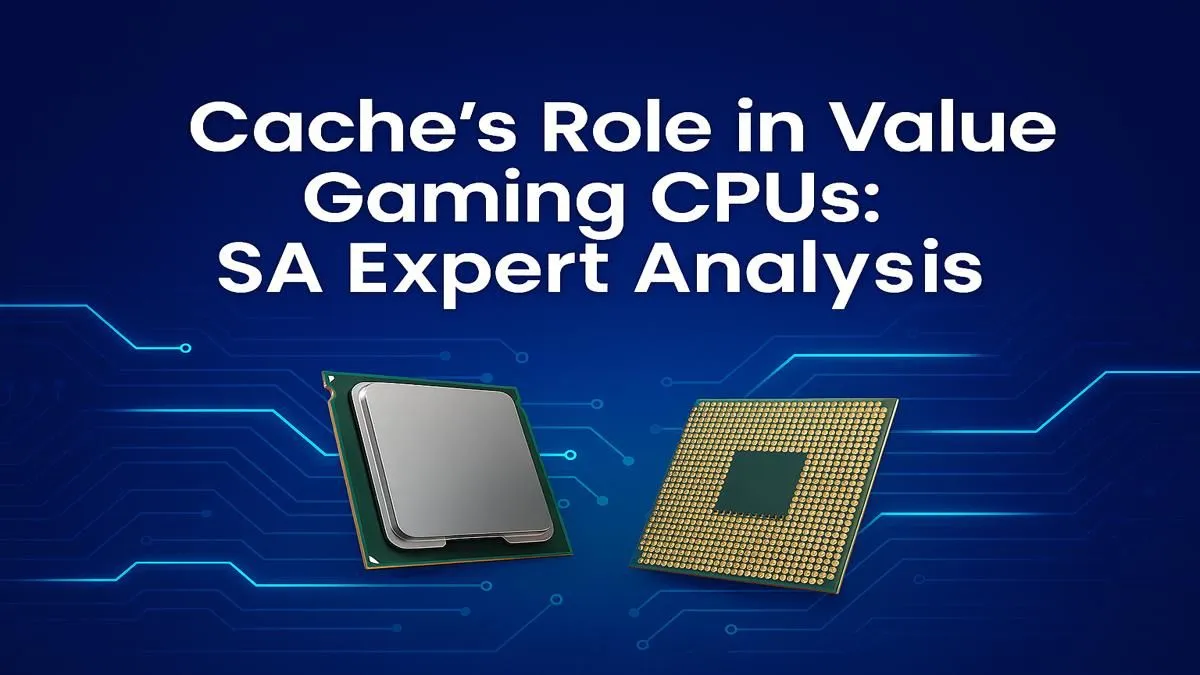
Building a gaming PC in South Africa means every rand counts. We obsess over graphics cards and core counts, but what about that mysterious spec... CPU cache? Is it just marketing noise, or does it actually affect your framerate when the action gets hectic in your favourite shooter? For budget-conscious gamers, understanding the role of CPU cache for gaming can be the key to unlocking smoother performance without breaking the bank. Let's dive in. ✨
Understanding CPU Cache: Your Processor's Super-Fast Memory
Think of your PC's memory like a kitchen. Your main storage (SSD/HDD) is the grocery store, and your RAM is the big pantry. To cook a meal (run a program), your CPU (the chef) has to fetch ingredients. Going to the pantry is faster than driving to the store, right?
CPU cache is like having a small, ultra-fast fridge right next to the stove. It stores the most frequently used data your CPU needs, making access nearly instant. It's broken down into levels:
- L1 Cache: The smallest and fastest. It's built right into the CPU core.
- L2 Cache: Slightly larger and slower, but still incredibly fast.
- L3 Cache: The largest and slowest of the three, shared across all CPU cores. This is the spec you'll most often see advertised, and it has a huge impact on gaming.
A larger L3 cache means the CPU can keep more game data on hand, reducing the need to fetch it from the much slower system RAM.
The Real-World Impact of CPU Cache for Gaming
So, how does this "fast memory" translate to better performance in games? It's all about consistency. While a higher clock speed might give you a higher peak framerate, a generous amount of CPU cache for gaming delivers a smoother, more stable experience.
Imagine you're in a heated 1v1 in Apex Legends. The game is tracking player positions, bullet trajectories, and environmental effects all at once. A CPU with a small cache might have to constantly reach out to system RAM for this data, causing tiny delays that you perceive as micro-stutter or lag. A CPU with a large L3 cache keeps that critical data ready to go, resulting in smoother frame times and a more responsive feel. This is why choosing a powerful CPU processor with adequate cache is so important. ⚡
Does Cache Matter for Value CPUs in South Africa?
This is the big question for anyone building on a budget. The answer is... it depends on the games you play.
For many graphically intense AAA titles at 1440p or 4K, your graphics card is likely the main bottleneck. In these cases, the difference between a budget CPU with average cache and one with slightly more might be minimal.
However, the impact of CPU cache for gaming becomes much more pronounced in CPU-bound scenarios, such as:
- High-FPS 1080p Gaming: In titles like Valorant or CS:GO, where players push for hundreds of frames per second, the CPU is working overtime. More cache directly translates to higher and more stable frame rates.
- Strategy & Simulation Games: Games like Civilization VI or Microsoft Flight Simulator process immense amounts of data. A larger cache can significantly speed up turn times and smooth out performance.
- Open-World Games: Exploring the vast landscapes of games like Cyberpunk 2077 or Elden Ring involves constantly loading new assets. A beefy L3 cache helps reduce stuttering as you traverse the world.
Both major brands have compelling options. Many modern offerings from Intel provide a great balance of core performance and cache for their price. On the other side, some of AMD's latest CPUs, especially their X3D models, demonstrate just how potent a massive L3 cache can be for pure gaming performance.
Check Your Benchmarks! 🧠
When researching a value CPU, don't just look at the average FPS. Pay close attention to the "1% low" and "0.1% low" framerate numbers in reviews. These figures reveal the worst-case stutters and are often improved significantly by a larger CPU cache, giving you a much better picture of real-world smoothness.
The Verdict: Is More Cache Worth the Rands?
For South African gamers on a budget, balance is everything. You shouldn't sacrifice a good graphics card for a CPU with a mountain of cache.
However, if you're a competitive gamer playing at 1080p or a fan of complex simulation games, investing in a CPU with a generous L3 cache is one of the smartest upgrades you can make. It's not just about hitting the highest number on a benchmark; it's about ensuring your game feels fluid and responsive when it matters most. Considering CPU cache for gaming is no longer a niche concern... it's a crucial part of building a well-rounded, future-proof rig. 🚀
Ready to Boost Your Frames?
Understanding CPU cache is the first step. The next is finding the processor that balances performance and price for your needs. From budget builds to high-end rigs, we've got the perfect CPU for you. Explore our complete range of CPU processors and build a smarter, faster PC today.