Ever felt your PC is so close to hitting that buttery-smooth 144 FPS, but it just can't hold it during a hectic firefight? That gap between 'good' and 'great' performance is where the magic of CPU overclocking lives. It's the art of safely pushing your processor beyond its factory settings, and this guide on CPU overclocking explained will demystify the science for you.
What is CPU Overclocking, Really?
At its core, CPU overclocking is the process of manually increasing a processor's clock speed, forcing it to perform more calculations per second than its official rating. Think of it like tuning a car's engine. The manufacturer sets a safe, reliable speed limit, but an enthusiast can tweak the components to unlock more power.
Every CPU has a "base clock" and a "boost clock." Overclocking involves carefully increasing these values, primarily by adjusting the CPU multiplier in your motherboard's BIOS/UEFI. This tells the chip to run faster, giving you a tangible performance uplift in games and demanding applications… for free! ✨
The Pros and Cons: Is It Worth It for You?
Before you dive into your BIOS, it's crucial to weigh the risks and rewards. Pushing your hardware has consequences, and understanding them is key to a successful overclock.
The Upside: More Power! 🚀
- Better Performance: The most obvious benefit. You can see higher average frame rates in CPU-bound games, faster video encoding, and snappier overall system responsiveness.
- Cost-Efficiency: You're getting more performance out of the hardware you already own, potentially matching the speed of a more expensive model.
- The Enthusiast Thrill: For many PC builders in South Africa, successfully overclocking a system is a rite of passage. It's a fun way to learn the deep inner workings of your rig.
The Downside: Handle with Care
- Increased Heat: More speed means more heat. Your stock cooler is almost certainly not up to the task.
- Higher Power Draw: A faster CPU consumes more electricity, which can strain your Power Supply Unit (PSU).
- System Instability: Pushing things too far can lead to crashes, the infamous Blue Screen of Death (BSOD), and data corruption.
- Voided Warranty: While manufacturers are more lenient these days, technically, any damage caused by manual overclocking can void your warranty.
Deciding if the risk is worth the reward often comes down to the quality of the CPU processors you start with. A high-end chip has more headroom than an entry-level one.
The AMD vs. Intel Approach to Overclocking
The process of overclocking differs slightly between the two silicon giants. Your choice of brand will dictate your path.
Intel's Unlocked "K" Series
Intel typically restricts manual overclocking to its premium "K" or "X" series processors (e.g., Core i7-14700K). To tune these chips, you'll need to pair them with a high-end motherboard chipset, usually a Z-series model (like the Z790). If you want the freedom to tweak every last megahertz, you'll need to look for an unlocked model in our range of Intel CPUs and a compatible motherboard.
AMD's Open Platform
Team Red is generally more open. Most modern Ryzen CPUs are "unlocked" from the factory, meaning they are ready for overclocking. You can perform manual overclocks on most B-series (e.g., B650) and X-series (e.g., X670) motherboards. This makes overclocking more accessible, as most of the processors in our AMD Ryzen lineup are ready for tuning right out of the box, provided you have the right motherboard.
AMD also offers a clever feature called Precision Boost Overdrive (PBO), which is a form of automated, intelligent overclocking that pushes the CPU as far as your cooling will safely allow.
Essential Monitoring Tip ⚡
Before you even think about changing settings, download monitoring software like HWiNFO64 and a stress-testing tool like Prime95 or Cinebench. HWiNFO64 gives you a detailed, real-time look at your CPU's temperatures, clock speeds, and voltages. This isn't just a tip; it's a non-negotiable step for safe overclocking.
Your Pre-Flight Checklist for Safe Overclocking 🔧
Ready to give it a go? Don't touch a single setting until you've got these three things sorted. This is the foundation of any stable overclock.
- A Capable CPU Cooler: We can't say this enough. Heat is the enemy of stability and the number one killer of components. A stock cooler will not be sufficient. You need a robust tower air cooler or, ideally, an All-in-One (AIO) liquid cooler to handle the extra thermal load.
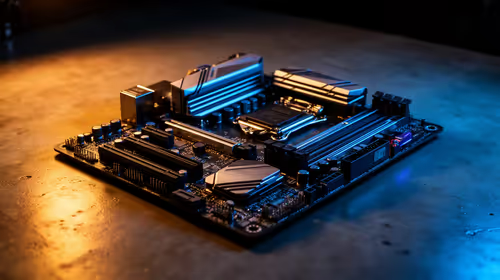
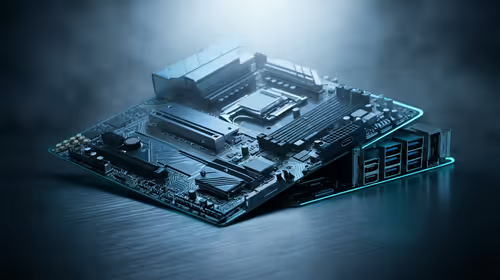
- A Quality Motherboard: The motherboard's Voltage Regulator Modules (VRMs) are responsible for delivering clean, stable power to the CPU. Cheaper boards have weaker VRMs that can overheat and throttle performance, completely defeating the purpose of overclocking.
- A Reliable Power Supply (PSU): An overclocked CPU draws significantly more power under load. Ensure your PSU has enough wattage headroom (we recommend at least 150-200W above your calculated load) and comes from a reputable brand. A failing PSU can take your entire system with it.
CPU overclocking isn't black magic; it's a methodical science of small, incremental changes and rigorous testing. For enthusiasts looking to squeeze every drop of performance from their rig, it's an incredibly rewarding journey.
Ready to Push the Limits?
Whether you're a seasoned overclocker chasing world records or just want a CPU that's insanely powerful out of the box, the right processor is waiting for you. Explore our massive range of CPUs and find the perfect core for your build today.