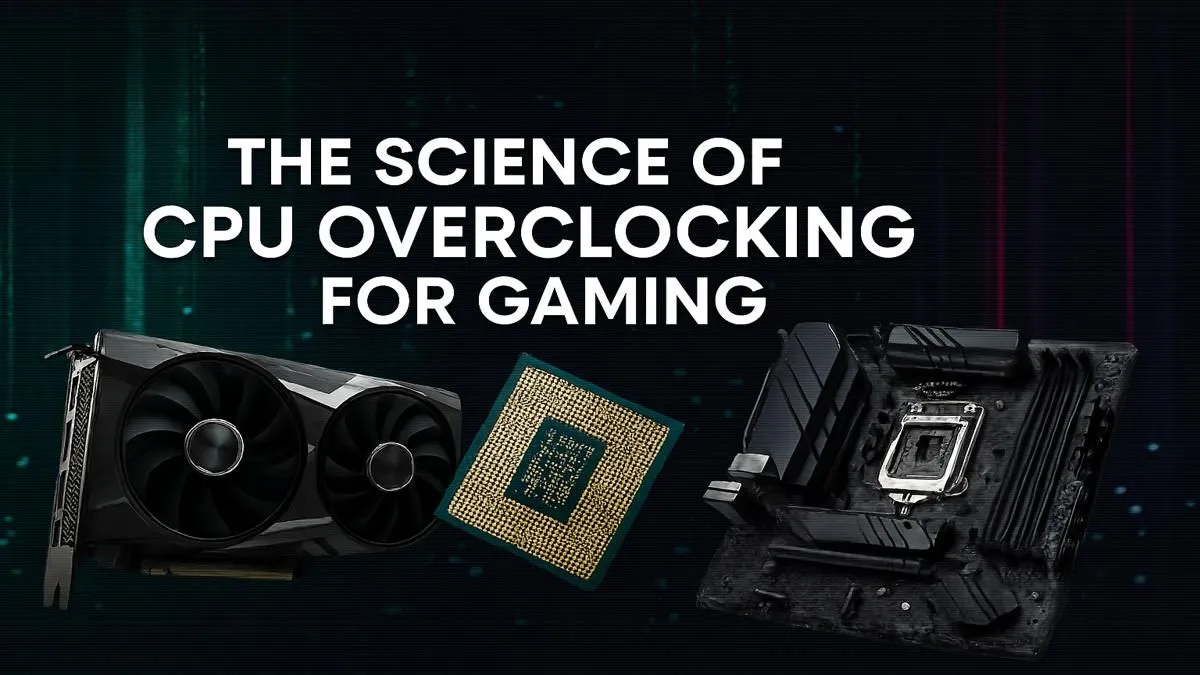
Staring at your FPS counter, wishing it would climb just a little higher? You're not alone. For South African gamers, squeezing every last drop of performance from our hardware is a national sport. The good news? Your PC might have a hidden power level, accessible through CPU overclocking for gaming. It’s the art of pushing your processor beyond its stock speeds for free performance. This guide cuts through the noise to give you the science-backed facts.
What is CPU Overclocking, Really?
Think of your CPU as an engine. The manufacturer sells it tuned to a reliable, safe speed (the "base clock"). Overclocking is like a pro mechanic tuning that engine to run faster and more powerfully. We do this by carefully increasing the CPU's clock speed (multiplier) and, sometimes, its voltage. The goal of CPU overclocking for gaming is simple: make your processor perform calculations faster, which can lead to higher frame rates and a smoother experience in your favourite titles. 🚀
The Real-World Benefits for Gamers
So, why bother with all this tweaking? The primary benefit is improved performance in CPU-bound scenarios. These are situations where your processor, not your graphics card, is the main bottleneck.
- Higher FPS: In games like Civilization VI, Valorant, or CS:GO at high refresh rates, a faster CPU can directly translate to more frames per second.
- Reduced Stuttering: Overclocking can help smooth out frame times, minimising those annoying micro-stutters that ruin immersion, especially in open-world games.
- Better Multitasking: If you stream your gameplay or run apps like Discord in the background, the extra processing power provides more headroom, keeping everything running smoothly.
For many, the process is also a rewarding hobby, allowing you to get the absolute maximum value from the hardware you paid for. While today's chips are incredibly powerful out of the box, a successful overclock can make a good processor feel great. You can browse a wide range of modern CPU processors online to see the latest stock speeds and potential.
The Science-Backed Risks: What You Need to Know
Pushing components beyond their rated limits isn't without risk. It's a delicate balance of three factors:
Heat & Throttling
The number one enemy of an overclock is heat. Pushing more voltage and higher frequencies generates significantly more thermal energy. If your cooling can't handle it, the CPU will protect itself by "thermal throttling"—aggressively slowing down, which completely defeats the purpose of overclocking.
Voltage & Degradation
Voltage is the electricity feeding the chip. Too little, and your system will be unstable and crash. Too much, and you can cause permanent damage or significantly shorten your CPU's lifespan through a process called electromigration. The key is finding the lowest stable voltage for your target clock speed.
Instability
An unsuccessful overclock results in instability, leading to the infamous Blue Screen of Death (BSOD), application crashes, or data corruption. This is why a methodical approach and rigorous stress testing are non-negotiable.
Stress Testing is Crucial ⚡
Never assume your overclock is stable after just booting into Windows. Use a combination of synthetic benchmarks like Prime95 (Small FFTs for heat) or Cinebench R23 (for a real-world load) for at least 30 minutes. For a gaming stability test, run a demanding game's built-in benchmark on a loop. Monitor your temperatures constantly using a tool like HWMonitor.
Is Your Rig Ready? The Overclocking Checklist 🔧
Before you even think about entering the BIOS, you need the right gear. CPU overclocking for gaming is a team sport for your components.
- An Unlocked CPU: Not all processors can be overclocked. You'll need an unlocked model. For Intel, this means a CPU with a 'K' or 'KF' suffix in its name, like the Core i7-14700K. You can find a full list of unlocked Intel CPUs on our site. On the AMD side, the news is better; almost all modern AMD Ryzen CPUs are ready for tweaking.
- A Capable Motherboard: You need a motherboard chipset that supports overclocking. For Intel, that's typically a Z-series board (e.g., Z790). For AMD, B-series (e.g., B650) and X-series (e.g., X670) boards are your best bet.
- Robust CPU Cooling: The stock cooler won't cut it. You need a high-performance air cooler or, ideally, an All-in-One (AIO) liquid cooler to manage the extra heat effectively.
- A Quality Power Supply (PSU): An overclocked CPU draws more power. A reliable PSU with enough wattage overhead is essential for delivering clean, stable power and preventing crashes.
So, Should You Overclock Your CPU?
The ultimate guide to CPU overclocking wouldn't be complete without this question. If you're an enthusiast who loves tinkering and wants to extract every ounce of performance from your rig, the answer is a resounding yes. It's a fun and educational process that can genuinely improve your gaming experience. ✨
However, if you just want to build your PC and jump straight into gaming without the hassle, it's perfectly fine to skip it. Modern CPUs from both Intel and AMD offer incredible performance right out of the box, with sophisticated boost technologies that automatically optimise speeds for you. The gains from manual overclocking are smaller than they used to be, but for those chasing the highest possible frame rates, it remains a worthy pursuit.
Ready to Build Your Beast?
Whether you're pushing the limits with overclocking or building a brand-new rig, the right components make all the difference. Explore our massive range of PC components and find everything you need to build the ultimate gaming machine in South Africa.