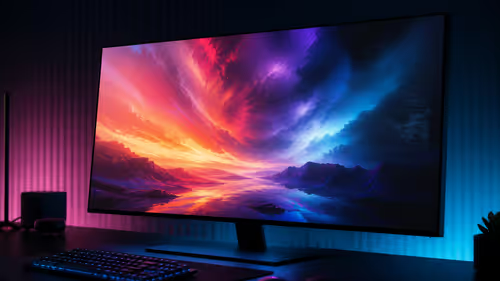
So, you’ve just unboxed a beautiful new monitor, ready to level up your work-from-home setup or dominate in your favourite game. You plug in your trusty old laptop, the screen flickers to life, and… wait. Your taskbar is missing. The edges of your screen are cut off. Ja, you've been hit by overscan. Don't stress. We'll show you how to easily fix overscan on your old laptop with a new monitor and get that perfect, pixel-for-pixel display.
Understanding and Fixing Laptop Overscan
Overscan is a relic from the old days of CRT televisions, designed to hide visual noise at the edges of an analogue broadcast. But why does it still pop up today? Sometimes, your laptop's graphics card and your new monitor don't communicate perfectly, causing your laptop to send an image that's slightly too big for the screen. The result is a zoomed-in, cropped picture.
Fortunately, the solution to fix this overscan on your new monitor is usually just a few clicks away in your settings, not a hardware fault. Before you start, ensure you're using high-quality cables and accessories, as a poor connection can sometimes cause display issues.
Your Step-by-Step Overscan Solution 🔧
Let's get this sorted. We'll start with the simplest fix and work our way through to the graphics driver settings, which almost always solves the problem.
Step 1: Check Your Monitor's On-Screen Display (OSD)
Before you touch your laptop's settings, check the monitor itself. Grab its remote or use the physical buttons (usually on the bottom or back) to open the On-Screen Display (OSD) menu.
Navigate to settings labelled "Picture," "Display," or "Screen." Look for an option called:
- Aspect Ratio: Change it from "16:9" or "Wide" to "Just Scan," "Screen Fit," "1:1," or "Full Pixel."
- Overscan: If you see this setting, simply turn it off.
This simple tweak often forces the monitor to display the exact image your laptop is sending, instantly fixing the issue for many users exploring our full range of PC monitors.
Pro Tip: Cable Choice Matters
the issue is the cable. Older HDMI versions on laptops can have limitations. If possible, use a DisplayPort cable, as it generally handles display scaling and resolution communication more reliably than HDMI, especially for high-refresh-rate [gaming monitors](https: www.evetech.co.za all-gaming-monitors x 1587.aspx).
Step 2: Adjust Your Graphics Card Settings
If the OSD trick didn't work, the next stop is your graphics card's control panel. This is the most reliable way to fix the overscan from your old laptop. The process differs slightly depending on whether you have an NVIDIA, AMD, or Intel GPU.
This step is crucial, especially if you're running demanding resolutions on one of today's stunning 4K monitors.
When It's More Than Just a Setting ✨
In rare cases, especially with very old laptops, the hardware itself might struggle to drive a modern, high-resolution display. Your laptop's graphics chip may not fully support the native resolution of your new monitor, leading to scaling problems that can't be fixed in software. This is common when trying to power massive immersive curved monitors or even some compact portable monitors with an ancient machine.
If you've tried everything and the display is still not perfect, it might be a sign that your laptop's hardware is the bottleneck.
Ready for a Flawless Display?
Don't let an old laptop hold your new screen hostage. Explore our incredible monitor promotions and find a display that delivers a perfect picture, every time. Check out the latest monitor deals at Evetech and leave display issues in the past.