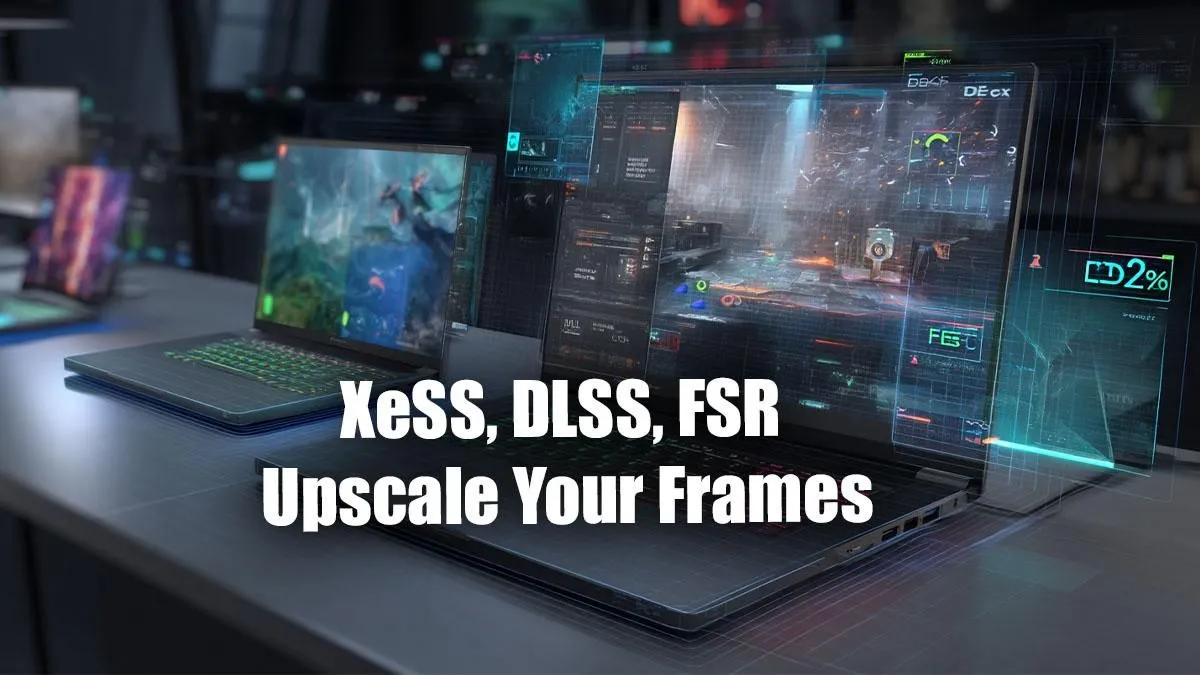
Striving for high frame rates in the latest titles without your graphics card sounding like a jet engine? We get it. In South Africa, getting the best performance for your buck is key. Frame upscaling tools are your secret weapon, boosting FPS for free. 🚀 This deep dive pits the three heavyweights against each other: Intel’s XeSS vs NVIDIA’s DLSS vs AMD’s FSR. Let's see which tech gives you the smoothest experience.
Understanding Frame Upscaling: XeSS, DLSS, & FSR Explained
So, what exactly are these frame upscaling tools? Think of them as smart performance enhancers. Instead of your GPU rendering every single pixel at your monitor's native resolution (like 1440p or 4K), it renders the game at a lower resolution (like 1080p). Then, sophisticated AI and algorithms intelligently upscale the image back to your native resolution, filling in the missing details with incredible accuracy.
The result? Your GPU works less hard, freeing it up to pump out significantly more frames per second (FPS). It's a clever way to get higher performance without sacrificing much visual quality.
XeSS vs DLSS vs FSR: The Tech Breakdown
While they all aim for the same goal, the "how" is where the real battle lies. Each of the big three—NVIDIA, AMD, and Intel—has its own unique approach to the frame upscaling challenge.
NVIDIA's DLSS (Deep Learning Super Sampling)
DLSS is the veteran in this space. It relies on machine learning and dedicated hardware called Tensor Cores, found only in NVIDIA's GeForce RTX graphics cards. By training its AI model on super-high-quality offline renders, DLSS has become exceptionally good at reconstructing images, often resulting in visuals that are as sharp, or sometimes even sharper, than the native resolution. The latest version, DLSS 3, even introduces Frame Generation, which creates entirely new frames for an even bigger performance leap. It’s a powerful tool, provided you have the right hardware, which you’ll find in many of the best gaming laptop deals available today.
AMD's FSR (FidelityFX Super Resolution)
AMD’s FSR takes a different, more democratic approach. 💡 It's an open-source technology, meaning it doesn't require specialised hardware and works on a massive range of GPUs—including NVIDIA and older Intel cards. While early versions were a bit softer than DLSS, FSR 2 and FSR 3 have made huge strides by using temporal data (information from previous frames) to improve image quality dramatically. This makes it a fantastic option for gamers who aren't on the latest and greatest hardware. If you're looking for great value, a machine from our range of AMD laptops on special can leverage FSR in hundreds of titles.
Intel's XeSS (Xe Super Sampling)
As the newest contender, Intel's XeSS combines the best of both worlds. Like DLSS, it uses AI and is hardware-accelerated on Intel's own Arc GPUs via dedicated XMX cores. However, it also includes a fallback mode that works on a wide variety of modern GPUs from AMD and NVIDIA. This hybrid strategy makes it incredibly versatile. Its image quality is highly competitive, often slotting right between DLSS and FSR, making the new generation of Intel laptops on special a very compelling choice for gamers.
The Verdict: Choosing Between XeSS, DLSS, and FSR
So, which of these frame upscaling tools should you use? The answer usually depends on the hardware in your rig. 🎮
- For Image Quality: DLSS generally holds a slight edge, thanks to its mature AI and dedicated hardware. XeSS comes in a very close second, with FSR right behind it. Honestly, at their "Quality" presets, all three look fantastic in motion.
- For Performance Boost: This varies wildly by game, resolution, and hardware. All three offer massive FPS gains (from 30% to over 100% in some cases), turning unplayable frame rates into a smooth and responsive experience.
- For Hardware Compatibility: FSR is the undisputed champion here, running on almost anything. XeSS is the versatile runner-up, while DLSS is the powerful but exclusive option for RTX owners.
Ultimately, the best tool is the one available in the game you're playing and supported by your GPU. Having these options is a massive win for PC gamers, making high-end performance more accessible across a wide range of laptop specials for sale in South Africa.
Pro Tip: Start with 'Quality' Mode
When enabling any upscaler, always start with its highest quality preset (e.g., "Quality" or "Ultra Quality"). The performance gain is still excellent, and you'll keep the most visual detail. Only drop to "Balanced" or "Performance" if you're still not hitting your target FPS.
Ready to Experience Next-Level Frames? The battle between XeSS vs DLSS vs FSR means more power for gamers, no matter your budget. Explore our best gaming laptop deals and find the perfect machine to unlock those silky-smooth frame rates today.