

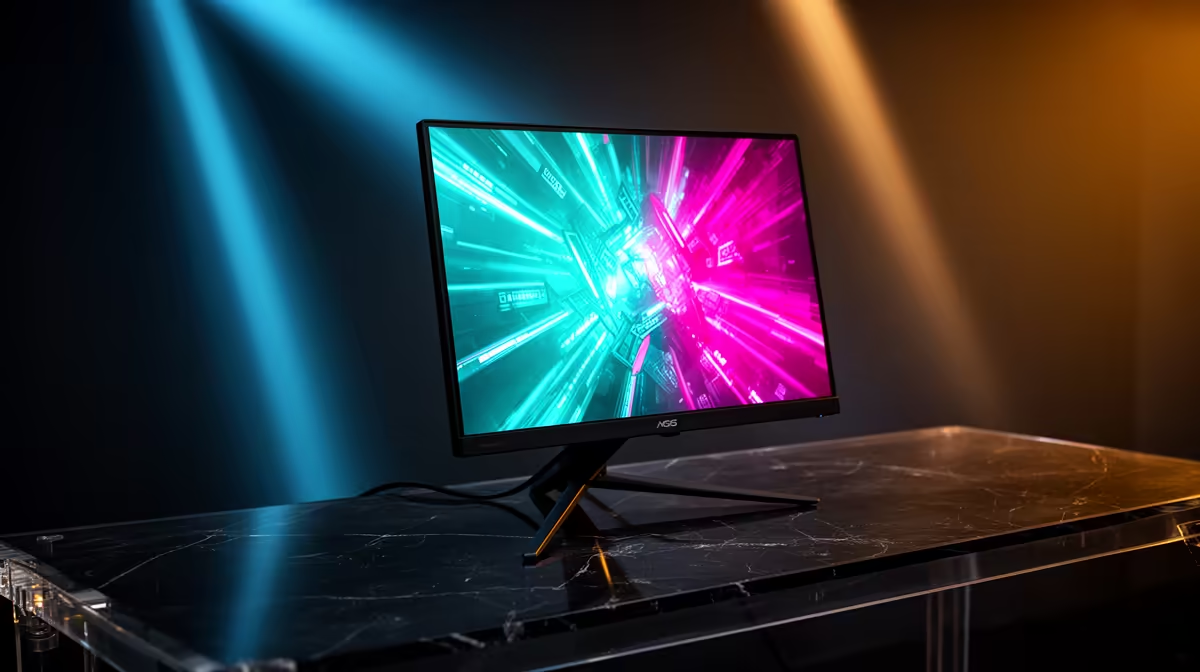
Remember that high-pitched whine? That was the sound of your old CRT monitor warming up for a LAN party. Today, our screens are silent, instant, and incredibly fast. But how did we get from that bulky, flickering box to the silky-smooth displays we have now? It all comes down to the evolution of the gaming monitor refresh rate, a journey from 60Hz CRT tubes to the ultra-responsive panels that define modern competitive gaming in South Africa. 🚀
The CRT Era: Where Refresh Rate History Began
Before flat screens, there was the Cathode Ray Tube (CRT). These hefty monitors worked by firing a beam of electrons at a phosphorescent screen, "painting" the image line by line, from top to bottom. The number of times it could paint the entire screen in one second was its refresh rate, measured in Hertz (Hz).
For decades, 60Hz was the standard. This wasn't chosen for gaming performance but for a practical reason: it synchronised with the 50-60Hz frequency of household electrical grids, which helped minimise visible flicker. For its time, it worked. But as games got faster, the limitations of this early approach to monitor refresh rate became clear. The technology inside today's PC monitors is a world away from those electron guns.
The LCD Revolution and the 60Hz Plateau
The arrival of Liquid Crystal Display (LCD) monitors was a massive shift. They were thin, light, and energy-efficient. But for early adopters and gamers, they came with a catch: many were stuck at a fixed 60Hz refresh rate and suffered from slow pixel response times. This resulted in "ghosting" or motion blur, where fast-moving objects left a faint trail behind them—a nightmare for competitive play.
For a long time, gamers faced a choice: the bulky, high-refresh-rate CRT or the sleek, blurry LCD. The industry needed to catch up, and the history of the gaming monitor refresh rate was about to enter its most exciting chapter.
Breaking the Barrier: The Rise of High Refresh Rate Gaming
The real leap forward came when manufacturers started pushing LCD technology past its 60Hz limits. First came 120Hz, then 144Hz became the new gold standard for serious gamers. Why did this matter so much?
A higher refresh rate means the screen updates more frequently, leading to:
- Smoother Motion: On-screen movement looks less choppy and more fluid, making it easier to track targets in an FPS like Valorant or Apex Legends.
- Reduced Input Lag: The time between your mouse movement and the action appearing on screen is lower.
- Clearer Images: Motion blur is significantly reduced, so you can see enemies more clearly while turning quickly.
Today, the evolution continues at a blistering pace. We now have 240Hz, 360Hz, and even 540Hz panels designed for esports professionals. The difference is tangible, giving players a critical competitive edge. You can find a huge variety across all gaming monitors, each tailored for a different type of player.
Don't Get Stuck at 60Hz! 🔧
Just bought a new 144Hz+ monitor? Don't forget the most crucial step! Windows often defaults to 60Hz. To fix this, right-click your desktop, go to Display Settings > Advanced Display Settings, and choose your monitor's highest available refresh rate from the dropdown menu. You have to manually tell your PC to use that extra speed!
More Than Just Hertz: Resolution and Modern Form Factors
A high refresh rate is just one piece of the puzzle. The modern display market offers an incredible variety of features that all interact with each other. The challenge for engineers has been to deliver a high gaming monitor refresh rate without compromising on image quality.
For years, the fastest panels were TN (Twisted Nematic) panels, which sacrificed colour accuracy for speed. Now, IPS (In-Plane Switching) and VA (Vertical Alignment) panels offer stunning colours and high refresh rates.
This innovation has also spread to every monitor shape and size. You can now get that buttery-smooth experience on incredible 5K and 4K monitors, which demand immense GPU power to drive. The technology is also a standard feature in immersive curved monitors that wrap the game around your vision. It's even found its way into compact and versatile portable monitors, perfect for a gaming laptop setup on the go. ✨
Ready to Experience True Fluidity? The history of the gaming monitor refresh rate shows how far we've come. Don't let your old screen be the bottleneck holding back your performance. From lightning-fast esports panels to stunning immersive displays, the perfect upgrade is waiting. Explore our massive range of PC monitor deals and find the perfect screen to conquer your game.











