



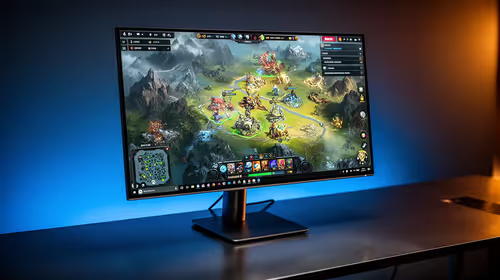
IPS vs VA for Strategy and Sim Games in SA
IPS vs VA for strategy and sim games should be judged by fit, not a single winner. Compare compatibility, latency, capacity, upgrade path, cost planning, and South African setup needs.
Read moreEver wondered how DHCP works to assign IP addresses on your network? This guide breaks down the Dynamic Host Configuration Protocol, explaining the DORA process simply for South African tech enthusiasts and gamers. 💻 Understand your network better and troubleshoot with ease! 🌐
Ever plugged in your PC or connected your phone to Wi-Fi and it just... works? No fiddling, no complicated settings. You can thank a clever little process called DHCP. But how does DHCP work, and why is it the unsung hero of every South African home network? From connecting your gaming rig for a late-night session to streaming Showmax on your tablet, DHCP is the magic that gets you online effortlessly. Let's break it down.
DHCP stands for Dynamic Host Configuration Protocol. That sounds complicated, but the concept is simple. Think of your home network as a small neighbourhood. For houses (devices) to get mail (data), they each need a unique street address (an IP address).
Instead of you having to manually assign an address to every single device—your phone, laptop, smart TV, gaming console—DHCP does it for you automatically. It’s the friendly digital "postmaster" that prevents chaos and ensures every device can talk to each other and the internet without any fuss.
The entire DHCP process is a quick, four-step conversation between your device (the client) and your router (the server). It's often called the "DORA" process.
The moment you connect a new device to your network, it sends out a broadcast message to the entire local network. It's essentially shouting, "Hello! I'm new here and I need an IP address!" Whether it's built into your motherboard or you're using a powerful USB wireless adapter, this is the hardware that kicks things off.
The brain of your network, your wireless router, acts as the DHCP server. It hears the cry for help and responds with an offer, saying, "I've got an available IP address for you. How about 192.168.1.105?" It also offers other crucial info like the subnet mask and gateway address (the exit to the internet).
Your device receives the offer and sends a message back, "Yes, please! I'll take that IP address." This message is also a broadcast, letting any other DHCP servers on the network (unlikely in a home setup) know that it has accepted an offer.
Finally, the router sends one last message to confirm everything. "Excellent! That IP address is yours for the next 24 hours." This is called a "lease." Your device is now officially on the network and ready to go online. ✨
The "lease" is the amount of time your device can use its assigned IP address. Before it expires, your device will automatically try to renew it. This system is efficient because if a device leaves the network (like a friend's phone), its IP address can be recycled and given to a new device without you ever noticing.
Imagine the alternative: static IPs. You'd have to manually log into every device, think of a unique IP address that isn't already in use, and type it in. Make one mistake, and you could create an "IP conflict," knocking another device offline. What a mission!
DHCP makes life simple.
This is especially true in a large home where you might need a good wireless range extender to cover every room. DHCP ensures that as you move around and your devices connect to different access points, the process of getting online remains seamless. A solid foundation in wireless networking components can save you a lot of headaches.
So next time you connect to a network and it just works, give a quiet nod to the invisible, hard-working DHCP process making it all possible. 🚀
Ready to Optimise Your Home Network? Understanding how DHCP works is the first step to a smoother online experience. If your connection is feeling a bit slow or unreliable, it might be time for an upgrade. A powerful router is the heart of a great network. Explore our massive range of networking gear and build the perfect setup for gaming, streaming, and more.
DHCP (Dynamic Host Configuration Protocol) is a network protocol that automatically assigns an IP address and other network settings to any device that connects to your network.
The four steps, known as DORA, are: Discover (device looks for a server), Offer (server offers an IP), Request (device asks for the offered IP), and Acknowledge (server confirms).
DHCP simplifies network management for your fibre or ADSL connection. It automatically handles IP addresses for all your devices, preventing conflicts and making it easy to connect.
A DHCP server, often your router, manages a pool of IP addresses and leases them to devices like your PC or phone, ensuring no two devices on your network have the same address.
For most gamers, DHCP is convenient and reliable. However, a static IP can be better for specific tasks like port forwarding, which is sometimes needed for hosting game servers.
This error means your device isn't set to get an IP automatically. You can fix this in your network adapter settings by selecting 'Obtain an IP address automatically'.
IPS vs VA for strategy and sim games should be judged by fit, not a single winner. Compare compatibility, latency, capacity, upgrade path, cost planning, and South African setup needs.
Read more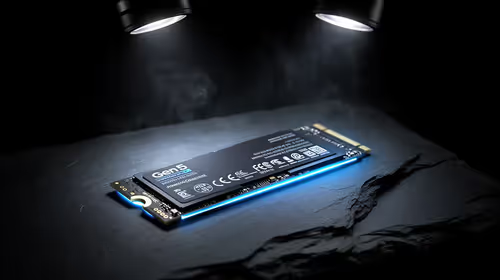
Gen 5 NVMe SSD guide for Bloemfontein gamers should be shortlisted around the job it must do. South African buyers should compare capacity, speed, thermals, and motherboard support, warranty path, and upgrade room before treating any pick as best.
Read more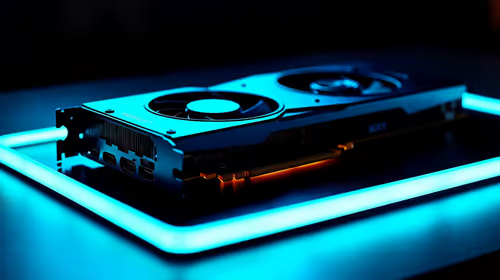
Skip the RTX 5070 if your first-time builder budget needs better balance. Better SA picks can free room for the right CPU, PSU, case, monitor, storage, and cooling while still giving a strong first gaming PC experience this year in South Africa.
Read more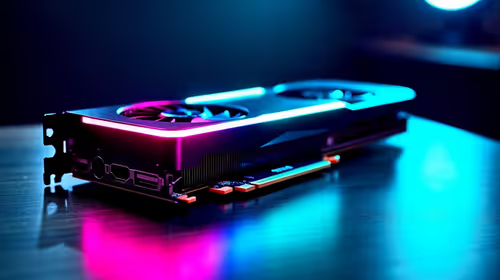
RTX 5080: weighing the pros and cons for SA should be shortlisted around the job it must do. South African buyers should compare GPU tier, VRAM, cooling, and PSU headroom, warranty path, and upgrade room before treating any pick as best.
Read more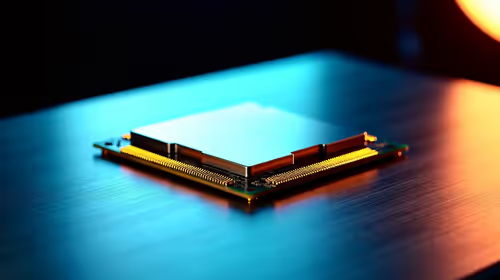
Core i5-13400F gives South African PC builders a capable mid-range CPU choice with clear limits. Check its gaming fit, discrete GPU requirement, LGA1700 platform costs, and upgrade path before locking in your parts list.
Read more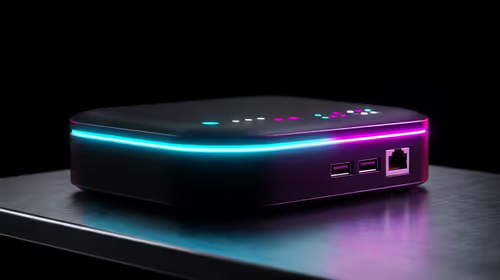
Pros and cons of the Wi-Fi 7 routers for SA should be shortlisted around the job it must do. South African buyers should compare WiFi standard, coverage, latency, and device support, warranty path, and upgrade room before treating any pick as best.
Read more
Steam content servers unreachable needs a download-path check, not an immediate reinstall of every game. Restart the client, inspect download settings and compare another connection when practical. Clearing the download cache is separate from deleting installed games.
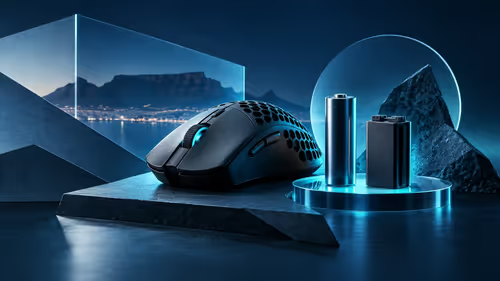
Keychron G6 HE has built-in and swappable battery versions with different weights. The product brief lists 42g and 46g respectively, each with a 3g tolerance. Choose by grip and battery preference before treating one headline weight as universal.

Corsair HS80 v2 MAX supports 2.4GHz wireless and Bluetooth. Its maximum battery figures use RGB-off conditions and differ by connection. Check microphone routing, comfort and the exact device support before assuming every wireless mode behaves alike.

Windows taskbar notification badges can be shown or hidden in Taskbar behaviours. This changes the small app indicators, not the underlying messages. Choose a calmer desktop while keeping a deliberate routine for checking important conversations and app updates.

Windows title bar window shake can minimise other open windows when you shake the active window by its title bar. Inspect the Multitasking setting and switch it off if that gesture interrupts your work. The preference costs R0 and does not require new hardware.

Windows Print Screen opens Snipping Tool when its keyboard preference is enabled. Change the option under Accessibility, Keyboard to choose another workflow. Test whether you need a clipboard image or a saved file.

Windows desktop icons missing may be a visibility setting. Right-click the desktop, choose View and inspect Show desktop icons. If only system icons are absent, use Desktop icon settings. Check the Desktop folder before assuming files were deleted.

Windows set time zone automatically greyed out calls for a location and device-policy check. Automatic time-zone selection relies on location services. A manual time-zone choice is separate from synchronising the clock; check both before replacing hardware.
Windows title bar window shake can minimise other open windows when you shake the active window by its title bar. Inspect the Multitasking setting and switch it off if that gesture interrupts your work. The preference costs R0 and does not require new hardware.
Windows Print Screen opens Snipping Tool when its keyboard preference is enabled. Change the option under Accessibility, Keyboard to choose another workflow. Test whether you need a clipboard image or a saved file.
Windows desktop icons missing may be a visibility setting. Right-click the desktop, choose View and inspect Show desktop icons. If only system icons are absent, use Desktop icon settings. Check the Desktop folder before assuming files were deleted.
Windows set time zone automatically greyed out calls for a location and device-policy check. Automatic time-zone selection relies on location services. A manual time-zone choice is separate from synchronising the clock; check both before replacing hardware.