


80+ Gold vs 80+ Platinum for Couch co-op gaming in SA
80+ Gold vs 80+ Platinum for couch co-op gaming is about PSU efficiency, heat, fan behaviour, quality, and wattage headroom, not direct FPS. SA buyers should compare the whole build.
Read moreEver wondered how does wireless charging work? We're demystifying the science behind it, from magnetic induction to the universal Qi standard. Discover the physics that allows your devices to power up without cables and explore what the future holds for this convenient tech! ⚡️📱
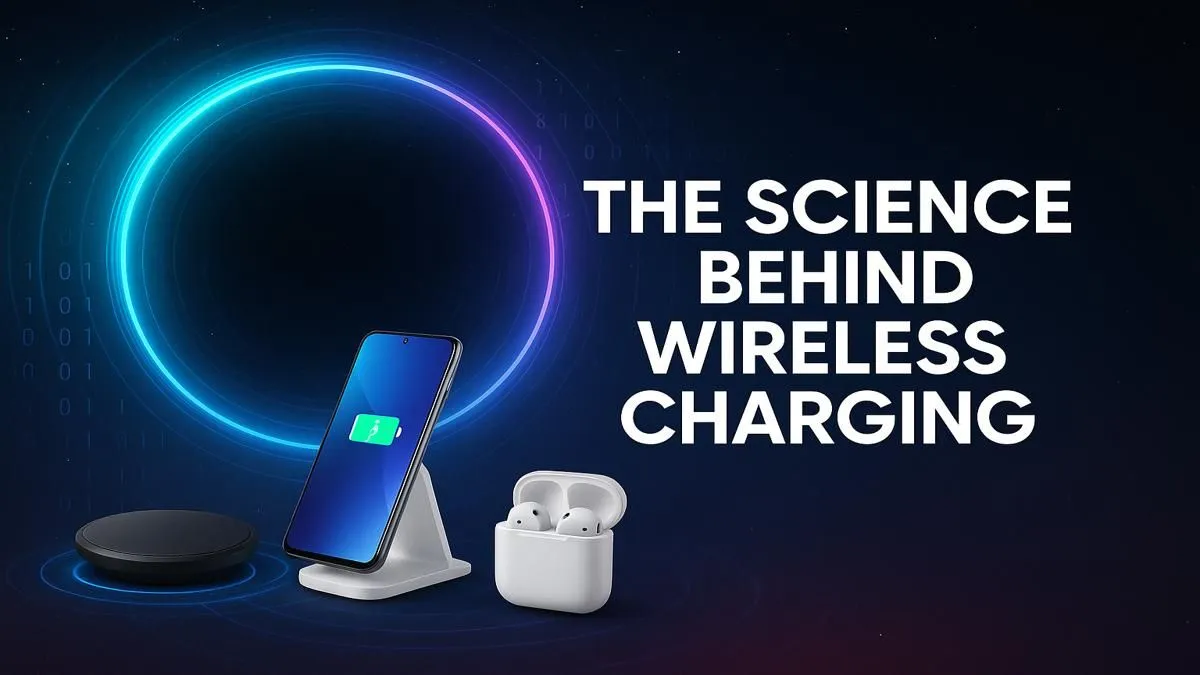
Tired of fumbling with cables in the dark or having your charging port give up the ghost? Wireless charging feels like magic. You just drop your phone on a pad, and it powers up. ✨ But it’s not magic… it’s pure science, and it’s simpler than you think. So, how does wireless charging work, really? Let's demystify the tech that’s cleaning up our desks and making life a little bit easier, one charge at a time.
At its core, wireless charging works using a principle called electromagnetic induction. Think of it as creating an invisible, short-range power cable between the charging pad and your device. It’s a concept discovered way back in the 1830s, but only now has it become small and efficient enough for our gadgets.
Here’s the simple version:
It’s a direct, cord-free transfer of energy. This elegant solution is why so many modern devices now include this feature, making a reliable wireless charger an essential part of any clean tech setup.
So, what’s actually happening inside that sleek pad on your desk? The process is a beautifully coordinated dance between two main components. Understanding this helps explain why some chargers are faster or more reliable than others.
The coil in the charging base is the engine of the whole operation. It takes the alternating current (AC) from your wall socket and, through its coiled copper wire, converts it into an oscillating magnetic field. The size, shape, and quality of this coil directly impact the strength and range of this field. Higher-quality pads, like those from trusted brands, often have larger or more precisely engineered coils for a more forgiving "drop zone" and better efficiency.
The receiver coil in your phone or peripheral is designed to be the perfect partner. When it detects the magnetic field from the pad, the electrons in its wire are pushed along, creating a direct current (DC) that your battery can use. The alignment between these two coils is crucial. If they’re not lined up well, the energy transfer is less efficient, resulting in slower charging or more heat. Brands like Promate focus on optimising this interaction for a seamless experience.
For the fastest charge, place your device in the centre of the wireless charging pad. This ensures the best alignment between the transmitter and receiver coils. If your phone case is extra thick or has metal components (like a pop socket), it might interfere with the magnetic field and slow down or prevent charging.
Ever wondered if any wireless charger will work with your phone? For the most part, the answer is yes, thanks to the Qi (pronounced "chee") standard. Developed by the Wireless Power Consortium, Qi is a universal standard that ensures interoperability between different brands of chargers and devices.
If both your phone and charger are "Qi-certified," you can be confident they will work together safely and efficiently. This standardisation prevents a market flooded with incompatible gear and ensures safety features are in place to manage heat and power levels. When you search for a Promate charger, for example, you're looking at products built to meet these global compatibility and safety benchmarks.
For a South African gamer or tech enthusiast, convenience is king. Wireless charging excels here. It’s perfect for your desk, letting you top up your phone between sessions without plugging and unplugging cables, which reduces wear and tear on your device's charging port. 🔌
While wired charging is still generally faster, the gap is closing. Plus, the sheer utility of having a dedicated spot to drop your phone, mouse, or headset makes it a fantastic quality-of-life upgrade. It’s no surprise that a good charger is considered a core gaming accessory these days, keeping your essential communication device powered up and ready for action.
Ready to Cut the Cord? Understanding the science makes it clear: wireless charging isn't magic, it's just smart tech. For a clutter-free desk and effortless power-ups, a quality wireless charger is a must-have. Explore our wide range of chargers and find the perfect power solution for your setup.
Qi wireless charging uses magnetic induction. A transmitter coil in the charging pad creates an oscillating magnetic field, which induces a current in a receiver coil in your device.
Yes, wireless charging safety is a top priority. Qi-certified chargers operate at low power and emit non-ionizing radiation, posing no health risk and including features to prevent overheating.
No, modern wireless chargers do not damage your battery. Smart charging technology stops the power flow once the battery is full, preventing overcharging and preserving long-term battery health.
Magnetic induction requires close contact between coils, common in charging pads. Resonant inductive coupling, an emerging standard, allows charging over greater distances and can power multiple devices.
Wireless charging efficiency is slightly lower than wired charging due to minor energy lost as heat during the transfer. However, the convenience often outweighs this small difference.
The key benefits of wireless charging include superior convenience (no fumbling with cables), reduced wear on your device's charging port, and a cleaner, more organized desk or nightstand.
80+ Gold vs 80+ Platinum for couch co-op gaming is about PSU efficiency, heat, fan behaviour, quality, and wattage headroom, not direct FPS. SA buyers should compare the whole build.
Read more
80+ Platinum or 80+ Titanium for competitive should be shortlisted around the job it must do. South African buyers should compare fit, performance, compatibility, and upgrade room, warranty path, and upgrade room before treating any pick as best.
Read more
The real world difference between IPS and OLED for AAA single-player gaming is immersion versus versatility. OLED lifts contrast and dark scenes, while IPS can suit bright rooms, mixed PC use, and SA buyers watching total setup cost.
Read more
HDMI 2.1 vs HDMI 2.0 for SA MMO needs a workload-first comparison. For SA buyers, judge real performance, platform fit, warranty path, power needs, and upgrade timing before choosing either side.
Read more
USB4 and Thunderbolt 4 differ for competitive esports through dock, display, and capture consistency. Use this real world difference between usb4 and thunderbolt 4 for competitive guide to keep SA tournament desks tidy without assuming better ping.
Read more
Magnetic switches vs Mechanical switches depends on Competitive esports needs, platform limits, and budget fit. Compare compatibility, latency, upgrade path, and real setup constraints before choosing for an SA build.
Read more
B850 motherboard FPS drops needs a methodical troubleshooting pass. Review drivers, thermals, power settings, background apps, cables and game settings before replacing parts in an SA gaming setup.

Gaming PC FPS drops in South Africa often come from drivers, thermals, background apps, power plans, or in-game settings. Check one change at a time and use the same scene before buying upgrades for your local setup.

Difference between PCIe 5.0 and PCIe 4.0 explained for PC builders starts with bandwidth, lanes, and support. SA builders should match the motherboard, GPU, NVMe drive, and budget before choosing a platform.
Windows 11 mechanical keyboard setups rarely cause display banding directly. Fix color banding by checking HDR, colour depth, GPU range, monitor profiles, and any new RGB utility conflicts.

Steam Big Art Mode enlarges library artwork in Big Picture Mode and on Steam Deck, while the same beta adds configurable screensavers. Both features are optional and currently require the Steam beta client.
Diablo 4 HDR settings work best after Windows and the display are calibrated, then the game's black point, brightness and white point are adjusted in that order. Use visible shadow detail and controlled highlights, not copied values from another screen.

The best HOTAS for Elite Dangerous is a separate stick-and-throttle set with enough analogue axes for pitch, roll, yaw and thrust, plus local support. Evetech's captured flight-simulation sample lists the complete Logitech X56 at R4,999.
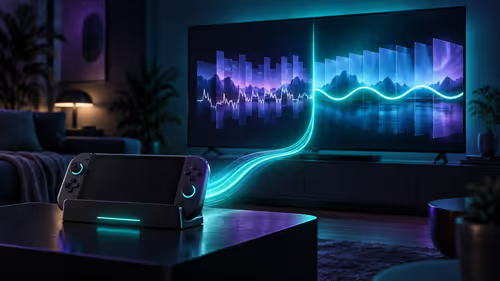
Nintendo Switch 2 docked VRR arrives with system version 23.0.0 and also requires a dock update. The connected TV or monitor and the running software must support VRR before the output can follow changing frame rates.

NVIDIA lists 550W required system power for the RTX 5060 reference specification, based on a high-end test system. A quality 550W unit can be enough, but CPU draw, transient load, connectors and ageing decide real headroom.
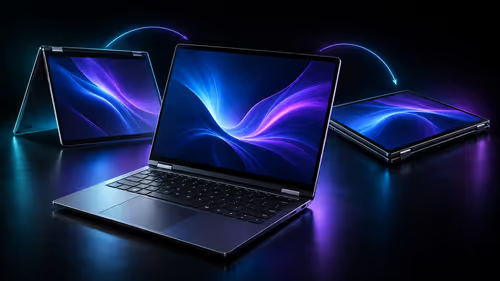
The VAIO T combines a 13.3-inch display with a multi-flip mechanism for laptop, tablet and outward-facing viewing modes. Orders begin in Japan on 18 September; South African availability is unconfirmed.

OpenRGB's master branch now carries changes labelled for 1.0 final, including translation and platform work, but the official tags page still lists 1.0rc3.1 as the newest packaged release. Stable users should wait for the signed release channel.
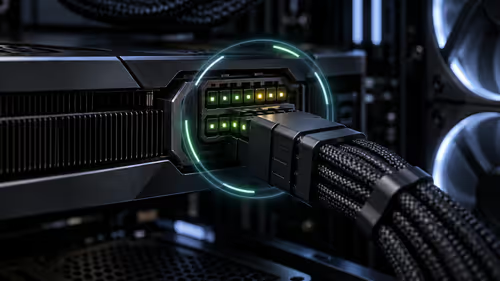
The Cooler Master GPU Shield Adapter monitors current on individual 12+4-pin contacts, adds visual and audible warnings, and can reduce system power during a severe abnormality. Local availability is unconfirmed.