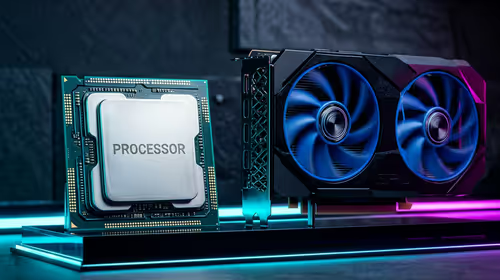
Spotted a graphics card online for a steal? That international price tag looks amazing, but before you click 'buy', hold up. Importing PC components to South Africa involves a maze of customs duties, VAT, and surprise fees that can wreck your budget. This guide breaks down the real costs and risks, helping you decide if that overseas 'bargain' is truly worth it... or a costly mistake waiting to happen. Let's dive in. 🚀
Understanding the True Cost of Importing PC Parts
The price you see on an international website is just the starting point. The final price you pay, often called the "landed cost," includes several extra charges that are easy to overlook. Successfully importing PC components to South Africa means planning for every single one.
Here’s a typical breakdown:
- Purchase Price: The advertised cost of the item (e.g., a GPU for $400).
- Shipping Fees: The cost to get it from their warehouse to your door. This can range from R500 to over R1500, depending on the courier and speed.
- Customs Duty: This is a tax on imported goods. Thankfully, most core computer components (like CPUs, RAM, and GPUs) are often classified with a 0% duty rate. However, this isn't a guarantee for every single item, like certain peripherals or cases.
- Value-Added Tax (VAT): This is the big one. SARS will levy 15% VAT on the total value of your shipment. That’s (Purchase Price + Shipping + Duties) x 15%.
- Courier Admin Fee: The courier service (like DHL or FedEx) charges a fee for handling the customs clearance process on your behalf. This can be another R150 to R500+ surprise.
Let's imagine that $400 GPU. At an exchange rate of R18.50/$, that's R7,400. Add R800 for shipping. Your new subtotal is R8,200. Now, add 15% VAT (R1,230) and a R250 admin fee. Suddenly, your "bargain" GPU costs R9,680. This is often far more than you'd pay locally, especially when you compare it to the value found in many budget gaming PCs that come fully assembled and tested.
The Customs Gauntlet: What to Expect 🧾
So, you've placed your order. What happens next? The process of importing PC parts to your door in South Africa follows a few key steps.
First, your package arrives in the country and is held at a customs facility. The courier's clearance department will then assess the included invoice, calculate the required duties and VAT, and send you an invoice for this amount. You cannot receive your package until this is paid in full.
Delays are common. If the seller declared the value incorrectly or the paperwork is missing, your shiny new component could be stuck in customs limbo for weeks. For most builders, the time and uncertainty just aren't worth the hassle, especially when sourcing parts for complete systems. It's often simpler to look at local builds, where even powerful PCs under R20,000 are readily available without the wait.
Customs Pro Tip 🔧
Most core PC components (CPU, GPU, RAM, Motherboards) fall under the HS Tariff Code 8473.30, which currently has a 0% customs duty rate in South Africa. However, you will always be liable for 15% VAT and courier admin fees. Always keep a copy of your purchase invoice handy, as customs may request it to verify the value.
Beyond the Rand: The Hidden Risks of Importing
The financial cost is only half the story. The biggest reason seasoned builders in South Africa buy locally comes down to one crucial thing: support.
Warranties and RMAs
What if your new motherboard is dead on arrival? If you bought it locally, you take it back to the supplier. If you imported it, you face the massive headache of an international RMA (Return Merchandise Authorisation). You'll have to pay to ship the faulty component back to the US, Europe, or Asia, a process that is both expensive and incredibly slow. You could be without a key part of your PC for months.
This risk is why many gamers prefer the security of pre-built PC deals, which come with a comprehensive local warranty covering every single part.
Compatibility and Troubleshooting
When you buy all your parts from different international sellers, you're on your own if something doesn't work right. Is it a faulty RAM stick or an incompatible motherboard BIOS? Local experts can help you troubleshoot, but if you've imported everything, that support system disappears. The peace of mind that comes with a professionally assembled machine, especially for high-value rigs like PCs above R20,000, is invaluable.
So, Is Importing PC Components to South Africa Ever Worth It?
For the vast majority of gamers and builders, the answer is a clear no. While there might be rare exceptions for extremely niche or hard-to-find components, the combined financial costs, shipping times, and massive risks associated with warranties make it an unwise gamble.
When you factor in the value of a local warranty, expert support, and the instant gratification of getting your parts immediately, buying from a trusted South African retailer is the smarter, safer, and often more affordable choice. You can get straight to building and gaming, confident that help is right here if you need it. Why endure the stress when some of the best gaming PC deals are available right on your doorstep? ✅
Ready to Build Without the Hassle?
The allure of importing PC components to South Africa is strong, but the reality of customs, surprise fees, and warranty nightmares often makes it a losing game. For transparent pricing, local support, and peace of mind, building with locally sourced parts is the smarter play. Explore our massive range of PC components and get your dream build started today.