Is there anything worse than your WiFi dropping mid-clutch in a Valorant match? Or the Netflix buffer wheel spinning while you’re trying to relax? In South Africa, a weak signal is a common frustration. You’ve probably heard of two solutions: a simple WiFi extender or a full mesh system. But when it comes to the crucial Mesh WiFi vs Extender South Africa debate, which one actually delivers a reliable connection? 📶
Understanding the WiFi Extender: A Quick Boost
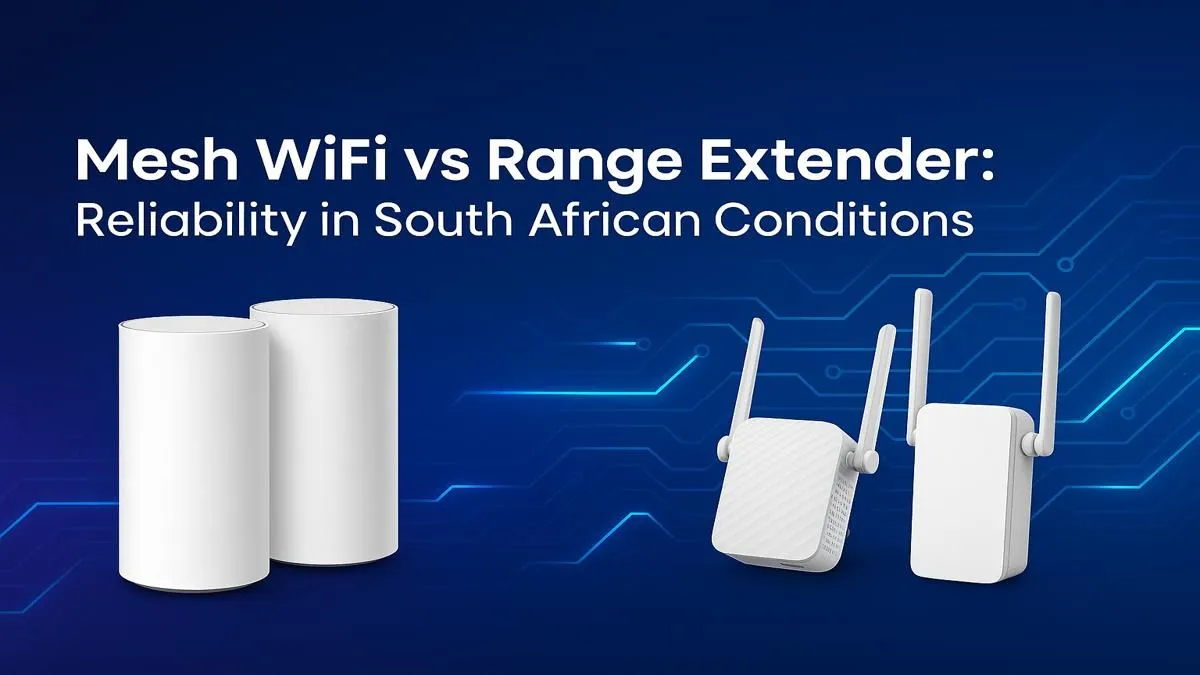
Think of a WiFi extender as a megaphone for your router's signal. You place it somewhere between your router and your WiFi dead zone, and it captures the existing signal, then rebroadcasts it further.
It's a straightforward concept and often the first thing people reach for when the signal in the bedroom or home office is weak. The main appeal is simplicity and cost. For a few hundred Rand, you can pick up a simple and affordable WiFi range extender and plug it in.
However, there's a catch. Extenders typically create a new network (like "MyHomeWiFi_EXT"). This means you have to manually switch your phone or laptop between networks as you move around. More importantly, they can cut your available bandwidth in half because the device has to both receive and transmit data on the same channel. For basic browsing it's fine, but for gaming or 4K streaming... it can be a bottleneck.
Introducing Mesh WiFi: Seamless Whole-Home Coverage
A mesh WiFi system takes a completely different approach. Instead of one device shouting louder, a mesh system uses multiple "nodes" or "points" placed around your house to create a single, unified, and intelligent network. 🏠
They all talk to each other, creating a seamless web of coverage. As you walk from the lounge to the patio, your device automatically connects to the strongest node without any interruption or network switching. It’s the same network name (SSID) everywhere.
This smart routing is what makes mesh systems so reliable. If one node has a weak connection, the system automatically reroutes traffic through a different node to ensure you get the fastest, most stable speed possible. Deciding between mesh WiFi vs an extender in South Africa often comes down to investing in modern wireless routers and mesh systems for a flawless experience versus a cheaper, simpler fix.
Placement is Everything! 📍
Whether you choose a mesh system or an extender, don't just hide it behind the TV cabinet. For an extender, place it about halfway between your router and the dead zone. For mesh nodes, position them in open areas, one or two rooms apart, to ensure a strong signal between them. Avoid placing them near thick brick walls or large metal appliances.
The Showdown: Mesh WiFi vs Extender in a South African Context
So, how do they stack up for the typical South African home with its double-brick walls and desire for a solid connection out by the braai? 🤔
Performance & Speed
A WiFi extender will always be slower than your main router's speed. A mesh system, on the other hand, is designed to maintain high speeds across your entire property. For fibre connections of 100Mbps or more, a mesh system is almost essential to get what you're paying for everywhere in the house.
Coverage & Reliability
An extender is great for patching one or two specific dead spots. A mesh system is designed for complete, whole-home coverage. The self-healing, intelligent routing of a mesh network makes it far more reliable, especially in larger or multi-story homes. Sometimes, the bottleneck isn't even the router but your device's own wireless adapter, so ensure all your hardware is up to scratch.
Ease of Use
While an extender is easy to plug in, the need to switch networks manually is a hassle. A mesh system is the definition of "set it and forget it." One network name, one password, and seamless roaming. Most are managed through a simple smartphone app.
Cost
This is the one area where extenders have a clear advantage. A single extender can cost under R1000, while a good 2- or 3-pack mesh system typically starts at a few thousand Rand.
Making the Right Choice for Your Home 🚀
So, after comparing mesh WiFi vs extenders in South Africa, which should you buy?
Choose a WiFi Extender if:
- You live in a smaller flat or townhouse.
- You only have one specific, stubborn dead zone (e.g., a single bedroom).
- You're on a very tight budget and just need a "good enough" fix.
Choose a Mesh WiFi System if:
- You live in a larger house, especially one with multiple floors or thick walls.
- You have multiple people gaming, streaming, and working from home simultaneously.
- You want the most reliable, fastest, and simplest solution for whole-home coverage.
- You value a seamless connection with no drop-offs as you move around.
Finding the ideal solution is key to building a powerful home network, and exploring all wireless networking options is the first step to ending your connectivity frustrations for good.
Ready to Banish Buffering for Good?
Whether you need a quick fix for the braai area or a powerful, seamless network for your whole home, the right solution is waiting. Stop letting lag ruin your game. Explore our full range of networking gear and build the reliable connection you deserve.