Is your WiFi signal weaker than Eskom's promises? You're trying to clutch a 1v3 in Valorant, but your connection drops the moment you leave the lounge. It's a classic South African problem: the router is on one side of the house, and the other side is a digital dead zone. The big question is how to fix it. This brings us to the ultimate showdown: Mesh WiFi vs Range Extender in South Africa. Let's find the best solution for your home.
Understanding the WiFi Range Extender
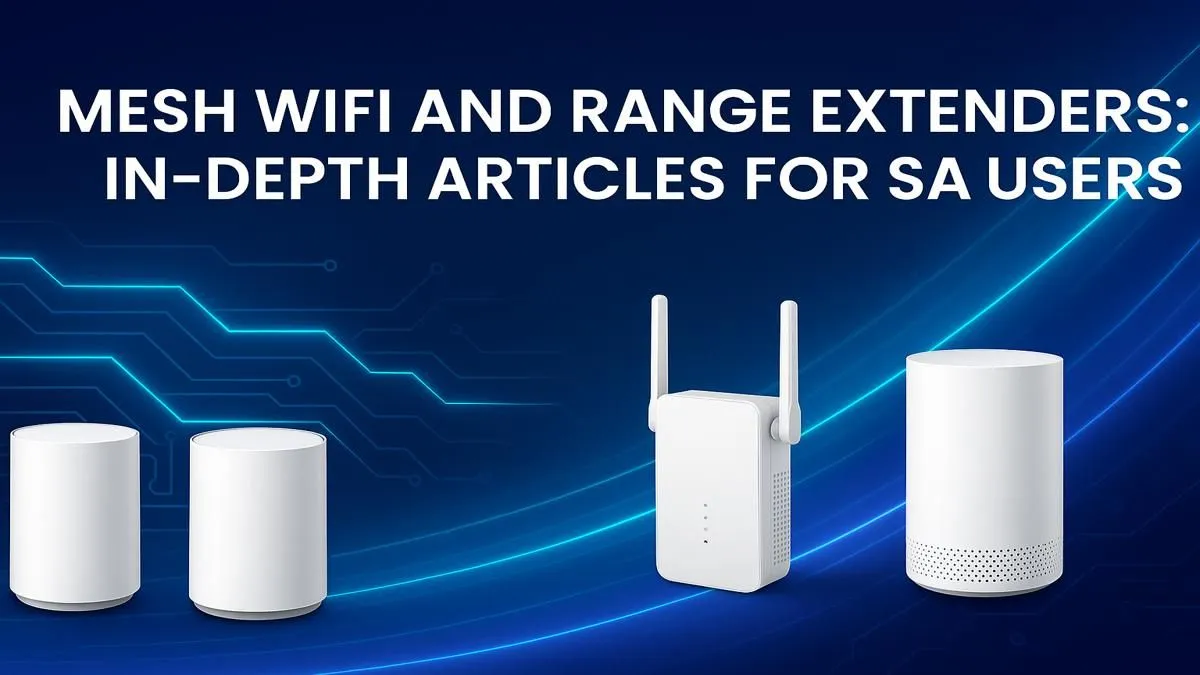
Think of a WiFi range extender as a simple signal booster. You place it somewhere between your main router and the area with a weak signal. It catches the existing WiFi signal and rebroadcasts it, extending its reach. Simple, right?
For many smaller homes or flats in South Africa, one or two simple WiFi range extenders can be a perfectly good, budget-friendly fix.
The Pros and Cons of Extenders
- Pro: Price. Extenders are significantly cheaper than mesh systems, often starting from just a few hundred ZAR.
- Pro: Simplicity. Most are plug-and-play. You plug it into a wall socket, connect it to your network, and you're good to go.
- Con: Performance Drop. This is the big one. An extender typically halves the potential bandwidth because it uses the same radio to both receive and transmit the signal.
- Con: Separate Networks. Most extenders create a new network (e.g., "MyWiFi_EXT"). You have to manually switch between networks as you move around your house, which can be a real pain.
Enter Mesh WiFi: The Modern Solution 🌐
A mesh WiFi system is a more advanced and seamless solution. It replaces your current router with a main "node" and uses several satellite nodes placed around your house to create a single, powerful, and intelligent WiFi network. All the nodes talk to each other, ensuring your devices are always connected to the strongest signal automatically.
This is the gold standard for larger, double-storey homes or properties with thick brick walls that kill signals. It's an investment in one of the most robust complete wireless networking solutions available today.
The Pros and Cons of Mesh WiFi
- Pro: Seamless Coverage. One network name, everywhere. Walk from the braai area to your bedroom office without ever dropping a connection. It's seamless. ✨
- Pro: Peak Performance. Mesh systems use a dedicated channel for communication between nodes, so you don't suffer the same speed loss as an extender. Your speed stays fast across the entire property.
- Con: Cost. A mesh system is a bigger investment. A starter kit with two or three nodes will cost more than a single extender.
- Con: Setup. While modern systems are very user-friendly, it involves replacing your existing router, which can be slightly more involved than plugging in an extender.
Placement Pro Tip ⚡
Never place your extender or satellite node in the actual dead zone. It needs a strong signal to amplify! The sweet spot is about halfway between your main router and the area you want to cover. This gives it a healthy signal to catch and rebroadcast effectively.
The Verdict: Mesh WiFi vs Range Extender for Your SA Home
So, which one is for you? The choice between a mesh WiFi system and a range extender in South Africa really comes down to three things: your home's size, your performance needs, and your budget.
Choose a Range Extender if...
- You live in a small-to-medium flat or house.
- You only have one or two specific dead spots to cover (like a study or patio).
- Your budget is tight, and you need a quick, affordable fix.
- You mainly browse the web and stream on one or two devices.
Choose a Mesh WiFi System if...
- You have a large, multi-storey home with lots of walls.
- You are a serious gamer, a 4K streamer, or work from home and need rock-solid stability. 🚀
- You have many smart home devices (cameras, lights, speakers) competing for bandwidth.
- You want the best, most seamless experience without manually switching networks.
- You're already considering upgrading your main wireless router anyway.
Ultimately, while an extender patches a hole, a mesh system rebuilds the foundation. For older PCs or laptops struggling with newer WiFi standards, pairing your network upgrade with one of the latest wireless adapters can also make a massive difference.
Ready to Banish WiFi Dead Zones for Good?
The Mesh WiFi vs Range Extender debate in South Africa depends on your home and budget. But one thing is certain: a stable connection is non-negotiable. Explore our full range of networking gear and find the perfect fix for your home.